It's been three years since Trump was elected. In those three years, I have posted on social media, I have donated to Democratic candidates, I have written to legislators (even though I live in Tennessee and asking our state legislators to do anything against Trump is about as useful as slamming my hand in the car door on purpose), I've gone to marches, I've gone to protests, I've cut people out of my life, and very little has changed. Yes, Democrats were able to take back the House in the last election, but they're not actually able to do anything there with Republicans in control of the Senate, but that's all we've gotten accomplished and it hasn't been enough.
For the past several months, I've had a feeling building in me that I have not done enough.
We all know that I'm not having kids, ever. Some of my friends have kids, though, and someday those kids might look at me (they'd be in their thirties at this point, past the age of jam hands and acting out in restaurants) and say, "What did you do to help stop Trump?" and I feel like I wanted to be able to give some kind of an answer besides, "I tweeted a lot," so when the Warren campaign called me and asked if I wanted to volunteer, I said yes.
And that's how I ended up knocking on doors alone in 27 degree weather at 9 AM on a Saturday.
The call to volunteer didn't come out of nowhere. Both the Warren and the Sanders campaigns have been texting me. I've been having a lot of really good conversations with the Warren texters about health care, student loan debt, consumer protection, actually taxing businesses, saving the middle class, and salvaging the remains of the Presidency, and I've been avoiding conversations with the Sanders people by staring awkwardly at the phone and hoping they believe that I'm just really super busy and can't talk right now but totally might text them back later. While texting with the Warren people they mentioned that there are opportunities for volunteers, like canvassing, texting, and phone banking, and I eventually said, "Sure, go ahead and have someone call me about that."
I'll admit, I tried really hard to get phonebanking or texting, but they had plenty of people to do that already.
"What we really need are canvassers. To knock on doors."
"Just random doors? Like, knocking on strangers' doors?"
"No, no. There are lists of people who have polled as Democratic voters, or donated, or expressed interest in Democrats online, so you're not knocking on hostile doors. We really, really need people to canvass before Super Tuesday."
"I..., well, I..."
FLASH FORWARD:
It is 20 years from now, and one of my friends' kids who is now an adult but I don't know their age in twenty years because I have no idea how old they actually are right now looks at me with big, wide eyes and asks, "What did you do to help stop Trump?"
"Oh, you know, they wanted me to talk to strangers but it was supposed to be cold on Saturday so I just tweeted out some early voting location information, and that's how we ended up in a fascist theocracy like in 'V for Vendetta'. Now, eat your Soylent Green, and I'll tell you about how we have always been at war with EastAsia."
"I'LL DO IT. I WILL CANVASS ON SATURDAY FROM 9 TO 11."
"Great! I'll send you some instructions this week, and then call to confirm."
The instructions were to go meet up at a campaign volunteer's house near me, and being the person that I am I got there twenty minutes early while they were still setting up signs in the yard and the guy's wife was still in her robe. I also met my first dog of the day, their rescue, who has a bit of a short term memory loss and thought I was a new person to meet each time she left and re-entered the room. It was delightful. I've never canvassed before, but in my head it was going to involve clipboards and checkmarks. This turns out not to be the case. Instead, you download an app onto your phone, and it tells you where to go and then who to ask for. We ran through it a couple times, and then I got a stack of informative postcards and was ready to go.
"Who's going with me?"
"Nobody else is signed up for the 9 AM shift."
"I'm going to talk to strangers by myself?"
"It'll be fine! Come back at 11!"
For a minute, as I walked to my car, I was nervous about knocking on strangers' doors, interrupting their Saturday mornings, and then trying asking them questions and trying to tell them about the Warren campaign. What if they got mad? What if they all decided they were voting for Trump instead? What if, this being Tennessee, they had guns and tried to chase me off their suburban land? I took a deep breath, remembered that I am from New York and have talked to a number of hostile residents of New Jersey as if they were actual human beings, and set out to canvass.
It actually went pretty well. In many cases, there were multiple houses on the same street, so I could park in the middle and walk up and down. I met a ton of dogs, all of whom were friendly, and I ended up peering at a ton of Ring doorbell cameras and pointing at my Warren postcard for people who would not come to the door. Several people thanked me for being out canvassing, but out of 30 or so people that I actually got to speak to (a lot of people had cars in their driveways but no one would answer the door; I marked them as "not home" so that someone would call or knock on their door again in the future), only two had decided on Warren. One had decided on Trump, although she didn't seem like an evil fascist racist wall-builder, two were set on Bernie, and everyone else said they were undecided. Many of the undecideds also said they were planning to early vote, so I hope they make up their minds soon.
Only one person closed their door on me while I was trying to tell them about early voting. They smiled when they did it, but that doesn't make it less rude.
Overall, it was a good experience.
But I told the volunteer that I'm probably busy next week and won't be able to do it again.
Next weekend is someone else's turn.
Sunday, February 23, 2020

Sunday, February 2, 2020
All The Books I Read in January
It's February, which means I have to tally up all the books I read in January before they end up sitting in a big pile on an end table, waiting for the end of the year. I only made it through four books this month, but if I'm going to make it through a book a week this year then I'm right on track.
1) I started the month and, I guess, the year with politics. As the election approaches and the field of Democratic candidates narrows, I've read Mayo Pete's book, Kamala Harris' book, a book about Joe Biden, and now Elizabeth Warren's This Fight Is Our Fight. Warren does a good job of clearly defining the problems facing the American middle class, and lays out defined, logical policies for addressing them. Right now I'm planning to vote for her in the primary, and really hope that Harris gets a vice president nod from someone, or maybe becomes attorney general.
2) My parents got me Rainbow Rowell's Carry On for Christmas, and I enjoyed it, so I ordered the sequel, Wayward Son. It finds our heroes, Simon, Baz, and Penny in a road trip across America in a convertible, finding wild magic, dragons, vampires, monsters with goat heads, and maybe themselves? What does the hero do the summer after he fulfills his destiny?
I enjoyed this, but the end makes me want another sequel and it took a few years to get this one, so now I'm a little bit sad about it.
3) Stephen King's Elevation was a novella, rather than a novel, and probably would not have gotten full hardcover treatment if it came from a less established author. Scott is busy fighting with his neighbors, a married pair of lesbians who moved to town to open a struggling restaurant, over their dog pooping on his lawn. Scott is also, a few pounds at a time, becoming immune to the effects of gravity, a secret that he'll only be able to keep for so long as his scale slowly counts down to zero. This was an interesting character study, but really should have just been part of a larger collection.
4) On the last day of the month I finished Mike Pearl's The Day It Finally Happens. Pearl is a disaster thinker, and this book walks through a number of world-shaking scenarios: the day Saudi Arabia runs out of oil, the day the internet fails, the day we verify the existence of extraterrestrials, and even the day we build Jurassic Park, among other things. What was a little surprising is that even though Pearl is a worst-case thinker, he manages to sound rather optimistic and hopeful. Overall, he thinks we'll get through it.
So, like I said, I'm on track for reading in January. Let's try to keep it going in February or, possibly, maybe even get a little ahead.
1) I started the month and, I guess, the year with politics. As the election approaches and the field of Democratic candidates narrows, I've read Mayo Pete's book, Kamala Harris' book, a book about Joe Biden, and now Elizabeth Warren's This Fight Is Our Fight. Warren does a good job of clearly defining the problems facing the American middle class, and lays out defined, logical policies for addressing them. Right now I'm planning to vote for her in the primary, and really hope that Harris gets a vice president nod from someone, or maybe becomes attorney general.
2) My parents got me Rainbow Rowell's Carry On for Christmas, and I enjoyed it, so I ordered the sequel, Wayward Son. It finds our heroes, Simon, Baz, and Penny in a road trip across America in a convertible, finding wild magic, dragons, vampires, monsters with goat heads, and maybe themselves? What does the hero do the summer after he fulfills his destiny?
I enjoyed this, but the end makes me want another sequel and it took a few years to get this one, so now I'm a little bit sad about it.
3) Stephen King's Elevation was a novella, rather than a novel, and probably would not have gotten full hardcover treatment if it came from a less established author. Scott is busy fighting with his neighbors, a married pair of lesbians who moved to town to open a struggling restaurant, over their dog pooping on his lawn. Scott is also, a few pounds at a time, becoming immune to the effects of gravity, a secret that he'll only be able to keep for so long as his scale slowly counts down to zero. This was an interesting character study, but really should have just been part of a larger collection.
4) On the last day of the month I finished Mike Pearl's The Day It Finally Happens. Pearl is a disaster thinker, and this book walks through a number of world-shaking scenarios: the day Saudi Arabia runs out of oil, the day the internet fails, the day we verify the existence of extraterrestrials, and even the day we build Jurassic Park, among other things. What was a little surprising is that even though Pearl is a worst-case thinker, he manages to sound rather optimistic and hopeful. Overall, he thinks we'll get through it.
So, like I said, I'm on track for reading in January. Let's try to keep it going in February or, possibly, maybe even get a little ahead.
Sunday, January 26, 2020
Magical Adventures in Pudding
Yesterday, I ate a unicorn.
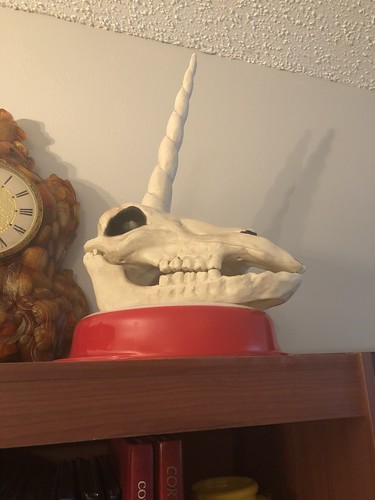
No, not that unicorn. That's the unicorn skull I bought at the grocery store on clearance after Halloween, and then stuck on my bookshelf like any other normal, grown adult. No, yesterday, I ate this unicorn:
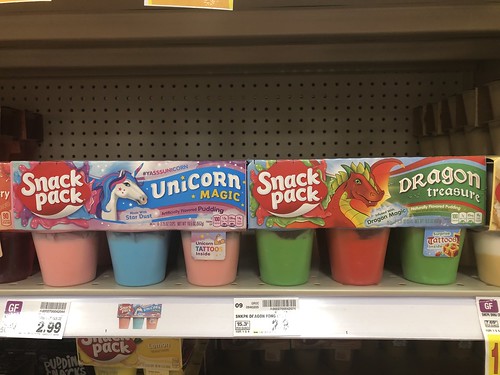
I was at the grocery store, where I bought juice but somehow left the juice in my cart in the parking lot and now will die of scurvy, and as I was sliding down the snacks aisle looking for something else, I saw that pudding. The colors stood out in the middle of the pudding display, a wall of browns, beiges, and sometimes pale yellows, and then when I got closer I saw, "Naturally flavored".
"What natural flavors taste like unicorns? What does a unicorn even taste like? Maybe I could ask that guy from Harry Potter?" I thought to myself, and then thought, "I should buy this."
So I did. It turns out that the pudding cups are not actually that terrible for you, as prepackaged entirely processed foods go. They don't contain high fructose corn syrup and they're only 100 calories per cup, so you can eat one and feel like you had a decent little dessert. Although the ingredients don't say so:

the unicorn pudding is also made with fairy dust and princess kisses (Am I going to get princess mono from eating this?), and tastes like joy and rainbow sparkles:
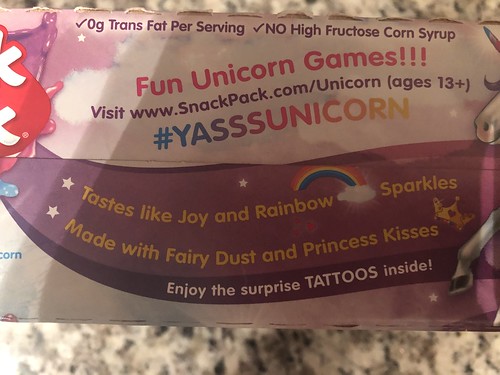
Oh, there's also star dust in there:

Since every atom inside us, and inside the unicorn pudding, was once part of a star, this statement is actually correct.
Anyway, after dinner, I decided it was pudding time:

and the pudding was sort of interesting.
The pink:

smells like Play-Doh. So does the blue. Neither of them has a specific flavor that I could isolate, but my notes say that they tasted vaguely of some sort of berries. The taste is either very slight, or the Indian food I had for dinner destroyed my taste buds and everything was numb.
This morning, since I have to take my morning medicine with food and I decided to pretend that this was food, I turned my attention to the dragon pudding. While it claims to be made with "dragon magic":
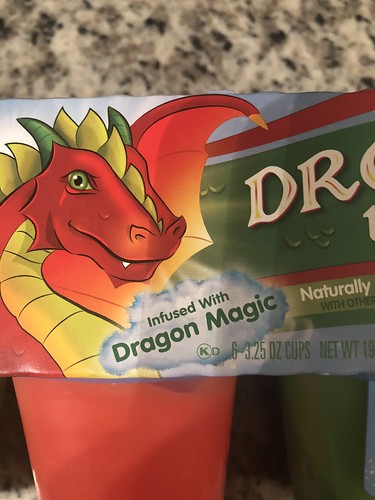
it is apparently made from rocks. Rubies and emeralds, to be more specific.
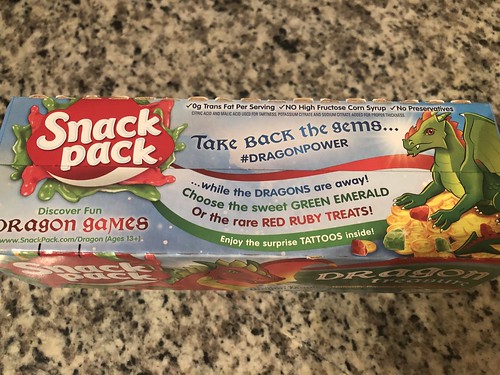
No fairy dust or princess kisses here.
The dragon pudding is aggressively colored, and would not look out of place at Christmas:

Before you start to think, "Why would you even eat something that color?" you need to know that the clear plastic cup is muting the green. Once you open it, it's even brighter and greener (more emerald?) than it looked:
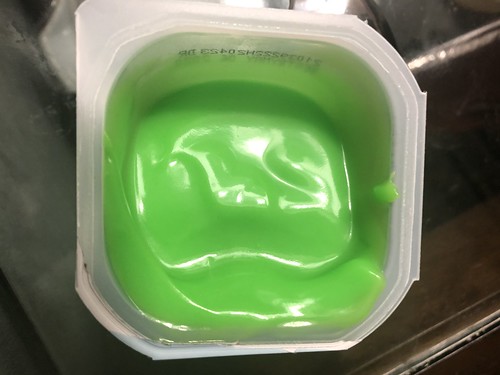
My body's natural response to that color was "SHOULD NOT GO IN MOUTH", but let's face it: if I listened to my body, I wouldn't keep getting on the treadmill, so I ate it anyway. I ate the red pudding first, though. Like the unicorn pudding, the red pudding was vaguely fruit-flavored in some way. My brain kept telling me it might be artificial cherry, but I also wondered if my brain was just suggesting that because of the color, and it was really just "Undefined Fruit #77" flavor from a chemical plant in New Jersey.
The green was even less flavored. It smelled of nothing, and initially tasted of nothing, but as I spooned it into my gaping mouthhole there was a little bit of an aftertaste. It was sort of like mint, but also sort of like a menthol cough drop. Either way, it wasn't very strong. Maybe these taste differently if you have youthful taste buds?
Either way, I now have two packs of these to finish.
And I have to go back to the store for juice.
No, not that unicorn. That's the unicorn skull I bought at the grocery store on clearance after Halloween, and then stuck on my bookshelf like any other normal, grown adult. No, yesterday, I ate this unicorn:
I was at the grocery store, where I bought juice but somehow left the juice in my cart in the parking lot and now will die of scurvy, and as I was sliding down the snacks aisle looking for something else, I saw that pudding. The colors stood out in the middle of the pudding display, a wall of browns, beiges, and sometimes pale yellows, and then when I got closer I saw, "Naturally flavored".
"What natural flavors taste like unicorns? What does a unicorn even taste like? Maybe I could ask that guy from Harry Potter?" I thought to myself, and then thought, "I should buy this."
So I did. It turns out that the pudding cups are not actually that terrible for you, as prepackaged entirely processed foods go. They don't contain high fructose corn syrup and they're only 100 calories per cup, so you can eat one and feel like you had a decent little dessert. Although the ingredients don't say so:
the unicorn pudding is also made with fairy dust and princess kisses (Am I going to get princess mono from eating this?), and tastes like joy and rainbow sparkles:
Oh, there's also star dust in there:
Since every atom inside us, and inside the unicorn pudding, was once part of a star, this statement is actually correct.
Anyway, after dinner, I decided it was pudding time:
and the pudding was sort of interesting.
The pink:
smells like Play-Doh. So does the blue. Neither of them has a specific flavor that I could isolate, but my notes say that they tasted vaguely of some sort of berries. The taste is either very slight, or the Indian food I had for dinner destroyed my taste buds and everything was numb.
This morning, since I have to take my morning medicine with food and I decided to pretend that this was food, I turned my attention to the dragon pudding. While it claims to be made with "dragon magic":
it is apparently made from rocks. Rubies and emeralds, to be more specific.
No fairy dust or princess kisses here.
The dragon pudding is aggressively colored, and would not look out of place at Christmas:
Before you start to think, "Why would you even eat something that color?" you need to know that the clear plastic cup is muting the green. Once you open it, it's even brighter and greener (more emerald?) than it looked:
My body's natural response to that color was "SHOULD NOT GO IN MOUTH", but let's face it: if I listened to my body, I wouldn't keep getting on the treadmill, so I ate it anyway. I ate the red pudding first, though. Like the unicorn pudding, the red pudding was vaguely fruit-flavored in some way. My brain kept telling me it might be artificial cherry, but I also wondered if my brain was just suggesting that because of the color, and it was really just "Undefined Fruit #77" flavor from a chemical plant in New Jersey.
The green was even less flavored. It smelled of nothing, and initially tasted of nothing, but as I spooned it into my gaping mouthhole there was a little bit of an aftertaste. It was sort of like mint, but also sort of like a menthol cough drop. Either way, it wasn't very strong. Maybe these taste differently if you have youthful taste buds?
Either way, I now have two packs of these to finish.
And I have to go back to the store for juice.
Monday, January 20, 2020
Fudgemas
Change has come into my life since last year. I have a chronic health condition, I moved after 13 years in the same apartment, and I went home for two weeks at Christmas because work was closed for a week and I stacked a week of vacation on top of that. Because I was out of town at a time when I am normally here, another change happened, and it upset several of my friends:
I didn't make fudge last year.
I'm not a candy maker. I don't make the kind of fudge that people talk about and look forward to because it's so delicious that oh, God, it's like a chocolate bird laid a chocolate egg in your mouth. No, instead, since 2010 I have made the kind of fudge that makes my friends look forward to how bad it's going to turn out and how bad I'm going to feel about it. These adventures include peanut butter fudge that never set and stayed liquid forever, Velveeta fudge that sweated out an undefined liquid and turned spongy, fudge that was somehow sticky if left out of the fridge too long, fudge that was flakey, fudge that was gritty, fudge that actually turned out ok, and one constant: every year I make fudge from the Carnation Famous Fudge boxed kit, and this year my friends were annoyed that a Christmas tradition came and went.
Well, friends, it's Christmas in January, I guess, because guess what I did today?
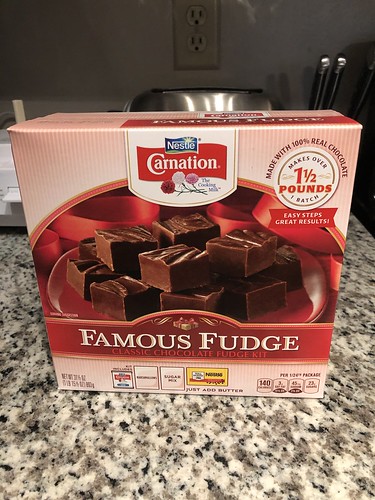
I bought the kid in early December, but just didn't get around to making it before I flew out of town, so I've just been walking past the box as it sits on the side table by my kitchen counter, silently daring me to tear it open.
As I said, change has come into my life, and that change affected this year's fudge process in two ways:
1) I have a different stove. For ten years I've made fudge on the same stove, but now I would be using a different stove.
2) I have different pots. When I moved into my first apartment in 1998, my mom gave me her pots and pans, which she and my dad had received for a wedding gift in 1970. I've replaced some of them over the years (the frying pan went first, because Dad warped it by constantly sticking it in cold water as soon as he was done cooking in it to make sure nothing stuck to the pan), and when I moved this summer I realized that the nonstick coating was finally starting to come off and maybe it was time for these 49 year old pans to go. That means that, for the first time ever, I would be making the fudge in a new pot.
Would the change in my life lead to changes in fudge outcomes?
Things started out relatively unchanged. I brought the butter, sugar, and condensed milk to a boil, and stirred vigorously:

This happens every year.
I removed the mixture from heat, and there was a slight delay of a few seconds while I tore open the marshmallow bag, dumped them in, then tore open the chocolate chip bag and dumped those in. After that, I stirred until both were melted, and something happened that has never happened before any time that I've made the famous fudge kit:

The fudge came together into a ball, like dough. Every other year I have to pour it into the pan and then scrape the rest off the sides, but this year it all came out in one piece, kind of the consistency of warm taffy, like I imagine a melted Tootsie Roll would. Recipes online always say that fudge has to be cooked until it reaches the soft ball stage, and had I somehow done that? Did my fudge spontaneously form a soft ball?
Was such a thing even possible?
Had change come to my fudge making?
I poured it into a round cake pan (Not the pan I usually use, but since I was changing everything else I figured why not change the dish it cools in, too?), smoothed the top with a spatula, and put it in the fridge to cool. Two hours later, I pulled it out, and it looked like it usually does on good years:
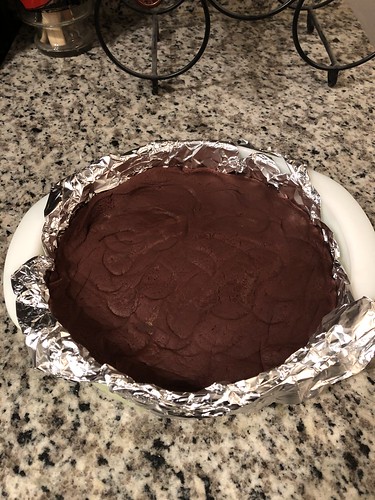
Not glossy, but not gritty and wrinkled like an old pioneer woman's face.
I lifted the foil out of the dish and let the fudge sit for twenty minutes, because I feel like one of the other reasons it seems hard and gritty sometimes is that I slice it when it's rock hard and half frozen, and I needed to just be patient and let it rest. See how much I'm changing and growing as a person? Anyway, I sliced, and got this:
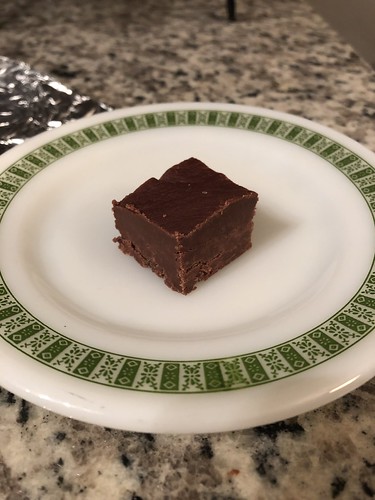
It's pretty good. It's solid, creamy, not gritty, and tastes fine. It's not the fudge on the box, but it never will be because the fudge on the box is made of wax and modeling clay and sprayed with oil by a food stylist so that it photographs well.
Merry Fudgemas, friends.
I didn't make fudge last year.
I'm not a candy maker. I don't make the kind of fudge that people talk about and look forward to because it's so delicious that oh, God, it's like a chocolate bird laid a chocolate egg in your mouth. No, instead, since 2010 I have made the kind of fudge that makes my friends look forward to how bad it's going to turn out and how bad I'm going to feel about it. These adventures include peanut butter fudge that never set and stayed liquid forever, Velveeta fudge that sweated out an undefined liquid and turned spongy, fudge that was somehow sticky if left out of the fridge too long, fudge that was flakey, fudge that was gritty, fudge that actually turned out ok, and one constant: every year I make fudge from the Carnation Famous Fudge boxed kit, and this year my friends were annoyed that a Christmas tradition came and went.
Well, friends, it's Christmas in January, I guess, because guess what I did today?
I bought the kid in early December, but just didn't get around to making it before I flew out of town, so I've just been walking past the box as it sits on the side table by my kitchen counter, silently daring me to tear it open.
As I said, change has come into my life, and that change affected this year's fudge process in two ways:
1) I have a different stove. For ten years I've made fudge on the same stove, but now I would be using a different stove.
2) I have different pots. When I moved into my first apartment in 1998, my mom gave me her pots and pans, which she and my dad had received for a wedding gift in 1970. I've replaced some of them over the years (the frying pan went first, because Dad warped it by constantly sticking it in cold water as soon as he was done cooking in it to make sure nothing stuck to the pan), and when I moved this summer I realized that the nonstick coating was finally starting to come off and maybe it was time for these 49 year old pans to go. That means that, for the first time ever, I would be making the fudge in a new pot.
Would the change in my life lead to changes in fudge outcomes?
Things started out relatively unchanged. I brought the butter, sugar, and condensed milk to a boil, and stirred vigorously:
This happens every year.
I removed the mixture from heat, and there was a slight delay of a few seconds while I tore open the marshmallow bag, dumped them in, then tore open the chocolate chip bag and dumped those in. After that, I stirred until both were melted, and something happened that has never happened before any time that I've made the famous fudge kit:
The fudge came together into a ball, like dough. Every other year I have to pour it into the pan and then scrape the rest off the sides, but this year it all came out in one piece, kind of the consistency of warm taffy, like I imagine a melted Tootsie Roll would. Recipes online always say that fudge has to be cooked until it reaches the soft ball stage, and had I somehow done that? Did my fudge spontaneously form a soft ball?
Was such a thing even possible?
Had change come to my fudge making?
I poured it into a round cake pan (Not the pan I usually use, but since I was changing everything else I figured why not change the dish it cools in, too?), smoothed the top with a spatula, and put it in the fridge to cool. Two hours later, I pulled it out, and it looked like it usually does on good years:
Not glossy, but not gritty and wrinkled like an old pioneer woman's face.
I lifted the foil out of the dish and let the fudge sit for twenty minutes, because I feel like one of the other reasons it seems hard and gritty sometimes is that I slice it when it's rock hard and half frozen, and I needed to just be patient and let it rest. See how much I'm changing and growing as a person? Anyway, I sliced, and got this:
It's pretty good. It's solid, creamy, not gritty, and tastes fine. It's not the fudge on the box, but it never will be because the fudge on the box is made of wax and modeling clay and sprayed with oil by a food stylist so that it photographs well.
Merry Fudgemas, friends.
Wednesday, January 1, 2020
I read some books and stuff
I didn't mean to take a year off from blogging. Actually, if we're being accurate, I've taken almost two years off, which, again, I did not mean to. It just kind of happened, and then it kept happening, and I kept swearing I would pick it up again and not getting to it. I don't even have a good excuse, really. I had some health issues, and I moved, and work got busy, and so here we are. I don't know if you can call it a New Year's Resolution, but I'm going to actually get back to blogging, and the best way to start is to do my traditional year end book review.
Which may be a little difficult because I did not keep track of what I was reading this year.
This is weird because I usually keep a list, and last year I kept that very extensive spreadsheet so that I could track all sorts of data on what I read and who wrote it. This year I didn't keep a list, but every couple months I took pictures of what I'd read because I was totally going to get back to blogging and writing about them. This means that right now, at the beginning of this entry, I have no idea of how many books I finished and I don't have any memory of some of them.
My first photo of books shows up in April. It represents everything I'd read so far this year, and it looks pretty far behind my usual tally. There are only 11 books in it, and at that point in the year there should be about 16.
City Behind a Fence, by Charles Johnson and Charles Jackson, was about the building of Oak Ridge, Tennessee. I've read other books on the subject, but this one actually went more in depth into what the houses and facilities were actually like, what the stores stocked, how people got assigned to housing, and focused less on the personal stories of the people involved, so it provided some balance to the other things I'd read.
Megan Abbott's Give Me Your Hand was a story about women in science, past friendships, academia, and murder. I remember this being a very tense, fast read that I enjoyed, but don't really remember anything specific.
Jim Munroe's Angry Young Spaceman took a pretty typical story of male post-collegiate angst and stuck it at the end of the galaxy on a non-human world. I liked this.
The fun part of Parker Posey's You're On An Airplane is that, in my memoir, the time I met Parker Posey would be a pretty good story and would take up a page or two, but in her memoir I don't appear at all. A lot of other people do, though, and this is ultimately an entertaining, if light, read.
Even though it's been months, I strongly remember Mary Crockett's How She Died, How I Lived. A high school loner texts five girls he goes to school with one night, and only one texts back. He meets up with her, and then brutally murders her. This is the story of how the other girls feel afterward, and how it impacted their school, their town, their friends, and the rest of their lives as they slowly approach both high school graduation and the killer's trial. Even though this came from the Young Adult section at Target, it was a very interesting read.
Gwendy's Button Box, by Stephen King and Richard Chizmar, was ok. It only took a day or so to read, and honestly wasn't that interesting. I don't know Chizmar's work, but I know King has done better.
Carol Goodman, who usually just writes murder mysteries involving secret babies, added supernatural elements to her typical formula with Incubus. I remember that it was vaguely entertaining, but little else.
My friend Leo wrote something about Ben Dolnick's The Ghost Notebooks, but I can't remember specifically what it was. She seemed to like the book, though, and I did, too. Short and disturbing, it tells the story of a couple who move to a tiny museum somewhere in New England (maybe upstate New York?) and the wife's sudden disappearance that seems to echo past events at the house.
I really enjoyed Madeline Miller's Circe, which retells several Greek myths from the perspective of Circe, rather than the heroic Greeks. It ultimately becomes a story of love, loss, motherhood, and revenge, and it was a good read. This is everything Disney wanted "Maleficent" to be, but without selling out Circe to make her more sympathetic or a victim.
Paul Tremblay's The Cabin at the End of the World tells the disturbing story of a family on vacation. A group of strangers approach their cabin, explaining very reasonably that the world will end if the family doesn't do certain things, but those things involve murder and torture. Are the strangers just a crazed cult, or is what they're saying true? And how does the family survive?
Babe Walker's White Girl Problems wasn't nearly as funny and satirical as it thought it was.
My next photo of books shows up in August, and only has eight books in it, bringing my total for the year at that point to 19.
I'm not sure how or why I picked up Kieron Connolly's Abandoned Civilizations, but it gave capsule descriptions of 90 or so ancient civilizations from around the world. It had a lot of pictures, but served as the kind of book that made you want to go look up more about these places in other books.
My friend Kristin sent me Into the Mist by David Brill, and it told all about deaths, injuries, and disasters in the Great Smoky Mountains National Park. Since I visit the park fairly often, this was an interesting read.
Craig Child's Atlas of a Lost World was supposed to be about Ice Age America, but turned out to be more about Child's travels to Ice Age archeological sites. It needed way more archeology and way less about Child.
Pete Buttigieg's Shortest Way Home was the first book I read this year to try to better understand the 500 or so Democratic presidential candidates. It talked about Pete's life and experiences, and was the first step in my long disenchantment with his candidacy.
I picked up Shelly Laurenston's Hot and Badgered because it had a hot guy on the front and sounded insane. It was a fairly entertaining, but also fairly shallow, love story between were-grizzly bears, were-honey badgers, and the international assassins trying to keep them apart.
Bobby Hall's Supermarket was derivative of lots of other books and movies, and I don't remember anything else about it except thinking, "Other people have done this better."
Paula Johnson's Lost Restaurants of Knoxville was an interesting tour of local history.
I read a second Carol Goodman book this year, The Other Mother. A return to Goodman's more traditional murder mysteries, this one features a typical Goodman secret baby, an isolated location with a mysterious past, and a protagonist who might be the murderer but might also be insane and pretending to be the murder victim. This was a good read even if some of the ending is a little dependent on coincidence more than it should be.
And now we come to a stack of books that are still on an end table in my living room, because they are waiting to be shelved, taken to the used bookstore for credit, and counted. I was holding on to them because I was going to get back to blogging again, and here we are, finding out how close to 52 books we're going to end up getting this year.
#20 - Carla Yanni's Living on Campus is an architectural history of dorms, residence halls, and fraternity and sorority houses at American colleges and universities. The intended audience for this is probably rather narrow, but if, like me, you work in higher education or have an interest in it this might interest you. I liked it a lot, but there are points when it gets a little dry, as it's more of a textbook than it is popular reading.
#21 - Josh Malerman's Inspection was a good book. 26 boys lived at a special school in the forest, never leaving campus or knowing the outside world. They were dedicated to their studies, to art, and to being the best boys that boys could be. J wonders what's beyond the forest, and whether their teachers are keeping things from them, and then one shocking day meets something else, someone that's not a boy. This other being, K, is something different, something called a girl, and she lives with 25 other girls at a special school, deep in the forest. I enjoyed this book a lot.
#22 - In So We Read On, Maureen Corrigan discusses "The Great Gatsby", and how it came to be an American classic. This is not another Fitzgerald biography, but is instead a biography of the book itself, explaining how it went from critical and commercial failure to being taught in high schools and colleges and becoming the beloved novel that it is today. This was a very good read about my historical literary boyfriend, F. Scott Fitzgerald.
#23 - The previous book mentioned noted jerk Ernest Hemingway discussing F. Scott in A Moveable Feast so I read that, too, confirming that noted jerk Ernest Hemingway is, indeed, a jerk. I'd say I want to punch him in the face, but he'd probably just write another one of his terrible novels about that, too, the jerk.
#24 - I count Tom King's The Vision as one of the best comic books of the decade, so I finally got around to reading his novel, A Once Crowded Sky, and it confirmed the sad truth: Tom King shouldn't be writing comic books. Tom King sees no joy in being a superhero, no wonder. He sees only sacrifice, and cost, and trauma, and pain, and everything he's written since "The Vision" confirms that, as does this book. Tom King only has one superhero story to tell, and it's not fun.
#25 - Remember when I said Stephen King was capable of better than "Gwendy's Button Box"? The Institute is one of his best novels in years. A science fiction story of geniuses, psychics, killers, and conspiracy, this was difficult to put down, even when parts of it break your heart.
#26 - Austin Grossman's Crooked tells the story of Richard Nixon, America's last sorcerer-president, and his secret war to keep the US safe from eldritch forces and supernatural powers. I enjoyed this a lot.
#27 - Peter Clines' Ex isle was the fifth book in his series about superheroes living through a zombie apocalypse. If you like the others, you'll like this one, but these are definitely not stand-alone books where you can pick up any of them and get a full story.
#28 - Flight or Fright was a collection of horror stories related to flying by various authors. Some were good, some were bad.
#29 - Jennifer Pozner's Reality Bites Back tried very hard to convince me that reality television is bad for women, families, and society in general. She makes strong arguments, and is probably actually right, but I love my garbage TV too much to give it up.
#30 - Bill Bryson's One Summer is a wild US history lesson about the summer of 1927, when Babe Ruth is in a home run derby, Charles Lindbergh is crossing the Atlantic, we're about to fall into the Great Depression, and the United States is never the same. This was a very entertaining, educational read.
#31 - Sarah Waters' The Little Stranger, a moody British ghost story, is a little long and ultimately unsatisfying.
At 31 books for the year (which I did not know at the time), I left to go visit my family in December, and read a bunch of books while I was home. Was it enough to get to 52?
#32 - Erik Asphaug's When the Earth Had Two Moons was a pretty entertaining book about solar system and planetary formation, and whether our system should be considered unusual or common among the millions and billions of other solar systems in the universe.
#33 - Back in the 1990's, before current college first year students were born, Kris Pulaski was the lead guitarist of a metal band just about to make it big. Instead, their lead singer went solo, buried their breakout album, and went on to global stardom while the rest of the band ended up in their personal versions of hell. In Grady Hendrix's We Sold Our Souls, Kris finds out what really happened: Terry did way more than just breaking up the band, and now Kris has to find him to save herself from eternal damnation. I really like Hendrix's writing, and this does not disappoint.
#34 - Gregory Maguire's Hiddensee tells a holiday story of a nutcracker, a rat, a princess, and a very complicated series of families. It's better than some of Maguire's books, but not as good as others.
#35 - Kamala Harris's The Truths We Hold makes me wish her presidential campaign was still running. I really hope she ends up as someone's vice president or attorney general pick.
#36 - Jared Diamond's The Third Chimpanzee, about the evolution of human beings, was interesting but, at times, also a little dry and boring.
#37 - Andrew Shaffer's Hope Never Dies, a murder mystery starring a rambling, annoyed Joe Biden who sits at home resenting that Barack Obama never calls, is pretty much exactly how I imagine Joe Biden behaves.
#38 - Rainbow Rowell's Carry On was a kind of Harry Potter homage, but with actual gay people and no slaves. I liked it.
#39 - As a collector of vintage Pyrex, I was intrigued by Sarah Archer's The Midcentury Kitchen, which talks about the growth of kitchen and appliance design and the changing roles of women in society in midcentury America. There are a lot of pictures, and sometimes not as much substance as I would have liked, but overall it was a good read.
#40 - Dan Savage's American Savage is a series of essays on marriage, love, sex, and the state of the US with regard to LGBTQ+ people. It was a good read, but being a few years old is also somewhat outdated.
It's also the last book I finished in 2019, which means I did not make my goal of 52 books, and actually came in as low as I have since I started counting this. Maybe in addition to getting back to blogging I can get back to reading more.
Which may be a little difficult because I did not keep track of what I was reading this year.
This is weird because I usually keep a list, and last year I kept that very extensive spreadsheet so that I could track all sorts of data on what I read and who wrote it. This year I didn't keep a list, but every couple months I took pictures of what I'd read because I was totally going to get back to blogging and writing about them. This means that right now, at the beginning of this entry, I have no idea of how many books I finished and I don't have any memory of some of them.
My first photo of books shows up in April. It represents everything I'd read so far this year, and it looks pretty far behind my usual tally. There are only 11 books in it, and at that point in the year there should be about 16.
City Behind a Fence, by Charles Johnson and Charles Jackson, was about the building of Oak Ridge, Tennessee. I've read other books on the subject, but this one actually went more in depth into what the houses and facilities were actually like, what the stores stocked, how people got assigned to housing, and focused less on the personal stories of the people involved, so it provided some balance to the other things I'd read.
Megan Abbott's Give Me Your Hand was a story about women in science, past friendships, academia, and murder. I remember this being a very tense, fast read that I enjoyed, but don't really remember anything specific.
Jim Munroe's Angry Young Spaceman took a pretty typical story of male post-collegiate angst and stuck it at the end of the galaxy on a non-human world. I liked this.
The fun part of Parker Posey's You're On An Airplane is that, in my memoir, the time I met Parker Posey would be a pretty good story and would take up a page or two, but in her memoir I don't appear at all. A lot of other people do, though, and this is ultimately an entertaining, if light, read.
Even though it's been months, I strongly remember Mary Crockett's How She Died, How I Lived. A high school loner texts five girls he goes to school with one night, and only one texts back. He meets up with her, and then brutally murders her. This is the story of how the other girls feel afterward, and how it impacted their school, their town, their friends, and the rest of their lives as they slowly approach both high school graduation and the killer's trial. Even though this came from the Young Adult section at Target, it was a very interesting read.
Gwendy's Button Box, by Stephen King and Richard Chizmar, was ok. It only took a day or so to read, and honestly wasn't that interesting. I don't know Chizmar's work, but I know King has done better.
Carol Goodman, who usually just writes murder mysteries involving secret babies, added supernatural elements to her typical formula with Incubus. I remember that it was vaguely entertaining, but little else.
My friend Leo wrote something about Ben Dolnick's The Ghost Notebooks, but I can't remember specifically what it was. She seemed to like the book, though, and I did, too. Short and disturbing, it tells the story of a couple who move to a tiny museum somewhere in New England (maybe upstate New York?) and the wife's sudden disappearance that seems to echo past events at the house.
I really enjoyed Madeline Miller's Circe, which retells several Greek myths from the perspective of Circe, rather than the heroic Greeks. It ultimately becomes a story of love, loss, motherhood, and revenge, and it was a good read. This is everything Disney wanted "Maleficent" to be, but without selling out Circe to make her more sympathetic or a victim.
Paul Tremblay's The Cabin at the End of the World tells the disturbing story of a family on vacation. A group of strangers approach their cabin, explaining very reasonably that the world will end if the family doesn't do certain things, but those things involve murder and torture. Are the strangers just a crazed cult, or is what they're saying true? And how does the family survive?
Babe Walker's White Girl Problems wasn't nearly as funny and satirical as it thought it was.
My next photo of books shows up in August, and only has eight books in it, bringing my total for the year at that point to 19.
I'm not sure how or why I picked up Kieron Connolly's Abandoned Civilizations, but it gave capsule descriptions of 90 or so ancient civilizations from around the world. It had a lot of pictures, but served as the kind of book that made you want to go look up more about these places in other books.
My friend Kristin sent me Into the Mist by David Brill, and it told all about deaths, injuries, and disasters in the Great Smoky Mountains National Park. Since I visit the park fairly often, this was an interesting read.
Craig Child's Atlas of a Lost World was supposed to be about Ice Age America, but turned out to be more about Child's travels to Ice Age archeological sites. It needed way more archeology and way less about Child.
Pete Buttigieg's Shortest Way Home was the first book I read this year to try to better understand the 500 or so Democratic presidential candidates. It talked about Pete's life and experiences, and was the first step in my long disenchantment with his candidacy.
I picked up Shelly Laurenston's Hot and Badgered because it had a hot guy on the front and sounded insane. It was a fairly entertaining, but also fairly shallow, love story between were-grizzly bears, were-honey badgers, and the international assassins trying to keep them apart.
Bobby Hall's Supermarket was derivative of lots of other books and movies, and I don't remember anything else about it except thinking, "Other people have done this better."
Paula Johnson's Lost Restaurants of Knoxville was an interesting tour of local history.
I read a second Carol Goodman book this year, The Other Mother. A return to Goodman's more traditional murder mysteries, this one features a typical Goodman secret baby, an isolated location with a mysterious past, and a protagonist who might be the murderer but might also be insane and pretending to be the murder victim. This was a good read even if some of the ending is a little dependent on coincidence more than it should be.
And now we come to a stack of books that are still on an end table in my living room, because they are waiting to be shelved, taken to the used bookstore for credit, and counted. I was holding on to them because I was going to get back to blogging again, and here we are, finding out how close to 52 books we're going to end up getting this year.
#20 - Carla Yanni's Living on Campus is an architectural history of dorms, residence halls, and fraternity and sorority houses at American colleges and universities. The intended audience for this is probably rather narrow, but if, like me, you work in higher education or have an interest in it this might interest you. I liked it a lot, but there are points when it gets a little dry, as it's more of a textbook than it is popular reading.
#21 - Josh Malerman's Inspection was a good book. 26 boys lived at a special school in the forest, never leaving campus or knowing the outside world. They were dedicated to their studies, to art, and to being the best boys that boys could be. J wonders what's beyond the forest, and whether their teachers are keeping things from them, and then one shocking day meets something else, someone that's not a boy. This other being, K, is something different, something called a girl, and she lives with 25 other girls at a special school, deep in the forest. I enjoyed this book a lot.
#22 - In So We Read On, Maureen Corrigan discusses "The Great Gatsby", and how it came to be an American classic. This is not another Fitzgerald biography, but is instead a biography of the book itself, explaining how it went from critical and commercial failure to being taught in high schools and colleges and becoming the beloved novel that it is today. This was a very good read about my historical literary boyfriend, F. Scott Fitzgerald.
#23 - The previous book mentioned noted jerk Ernest Hemingway discussing F. Scott in A Moveable Feast so I read that, too, confirming that noted jerk Ernest Hemingway is, indeed, a jerk. I'd say I want to punch him in the face, but he'd probably just write another one of his terrible novels about that, too, the jerk.
#24 - I count Tom King's The Vision as one of the best comic books of the decade, so I finally got around to reading his novel, A Once Crowded Sky, and it confirmed the sad truth: Tom King shouldn't be writing comic books. Tom King sees no joy in being a superhero, no wonder. He sees only sacrifice, and cost, and trauma, and pain, and everything he's written since "The Vision" confirms that, as does this book. Tom King only has one superhero story to tell, and it's not fun.
#25 - Remember when I said Stephen King was capable of better than "Gwendy's Button Box"? The Institute is one of his best novels in years. A science fiction story of geniuses, psychics, killers, and conspiracy, this was difficult to put down, even when parts of it break your heart.
#26 - Austin Grossman's Crooked tells the story of Richard Nixon, America's last sorcerer-president, and his secret war to keep the US safe from eldritch forces and supernatural powers. I enjoyed this a lot.
#27 - Peter Clines' Ex isle was the fifth book in his series about superheroes living through a zombie apocalypse. If you like the others, you'll like this one, but these are definitely not stand-alone books where you can pick up any of them and get a full story.
#28 - Flight or Fright was a collection of horror stories related to flying by various authors. Some were good, some were bad.
#29 - Jennifer Pozner's Reality Bites Back tried very hard to convince me that reality television is bad for women, families, and society in general. She makes strong arguments, and is probably actually right, but I love my garbage TV too much to give it up.
#30 - Bill Bryson's One Summer is a wild US history lesson about the summer of 1927, when Babe Ruth is in a home run derby, Charles Lindbergh is crossing the Atlantic, we're about to fall into the Great Depression, and the United States is never the same. This was a very entertaining, educational read.
#31 - Sarah Waters' The Little Stranger, a moody British ghost story, is a little long and ultimately unsatisfying.
At 31 books for the year (which I did not know at the time), I left to go visit my family in December, and read a bunch of books while I was home. Was it enough to get to 52?
#32 - Erik Asphaug's When the Earth Had Two Moons was a pretty entertaining book about solar system and planetary formation, and whether our system should be considered unusual or common among the millions and billions of other solar systems in the universe.
#33 - Back in the 1990's, before current college first year students were born, Kris Pulaski was the lead guitarist of a metal band just about to make it big. Instead, their lead singer went solo, buried their breakout album, and went on to global stardom while the rest of the band ended up in their personal versions of hell. In Grady Hendrix's We Sold Our Souls, Kris finds out what really happened: Terry did way more than just breaking up the band, and now Kris has to find him to save herself from eternal damnation. I really like Hendrix's writing, and this does not disappoint.
#34 - Gregory Maguire's Hiddensee tells a holiday story of a nutcracker, a rat, a princess, and a very complicated series of families. It's better than some of Maguire's books, but not as good as others.
#35 - Kamala Harris's The Truths We Hold makes me wish her presidential campaign was still running. I really hope she ends up as someone's vice president or attorney general pick.
#36 - Jared Diamond's The Third Chimpanzee, about the evolution of human beings, was interesting but, at times, also a little dry and boring.
#37 - Andrew Shaffer's Hope Never Dies, a murder mystery starring a rambling, annoyed Joe Biden who sits at home resenting that Barack Obama never calls, is pretty much exactly how I imagine Joe Biden behaves.
#38 - Rainbow Rowell's Carry On was a kind of Harry Potter homage, but with actual gay people and no slaves. I liked it.
#39 - As a collector of vintage Pyrex, I was intrigued by Sarah Archer's The Midcentury Kitchen, which talks about the growth of kitchen and appliance design and the changing roles of women in society in midcentury America. There are a lot of pictures, and sometimes not as much substance as I would have liked, but overall it was a good read.
#40 - Dan Savage's American Savage is a series of essays on marriage, love, sex, and the state of the US with regard to LGBTQ+ people. It was a good read, but being a few years old is also somewhat outdated.
It's also the last book I finished in 2019, which means I did not make my goal of 52 books, and actually came in as low as I have since I started counting this. Maybe in addition to getting back to blogging I can get back to reading more.
Tuesday, January 1, 2019
The Year in Books and the Year Without Books
Last December, I looked around my living room and noticed that I had a problem. There were unread books under both end tables, and under the coffee table. While this has been pretty normal for my living room the entire time that I've lived in this apartment, a new development was troubling me: there were also multiple stacks of unread books next to the coffee table, enough of them to reach the height of the coffee table and extend its length by almost two feet. Those books were there because I ran out of room under the tables.
When was I going to read these books?
And why was I still buying more books, pretty much every weekend?
I decided that I needed to address the situation, so I made a New Year's Resolution: I would not buy any books in 2018. I needed to read books and get them out of the apartment, so I made myself some rules.
1) I could buy one book during the year. I knew I would need an out at some point during the year, but, unfortunately for me, I burned my one book before the end of January, when I found out that Chad Michael Murray, the actor, wrote a book with Heather Graham, a legitimate author.
I regret nothing, because this book was a hilarious shitshow.
American Drifter introduced us to River Roulet, a young US army veteran trying to put the horrors of war behind him by backpacking through Brazil. While in Rio, he meets a beautiful woman, but she is the girlfriend of a powerful drug lord who rules Rio with an iron fist. So River and Natal, the beautiful woman, are on the run from the henchmen of her drug dealer boyfriend. They take trains and busses and hide in abandoned houses, but the men always seem to find them and River and Natal keep getting separated but their love is so strong that they always find each other again even in the extremely crowded streets of Rio.
Except that there is no Natal.
I know I'm not supposed to laugh, but Natal was his wife who was killed while he was deployed with the army. They always wanted to go to Brazil, so when he gets discharged for PTSD he goes, drops off the grid to become a handsome drifter, and the entire book is just his PTSD hallucination. The men constantly chasing him are the private investigators his parents hired to find him. In the end they take him back to America and he is institutionalized.
Except he also actually really did fight a Brazilian drug lord. And burned down his heavily armed compound. While hallucinating that he was rescuing Natal.
2) My other exception was that I was allowed to buy any copy of Joan Crawford's My Way of Life, because I've been looking for that thing for years and I was not about to pass it up. In August, I found out that with the popularity of Feud someone put the book back into print, so I ordered one, but haven't read it yet.
Other than those two books, I only slipped one time during the whole year. I was in Pittsburgh in October for a conference, and I spotted this for fifty cents in a bin at a comic store:
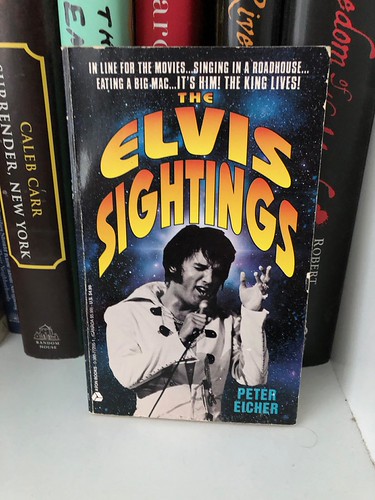
How could I not want that?
Yes, I broke my resolution, but I guarantee that book is worth it.
I made a second book-related resolution this year, which was to keep track of the books that I read and data about them in a spreadsheet, so that I could draw a picture of my reading habits at the end of the year. I usually just keep a running list of summaries, but I was curious about what this could tell me, and started tracking on January 1. I used the following columns on my spreadsheet:
1) Title
2) Author
3) Author Sex
4) Publication Year
5) Format
6) Author Race
7) Days Spent Reading
8) Fiction/Nonfiction
9) Stars Out of Five
10) Genre
11) Page Count
12) How Was it Acquired?
13) Any Awards?
So, what did we learn?
Title and Author I read 51 books this year. This is low for me, but there was a period from late July to late August where I just stopped reading. I stopped doing a lot of things about halfway through the year, like updating this blog regularly, staying on diet, getting all my steps regularly, and eventually reading for fun, but by November I was turning most of that around. Hopefully that means I will be back to my normal reading levels soon.
Author Sex If I couldn't find a record of the author self-identifying, I went with the one that they appeared to be. I may have misgendered someone, for which I apologize, but statistics allow a margin of error, so it doesn't matter much one way or the other if I got a few wrong. Two of the books I read this year had multiple authors, so I have 53 authors for 51 books. Of those 53 authors, I read 20 women and 33 men. It's not an even split, but it's not horribly out of balance. Maybe I'll try alternating this year, to see if I can get it more even.
Publication Year I'm not sure why I thought this was information that I needed to track, but 47 books were published in this century, and 4 were published in the last one. The oldest book I read was published in 1955.
Format I didn't finish a single book on my Kindle this year, and I don't listen to audiobooks, so my only formats are paperback and hardcover. I read 14 hardcovers and 37 paperbacks.
Author Race Like the category of Author Sex, I did my best with this one. While I have 1 unknown, the majority of authors I read this year appeared to be white. And when I say the majority, I mean 47 out of 53. I need to make a more conscious effort this year to seek out voices other than white ones.
Days Spent Reading It takes me an average of 4.7 days to finish a book.
Fiction or Nonfiction I read 34 works of fiction, and 17 nonfiction.
Stars Out of Five I am apparently somewhat stingy with my stars. Here are the books that I gave five stars to:
Rob Rufus' Die Young With Me
Tina Fey's Bossypants
Margaret Lazarus Dean's Leaving Orbit: Notes From the Last Days of American Spaceflight
M. R. Carey's The Girl With All the Gifts
Michelle Obama's Becoming
Adam Silvera's They Both Die At The End
That's it. Everything else I read was somehow disappointing in some way, and it cost them at least one star. I didn't read any books that I only gave one star two, but four only got two stars.
Genre Genre was all over the place. The category I read the most of was science fiction, and second place was a tie between horror and memoir. Some people would argue that those are the same category. I tried to mark what a book mainly was, even though several of them would have fit in multiple categories.
Page Count The shortest book I read was 152 pages, and the longest 678. My average page count was 353.
How Was It Acquired? I borrowed one book, and found two in free book piles in the Communications Building hallways. Out of the rest, 25 were gifts, and 23 were books I bought for myself.
Any Awards? This section may also be inaccurate, as it was hard to track down the information. Amazon, GoodReads, Wikipedia, and Google Books are all inconsistent about listing a book's awards, so I did my best to research. As near as I can tell, seven books that I read this year won awards.
I'm planning to track the books this way again this year, and while I am not resolving not to buy any, I am going to be conscious of what I am purchasing and when I actually plan to read it.
When was I going to read these books?
And why was I still buying more books, pretty much every weekend?
I decided that I needed to address the situation, so I made a New Year's Resolution: I would not buy any books in 2018. I needed to read books and get them out of the apartment, so I made myself some rules.
1) I could buy one book during the year. I knew I would need an out at some point during the year, but, unfortunately for me, I burned my one book before the end of January, when I found out that Chad Michael Murray, the actor, wrote a book with Heather Graham, a legitimate author.
I regret nothing, because this book was a hilarious shitshow.
American Drifter introduced us to River Roulet, a young US army veteran trying to put the horrors of war behind him by backpacking through Brazil. While in Rio, he meets a beautiful woman, but she is the girlfriend of a powerful drug lord who rules Rio with an iron fist. So River and Natal, the beautiful woman, are on the run from the henchmen of her drug dealer boyfriend. They take trains and busses and hide in abandoned houses, but the men always seem to find them and River and Natal keep getting separated but their love is so strong that they always find each other again even in the extremely crowded streets of Rio.
Except that there is no Natal.
I know I'm not supposed to laugh, but Natal was his wife who was killed while he was deployed with the army. They always wanted to go to Brazil, so when he gets discharged for PTSD he goes, drops off the grid to become a handsome drifter, and the entire book is just his PTSD hallucination. The men constantly chasing him are the private investigators his parents hired to find him. In the end they take him back to America and he is institutionalized.
Except he also actually really did fight a Brazilian drug lord. And burned down his heavily armed compound. While hallucinating that he was rescuing Natal.
2) My other exception was that I was allowed to buy any copy of Joan Crawford's My Way of Life, because I've been looking for that thing for years and I was not about to pass it up. In August, I found out that with the popularity of Feud someone put the book back into print, so I ordered one, but haven't read it yet.
Other than those two books, I only slipped one time during the whole year. I was in Pittsburgh in October for a conference, and I spotted this for fifty cents in a bin at a comic store:
How could I not want that?
Yes, I broke my resolution, but I guarantee that book is worth it.
I made a second book-related resolution this year, which was to keep track of the books that I read and data about them in a spreadsheet, so that I could draw a picture of my reading habits at the end of the year. I usually just keep a running list of summaries, but I was curious about what this could tell me, and started tracking on January 1. I used the following columns on my spreadsheet:
1) Title
2) Author
3) Author Sex
4) Publication Year
5) Format
6) Author Race
7) Days Spent Reading
8) Fiction/Nonfiction
9) Stars Out of Five
10) Genre
11) Page Count
12) How Was it Acquired?
13) Any Awards?
So, what did we learn?
Title and Author I read 51 books this year. This is low for me, but there was a period from late July to late August where I just stopped reading. I stopped doing a lot of things about halfway through the year, like updating this blog regularly, staying on diet, getting all my steps regularly, and eventually reading for fun, but by November I was turning most of that around. Hopefully that means I will be back to my normal reading levels soon.
Author Sex If I couldn't find a record of the author self-identifying, I went with the one that they appeared to be. I may have misgendered someone, for which I apologize, but statistics allow a margin of error, so it doesn't matter much one way or the other if I got a few wrong. Two of the books I read this year had multiple authors, so I have 53 authors for 51 books. Of those 53 authors, I read 20 women and 33 men. It's not an even split, but it's not horribly out of balance. Maybe I'll try alternating this year, to see if I can get it more even.
Publication Year I'm not sure why I thought this was information that I needed to track, but 47 books were published in this century, and 4 were published in the last one. The oldest book I read was published in 1955.
Format I didn't finish a single book on my Kindle this year, and I don't listen to audiobooks, so my only formats are paperback and hardcover. I read 14 hardcovers and 37 paperbacks.
Author Race Like the category of Author Sex, I did my best with this one. While I have 1 unknown, the majority of authors I read this year appeared to be white. And when I say the majority, I mean 47 out of 53. I need to make a more conscious effort this year to seek out voices other than white ones.
Days Spent Reading It takes me an average of 4.7 days to finish a book.
Fiction or Nonfiction I read 34 works of fiction, and 17 nonfiction.
Stars Out of Five I am apparently somewhat stingy with my stars. Here are the books that I gave five stars to:
Rob Rufus' Die Young With Me
Tina Fey's Bossypants
Margaret Lazarus Dean's Leaving Orbit: Notes From the Last Days of American Spaceflight
M. R. Carey's The Girl With All the Gifts
Michelle Obama's Becoming
Adam Silvera's They Both Die At The End
That's it. Everything else I read was somehow disappointing in some way, and it cost them at least one star. I didn't read any books that I only gave one star two, but four only got two stars.
Genre Genre was all over the place. The category I read the most of was science fiction, and second place was a tie between horror and memoir. Some people would argue that those are the same category. I tried to mark what a book mainly was, even though several of them would have fit in multiple categories.
Page Count The shortest book I read was 152 pages, and the longest 678. My average page count was 353.
How Was It Acquired? I borrowed one book, and found two in free book piles in the Communications Building hallways. Out of the rest, 25 were gifts, and 23 were books I bought for myself.
Any Awards? This section may also be inaccurate, as it was hard to track down the information. Amazon, GoodReads, Wikipedia, and Google Books are all inconsistent about listing a book's awards, so I did my best to research. As near as I can tell, seven books that I read this year won awards.
I'm planning to track the books this way again this year, and while I am not resolving not to buy any, I am going to be conscious of what I am purchasing and when I actually plan to read it.
Tuesday, March 27, 2018
The Knoxville Covenant Health Half Marathon
I've spent two years trying to participate in the Knoxville half marathon, which I finished on Sunday.
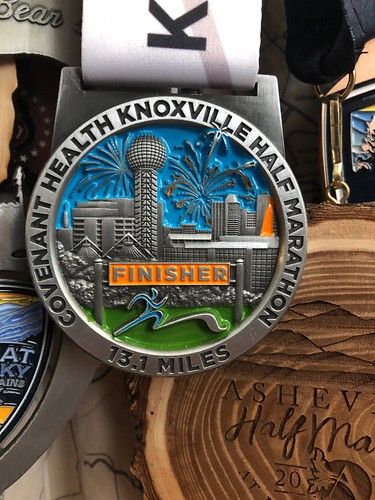
I first became aware of this race in March 2016, when I was walking to Sunday brunch with my friends and crossed the race course a few times. During one of those crossings, I stopped to talk to a volunteer who explained that the race goes through Knoxville and finishes on the 50 yard line at Neyland Stadium. Living in Knoxville, that's kind of a big deal. At this point, I'd already finished the Great Smoky Mountains half marathon and the Asheville half marathon at the Biltmore, so the idea of doing another wasn't terrifying, and in August of 2017, right before I did the GSM half again, I registered for the Knoxville Covenant Health Half Marathon for Spring 2017.
Then I didn't participate in the race.
The month before the race, I did the Asheville half again, and not only did I come in last place but I also picked up a terrible cold that ended up settling into my chest and hung around for a month. I was determined to still do the Knoxville half, and took so much cold medicine that I am probably on a list somewhere as a possible meth cooker, but the week of the race I was still coughing and my average mileage time was a half hour a mile, so I had to painfully admit that I could not do this race. Since I didn't cancel until the week of, I lost my registration fee, and I was too ashamed to even go pick up my race shirt. I was so mad and disappointed in myself for getting sick and for not going to see a doctor to receive actual treatment rather than dosing myself with Mucinex and orange juice for a month, and I resolved that this year, it was going to happen.
And it did.
After finally defeating the GSM half this fall (I mean it; I'm not doing that one again because the course has physically injured me two years in a row) I decided not to do the Asheville half again. I got a flu shot this year, which I usually never do. I physically avoided any friend who said they had a cold. My health was not going to be an issue this year, even if I had to sequester myself and live in a Lysol-scented bubble. I did not get a cold.
But damn, this race was a bit of a struggle.
At first, I wasn't intimidated by the course, because a lot of it takes place on streets and greenways that I normally walk on the weekends. Sure, I don't normally add them together in this particular combination, but I've walked a lot of the course at various times and for various differences, and wasn't too afraid. I even talked to people who had done it, and they all assured me that there were only a couple of terrible hills, and long stretches that were "mostly flat". I even agreed, because I pictured them in my head and thought things like, "Yes, Forest is mostly flat" without thinking things like, "It's mostly flat because the entire street is just one long rise in elevation". I got a little bit more worried when I looked at the elevation chart. There is never a spot where this course is flat. There are spots that are flat-ish, in that they are flatter than other parts, but no parts are actually flat.
People warned me that the hill on Noelton Drive (it's not really "on" Noelton so much as it is Noelton; the entire street is a hill) was the worst, but that came after an entire neighborhood of hills. It was a lot, and my legs felt like jelly when I got to the top of it, which was kind of a bad thing since that hill is pretty close to the halfway mark. I even felt a little dizzy for a moment, and thought about telling the next cop car I saw that I was done. Fortunately, just before the Mile 8 marker, the course goes past my friend Mindy's driveway, and Mindy's whole family and my friend Yodi were all out in the driveway to cheer for me. I've never had a cheering section at a race before, other than at the end when my friends finish before me, and it was shockingly motivating. Yodi even ran out to walk with me for a minute. He was playing some sort of song on a speaker, and wanted me to dance, but I have no idea what that song was because at that point all I could mentally process was, "I have to finish now."
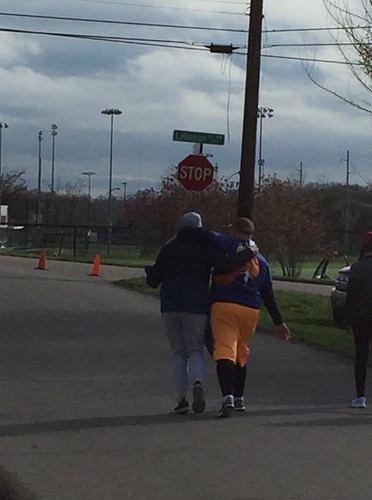
"You can do it!" Yodi told me.
"I want to die," I answered.
Later, just after Mile 9, I tried to cut around a large puddle on the Third Creek Greenway by stepping onto the grass, and I went all the way down onto both hands and both shins in mud. Other runners offered to help, but I was good and covered. I looked kind of like I turned the half marathon into a Spartan Race, but I kept going. When I was telling my mom about it on the phone, she asked, "Well, what did you do?" and that was my answer. I kept going. Four miles from the finish, someone could have covered me in a bucket of pig blood like Carrie at the prom, and I would have wiped it out of my eyes and kept walking. I'm not stopping for mud.
I also wasn't hurt, and I didn't die.
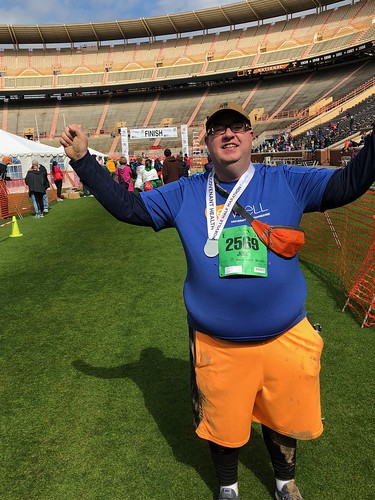
I finished.
I do have to disagree with the idea that Noelton is the worst hill. My vote goes for the one at 22nd Street, because it went on forever. Noelton is steeper, but you can see the top. On 22nd Street, it just felt like you were climbing and climbing and climbing, and eleven miles into the race that's not a feeling that you want to have, especially when it was past the last water station.
I also have to take a moment to thank my friends. They sent encouragement online, and texts. My friend Erin saw me on TV and texted me the photo during the race, so that I saw it on my Apple Watch and thought, "Holy shit, I'm on TV." (That was fascinating to me because nobody ever takes pictures of the back of the race. You always see photos of the front people, the ones who are sleek and running and managing to smile, but nobody ever takes pictures of the slow, steady turtles at the back.) Mindy asked if I wanted them to run out with any specific consumables, an offer that I might take her up on next year because that spot is a great place for a quick sugar rush. Yodi gave me a hug when I needed one. Sara met me at the stadium, held my stuff when I wanted to immediately go to the bathroom to wash my hands (God bless her. She deserves some kind of a medal because my attitude for about 20 minutes after I finish a half marathon is a mix of disjointed enthusiasm and irritation. I handed her my water bottle and the bag with my other shoes and blurted, "I'M DONE WITH THESE. I'M DONE," and she took them without batting an eye.), untied one of my shoes for me when I was having trouble bending, drove me to brunch to meet our friends Drew and Peter, didn't complain when I wanted to catch Pokémon for a minute after brunch, and drove me back to my car later.
My friends are wonderful.
They are currently all forgiven for any incidences of tardiness to meals, movies, or other events over the past year.
And now I have a time to measure myself against when I do this race again next year.
I first became aware of this race in March 2016, when I was walking to Sunday brunch with my friends and crossed the race course a few times. During one of those crossings, I stopped to talk to a volunteer who explained that the race goes through Knoxville and finishes on the 50 yard line at Neyland Stadium. Living in Knoxville, that's kind of a big deal. At this point, I'd already finished the Great Smoky Mountains half marathon and the Asheville half marathon at the Biltmore, so the idea of doing another wasn't terrifying, and in August of 2017, right before I did the GSM half again, I registered for the Knoxville Covenant Health Half Marathon for Spring 2017.
Then I didn't participate in the race.
The month before the race, I did the Asheville half again, and not only did I come in last place but I also picked up a terrible cold that ended up settling into my chest and hung around for a month. I was determined to still do the Knoxville half, and took so much cold medicine that I am probably on a list somewhere as a possible meth cooker, but the week of the race I was still coughing and my average mileage time was a half hour a mile, so I had to painfully admit that I could not do this race. Since I didn't cancel until the week of, I lost my registration fee, and I was too ashamed to even go pick up my race shirt. I was so mad and disappointed in myself for getting sick and for not going to see a doctor to receive actual treatment rather than dosing myself with Mucinex and orange juice for a month, and I resolved that this year, it was going to happen.
And it did.
After finally defeating the GSM half this fall (I mean it; I'm not doing that one again because the course has physically injured me two years in a row) I decided not to do the Asheville half again. I got a flu shot this year, which I usually never do. I physically avoided any friend who said they had a cold. My health was not going to be an issue this year, even if I had to sequester myself and live in a Lysol-scented bubble. I did not get a cold.
But damn, this race was a bit of a struggle.
At first, I wasn't intimidated by the course, because a lot of it takes place on streets and greenways that I normally walk on the weekends. Sure, I don't normally add them together in this particular combination, but I've walked a lot of the course at various times and for various differences, and wasn't too afraid. I even talked to people who had done it, and they all assured me that there were only a couple of terrible hills, and long stretches that were "mostly flat". I even agreed, because I pictured them in my head and thought things like, "Yes, Forest is mostly flat" without thinking things like, "It's mostly flat because the entire street is just one long rise in elevation". I got a little bit more worried when I looked at the elevation chart. There is never a spot where this course is flat. There are spots that are flat-ish, in that they are flatter than other parts, but no parts are actually flat.
People warned me that the hill on Noelton Drive (it's not really "on" Noelton so much as it is Noelton; the entire street is a hill) was the worst, but that came after an entire neighborhood of hills. It was a lot, and my legs felt like jelly when I got to the top of it, which was kind of a bad thing since that hill is pretty close to the halfway mark. I even felt a little dizzy for a moment, and thought about telling the next cop car I saw that I was done. Fortunately, just before the Mile 8 marker, the course goes past my friend Mindy's driveway, and Mindy's whole family and my friend Yodi were all out in the driveway to cheer for me. I've never had a cheering section at a race before, other than at the end when my friends finish before me, and it was shockingly motivating. Yodi even ran out to walk with me for a minute. He was playing some sort of song on a speaker, and wanted me to dance, but I have no idea what that song was because at that point all I could mentally process was, "I have to finish now."
"You can do it!" Yodi told me.
"I want to die," I answered.
Later, just after Mile 9, I tried to cut around a large puddle on the Third Creek Greenway by stepping onto the grass, and I went all the way down onto both hands and both shins in mud. Other runners offered to help, but I was good and covered. I looked kind of like I turned the half marathon into a Spartan Race, but I kept going. When I was telling my mom about it on the phone, she asked, "Well, what did you do?" and that was my answer. I kept going. Four miles from the finish, someone could have covered me in a bucket of pig blood like Carrie at the prom, and I would have wiped it out of my eyes and kept walking. I'm not stopping for mud.
I also wasn't hurt, and I didn't die.
I finished.
I do have to disagree with the idea that Noelton is the worst hill. My vote goes for the one at 22nd Street, because it went on forever. Noelton is steeper, but you can see the top. On 22nd Street, it just felt like you were climbing and climbing and climbing, and eleven miles into the race that's not a feeling that you want to have, especially when it was past the last water station.
I also have to take a moment to thank my friends. They sent encouragement online, and texts. My friend Erin saw me on TV and texted me the photo during the race, so that I saw it on my Apple Watch and thought, "Holy shit, I'm on TV." (That was fascinating to me because nobody ever takes pictures of the back of the race. You always see photos of the front people, the ones who are sleek and running and managing to smile, but nobody ever takes pictures of the slow, steady turtles at the back.) Mindy asked if I wanted them to run out with any specific consumables, an offer that I might take her up on next year because that spot is a great place for a quick sugar rush. Yodi gave me a hug when I needed one. Sara met me at the stadium, held my stuff when I wanted to immediately go to the bathroom to wash my hands (God bless her. She deserves some kind of a medal because my attitude for about 20 minutes after I finish a half marathon is a mix of disjointed enthusiasm and irritation. I handed her my water bottle and the bag with my other shoes and blurted, "I'M DONE WITH THESE. I'M DONE," and she took them without batting an eye.), untied one of my shoes for me when I was having trouble bending, drove me to brunch to meet our friends Drew and Peter, didn't complain when I wanted to catch Pokémon for a minute after brunch, and drove me back to my car later.
My friends are wonderful.
They are currently all forgiven for any incidences of tardiness to meals, movies, or other events over the past year.
And now I have a time to measure myself against when I do this race again next year.
Subscribe to:
Posts (Atom)