Saturday, January 1, 2022

The last books of 2021

I kept meaning to update this in November, and then suddenly it was December and I kept not updating because I thought I might finish another book before the end of the year, but I did not, so here we are. In October, the last time I did update, I had just my 52 books a year goal, so all of these books are gravy.

53/52: Madeline Miller's Song of Achilles: This landed on my radar because it was having a moment on BookTok and also on Gay Twitter, and it seemed like everyone was reading it so I decided I should, too. This book was excellent. Miller tells the story of Achilles and Patroclus from birth to death, but she tells it as a love story. There's no suggestion that they're lovers, as is often done in versions of the Trojan War. Instead, Miller takes it as a given and works from there. If you're familiar with "The Iliad" you already know, vaguely, where the story is going, but still, tears came out of my cryholes. This was one of the best books I read all year.

54/52: Patrick Boucheron's Machiavelli: The Art of Teaching People What To Fear: I bought this on an early fall trip to Washington, DC, at a bookstore near Dupont Circle that had my last name. It turned out to look more interesting than it actually was, as I was expecting a biography of Machiavelli. It was pretty light on the biographic details, and instead was more of a discussion of how to read Machiavelli and apply it to our current political climate. That's still a useful discussion, but not really what I wanted.

55/52: Jeremy Finley's The Darkest Time of Night: A decent mix of suspense and science fiction. When her grandson goes missing in the woods behind the family home, Lynn is reminded of the work she did in the 1960's as a grad student in the astronomy department, taking stories from people who said their family members were taken by lights in the sky. This isn't the first time someone has vanished in those woods, and as Lynn gets closer to the truth she gets closer to sinister forces determined to keep it from the public. What are they protecting, and why? And where has Lynn's grandson actually gone?

56/52: Walter Tevis' The Queen's Gambit: Like a lot of people, I got a copy of this because I watched the series on Netflix and was intrigued. If you've watched the series, you'll blow right through this, because the show is almost a page by page recreation of the book. It's still a good read and an interesting story, but neither the book nor the movie has made me want to try to become a better chess player.

57/52: Dave Quinn's Not All Diamonds And Rose: This was entertaining, but only for a very select audience. Amazon calls it "the definitive oral history of the Real Housewives", but there are a number of former Real Housewives who refused to be interviewed. They did get a lot of producers and production team members, though, and the format of one chapter for each version of the franchise makes it easier to keep up with, so kudos on the structure. As a fan, I have a few opinions:

    1) How are you going to interview Quinn from Orange County without bringing up the time she put on a wig, claimed to be her alter ego of Roxy, and went out to bars to pick up guys? Are we all just pretending that didn't happen?

    2) The list of people who wouldn't be interviewed is at the very end of the book. It would make more sense to have a list at the beginning of each chapter, so that you're not wondering the whole time if someone is going to jump in.

    3) The DC chapter is only a few pages long, and you can tell that Bravo and Andy Cohen, who cooperated with this book, really just want to bury the whole thing. The only part of DC that they talk about is when the Salahi's crash the state dinner at the White House, and it is told entirely from the point of view of the production staff. I really wanted to hear from the DC Housewives what they thought about that incident, how they felt about being cancelled after only one season, whether being on the show had any impact on them, or really anything, but the book only spoke with a few of them and doesn't publish any of those interviews.

58/52: Jean Hanff Korelitz's The Plot: Jacob is a creative writing teacher, coasting on the reputation of his promising early work that hasn't blossomed into a writing career, when his student, Evan, brings him a story idea that Evan is planning to write. Evan insists that his plot, and its twist, will make his book an immediate best seller, and Jacob has to admit that he thinks Evan is correct. As a few years go by, Jacob wonders what happened to Evan, and discovers that he died without publishing. No copy of his work seems to have survived, but Jacob remembers all the details of the plot, and decides to write it himself. Now he has an instant best seller, fame, talk show appearances, and movie deals, until an anonymous email comes saying, "You are a thief." Now Jacob is trying to keep everyone from finding out what he's done while also finding out where Evan, and the plot, actually came from. This was suspenseful, but when they finally reveal what the plot was, it's not that shocking or original.

59/52: Paul Tremblay's Survivor Song: Mutate super-rabies is sweeping across New England, turning people who are bitten into violent, mindless animals. Natalie, who is due to give birth in a few days, calls her college friend Rams, a doctor, because she has been attacked by a neighbor and she has been bitten. Now they are racing against time to get to a hospital in time to get Natalie a rabies vaccine and to give birth, but the locals hospitals are overwhelmed and the streets are overrun with the infected and with heavily armed militias insisting that the virus isn't real. I guess I wasn't in the mood for plague fiction during our pandemic, because I usually like Tremblay's work, but as soon as the militia showed up I was just kind of "Ugh" and pushed through to finish this.

60/52: Liz Brown's Twilight Man: Love and Ruin in the Shadows of Hollywood and the Clark Empire: Some time back (this year or last year; I cannot remember) I read "Empty Mansions", the story of the last daughter of the Clark copper empire and the slow dissolution of the Clark family fortune, so when I saw the Clark Empire mentioned here I was intrigued. Brown tells the story of her great-granduncle, William Andrews Clark, Jr., a founder of the Los Angeles Philharmonic, backer of the creation of the Hollywood Bowl, and noted philanthropist, and Clark's lover, Harrison Post. Brown details the constant danger Clark's lifestyle placed them both in, and how after Clark's death Post, suddenly rich, was a target of his own family's plot to exploit his wealth and bleed him dry. It's a good read, and goes to some unexpected places.

Sunday, October 3, 2021

All the Books I Read In September

 When we left off, 27 days ago, I was at 38 books for the year out of my goal of 52. Since then, football season started, I got back into a regular treadmill routine, and I went out of town for a long weekend, and all of this added up to a ton more books.

39/52: Survive the Night by Riley Sager: Charlie needs a ride home from campus back to Ohio for the December break, and Josh is putting up a poster on the ride board right when she is. Happy coincidence, right? But there's something a little off about Josh. He won't show Riley the inside of the trunk. His story keeps changing and is full of holes. He seems determined to drive her somewhere, very quickly, and Riley starts to wonder if maybe, in leaving campus, she hasn't quite left the Campus Killer who murdered her roommate behind. This was suspenseful and twisty and very enjoyable.

40 and 41/52: Goal Lines and First Times and Line Mates and Study Dates, by Eden Finley and Saxon James: The last two books in the college hockey gay romance series I was reading. Again, they're pretty much the same book over and over, but they were very entertaining on the treadmill. Maybe I should go back and finish the 50 Shades trilogy.

42/52: The Only Good Indians by Stephen Graham Jones: Ten years ago, four American Indian men slaughtered a herd of elk on land reserved for the tribal elders, and left the carcasses to rot. Now, something is coming back for them and their families, looking for revenge. This was a little different, but still good and spooky.

43/52: Bath Haus by P.J. Vernon: Nathan and Oliver seem to have it all: a dog, a townhouse, a happy relationship, but when Oliver visits Haus, a gay bathhouse, while Nathan is out of town, things go horribly awry and Oliver barely gets out alive. Now he's caught in a game with a killer, and his lies are stacking up and about to topple. Can he save himself, his family, and the perfect life they've built? And will he want to? The tone of this book reminded me a lot of Scott Smith's books, where one thing goes wrong and bad choices keep stacking up the problems. It was a good read.

44/52: Burnt Offerings by Robert Marasco: Amazon suggested I read this, and since I've seen the movie a bunch of times I figured why not read it? A small family gets out of New York City for the summer by renting a vacation home that seems too good to be true. The sprawling mansion upstate rents for the entire summer for less than a month of their apartment, and the only caveat is that they must bring food upstairs every day for the lady of the house, who keeps to her room and won't be any trouble at all. It's a slow burner, but a decently distracting read. 

45/52: The Suicide House by Charlie Donlea: Deep in the woods on the grounds of an elite prep school is the Suicide House, an old former faculty residence that the students now sneak into for late night parties. A year ago, a teacher murdered two students in the Suicide House, and now the other students on campus keep returning to it to kill themselves. What's happening at the prep school, and what does it have to do with a mysterious secret student society on campus? Is there a way to win the game, and survive? This was a decent mystery, but deeply exploring all the personality quirks of the various police distracted from the plot more than it enhanced it.

46/52: Fledgling by Octavia Butler: An interesting vampire novel with an uncomfortable undercurrent of pedophilia. Based on how the novel unfolds, you can argue that it's not pedophilia, but putting your vampire in the body of a preteen and having it have sex with multiple adults sure looks like pedophilia. The novel, like I said, is interesting, but there's a strong undercurrent of uncomfortable. 

47/52: Haunted City by Joy Dickinson: Subtitled "An Unauthorized Guide to Magical, Magnificent New Orleans of Anne Rice" there's a lot of meticulously researched history in here but not a lot of Anne Rice. If you want a building by building history of every structure in the French Quarter of New Orleans, this is the book for you. If you want discussion beyond a sentence or two of how these buildings and locations shaped Rice's most famous works, then you should pass on this.

48/52: In Calabria by Peter S. Beagle: Claudio lives alone, by choice, in a hillside estate in Calabria. His only regular contact with others is his weekly delivery from the mailman, and he likes it that way. Claudio's peaceful days of writing poems and caring for his animals are interrupted when he receives a strange visitor: a pregnant unicorn chooses his farm to give birth. A chance sighting during the mail delivery leaks Claudio's news to the world, and his solitude is broken by reporters, gawkers, helicopters, and other, more sinister forces. Can he protect his life and the life of the unicorn from the overwhelming attention of a world looking for a miracle? This was short, but thoughtful.

49/52: More Happy Than Not by Adam Silvera: Adam Silvera will break your heart. I know this each time I pick up an Adam Silvera book, but I read them anyway, because they're good, but they'll break your heart. In this one, Aaron struggles to recover from his father's suicide, and his own attempt soon after. His girlfriend and his friends are trying to help, but he's also growing closer to Thomas, a new boy in the neighborhood, and conflicted about his feelings toward Thomas. With so many things making him unhappy, Aaron wonders if the controversial new memory-altering procedure from the Leteo Institute is what he really needs to find happiness, by wiping away everything that troubles him.

50/52: Killing Is My Business by Adam Christopher: This is the second book in Christopher's "Ray Electromatic" series, featuring the robot private detective of the same name, who is also sometimes a robot assassin. Ray's dual roles have him playing both sides of the same case in this book, which moves very quickly. I breezed through it in an afternoon, but it was still atmospheric and fun.

51/52: I'd Die For You by F. Scott Fitzgerald: As I read these 18 lost and previously unpublished stories by F. Scott Fitzgerald, I got the sense that I'd read them before, and think maybe I did read the hardcover when it came out. Ether way, most of them are still a good read if you like Fitzgerald.

52/52: More Than Enough by Elaine Welteroth: This memoir felt like it was missing something. Welteroth is most famous for being the first woman of color to be named editor in chief of "Teen Vogue", but the book seems really scant on covering that part of her life. I was surprised to see that this won awards, but hey, good for Elaine Welteroth, I guess.

Monday, September 6, 2021

A lot of books

It's been a really long time since I shared a book list, and they've just kind of stacked up, so I'm going to roll right in without a lot of preamble. 

24/52: Between the World and Me by Ta-Nehisi Coates: I probably should have read this twice, but instead just went through a really slow reading where I'd absorb, think, go read some more, absorb, think, and go read some more again. It took me a surprising amount of time to read what is essentially a short book, but it was time well spent.

25/52: Home Before Dark by Riley Sager: I'm really enjoying Riley Sager's brand of horror. In this one, Maggie returns to the house where she lived as a child, and where her father claims they were tormented by demons and the ghosts of the family that was killed there. He turned the story into a best selling book that Maggie has spent her whole life trying not to live under, and now that he's dead, she wants answers. But what if the answers are that the book is actually true?

HALFWAY/52: Divas, Dames, and Daredevils by Mike Madrid: An exploration of the lost female heroes from the Golden Age of comics, I found this somewhat disappointing. Each chapter has a full comic story reprinted, in some cases two, but were somewhat light on comics history or a discussion of what these characters meant in the long run, what else they influenced, or why we should remember them now.

27/52: They Never Came Home by Lois Duncan: I found this on my bookcase, and like most of Duncan's books it's a solid suspense novel for the age group. Reading them when older, you notice a little more that the story often depends on a lot of coincidences. In this one, Joan copes with grief after her boyfriend and her brother vanish on a hike in the mountains together. What happened to them? Where did they go? And why didn't they ever come back?

28/52: The Darkness Outside of Us by Eliot Scrafer: Ambrose and Kodiak are teenaged astronauts from rival nations, forced together into a joint rescue mission, and they have a lot of questions. Why don't they remember the launch? Why does their ship show signs of other people having been inside? And why are they picking up radio transmission from earth that don't match the information they're receiving from mission command? The two of them have to work together to figure things out and survive, but can they?

29/52: Cemetery Boys by Aiden Thomas: Yadriel's family summons and speaks to ghosts, but Yadriel has never been able to participate because he is trans, and his family constantly pushes him toward the traditionally female role instead. When his cousin goes missing and is assumed dead, Yadriel takes the chance to prove himself by summoning his cousin, but instead summons Julian, the leather jacket bad boy of his high school. Now the two of them have to work together to figure out what happened to Julian and to Yad's cousin, because Yadriel's whole family is in danger.

30/52: We Keep the Dead Close by Becky Cooper: When Becky Cooper was an undergraduate at Harvard, she heard the whispered rumor about the anthropology grad student who was murdered in her apartment, her death scene ritualistically staged and a rising star professor suspected of the killing before Harvard covered up the investigation. Eventually she discovers that the murder was real, and spends years investigating the case, the suspects, the victim, and what it means to become a story instead of a person. I'll go ahead and spoil that the killer is discovered at the end, so the book isn't incomplete, but by the time you find out who the murderer was it may not matter anymore.

31/52: What If It's Us by Becky Albertalli and Adam Silvera: Arthur and Ben have an adorable meet-cute at the post office, but is that all they're destined for? What if their attempts at first dates keep falling apart? Are they meant to be together in a classic New York City love story, or are they just two guys who bumped into each other? This was very cute, and an enjoyable read.

32/52: Utopia Drive by Erik Reece: This road trip through America's mostly failed utopian communities should have been interesting, but reads like a textbook. I really wanted to like this, but it was a slog to get through.

33/52: The Night Visitors by Carol Goodman: In the same way you know what you're getting when you open a Mary Higgins Clark or Tom Clancy novel, you know what you're getting with Carol Goodman: endangered woman with a complicated past, central New York location that's referred to as upstate because it's above Westchester but really there's like seven more hours of New York state above it where the actual real upstate is, and at least one secret baby per novel. They're still interesting, and fun reads.

34/52: The Sky Blues by Robbie Couch: Sky Baker is openly gay in high school, but doing his best to be invisible and just get through his four years. At the same time, he wants to invite his crush, Ali, to prom, but his plans are shattered when a homophobic email about him goes viral at school. Now, all eyes are on Sky and he only has 30 days to decide if he's going to fight back or vanish quietly away.

35/52: Any Way the Wind Blows by Rainbow Rowell: In the final book of the Simon Snow trilogy, we say goodbye, but what does that mean? What happens after the chosen one and his friends graduate from magical school and have to be adults? Where do they go? What do they do? And who do they want to be? This was a long goodbye, but a good one.

36 nd 37/52: Power Plays and Straight A's and Face Offs and Cheap Shots by Eden Finley and Saxon James: I am reading this quartet of books on the kindle while I treadmill. It was recommended to me by Amazon as a gay romance, and... yeah. So far the books are pretty similar: there's at least one hockey player who accidentally falls in love with another guy, who may also be a hockey player, and I'm not sure how Amazon classifies "romance" or what happens in straight people romance books, but all of a sudden there are a lot of parts going in a lot of places in extensive detail and should I have been more of a hockey fan in college?

38/52: The Final Girl Support Group by Grady Hendrix: They are the Final Girls, the sole survivors of various massacres, and they meet regularly for group with their therapist until the day that one of them doesn't come to group, because she's dead. And then they're all in some sort of trouble, and threats are coming from all sides. Someone is out to kill the Final Girls, but is it someone from outside, or someone they've shared all their secrets with all along?

Sunday, May 2, 2021

All Five Books I Read in April

 I didn't read quite as many books in April as I did in March, which is odd since I read an extremely long book in March, but I also did a lot more outside walking instead of treadmill walking, so I didn't read as much on the Kindle as I did in the colder months. Still, I finished five books, which puts me almost at the halfway mark for the year, so it's not like I've fallen behind.

Also, oddly, I seem to have accidentally had a theme for the month, which was thriller/horror. Two of the books were from the same author, though, so maybe not that surprising.

Anyway...

19/52: In Later, by Stephen King, Jamie is a young teen who sees dead people. They tell him things if he asks them questions, but his single mother has convinced him that he needs to keep his gift to himself, and he does until they day they have to use it to survive. Now a policewoman who knows his secret draws him into a confrontation with a dead serial killer, but the dead can't really hurt you, unless it turns out that they can.  This was a fast read, but a good one. Stephen King wrote some real clunkers for a few years there *stares in Dreamcatcher* but his recent ones have mostly been good, and a return to his classic level.

20/52: In Laurie Elizabeth Flynn's The Girls Are All So Nice Here, the girls are not actually that nice at Ambrosia's ten year college reunion. Instead, they have questions, which they've had all along since the night during freshman year when Amb was involved in some sort of incident that unfolds during flashbacks. Somebody wants to know what happened that night, and what happened leading up to it, but Ambrosia doesn't want to share, especially when it becomes clear that someone doesn't just want the truth. They also want revenge. 

This was a pretty good book, but I was irritated by one thing: it's not clear at the beginning who died on the fateful night, and this is obscured throughout the first half of the book. That's not what I object to, though. Part of the way the death is concealed is that one of the people Ambrosia describes seeing at the reunion isn't actually there. Ambrosia is seeing her face on memorial posters. It feels like a cheap trick rather than a plot twist to keep saying you see someone's staring eyes, but then once the flashbacks reveal they're dead to start adding, "On the memorial posters all over campus". 

21/52: I could not stop reading Riley Sager's Lock Every Door. Jules, broken up with and also broke, takes a job as an apartment sitter in one of Manhattan's most famous buildings, the Bartholomew. Jules is excited to move into the setting of one of her favorite novels, even more so when she finds out that the author of the book still lives there. Broke and needing this job, Jules ignores the stories about the building, but why isn't she allowed to tell anyone she's living there? Why are the residents so secretive and standoffish? What happened to Ingrid, the apartment sitter from downstairs who moved out in the middle of the night and can't be reached? And what happened to the apartment sitter before Jules? Will Jules figure out what's happening at the Bartholomew, or will she be the next story posted online in the middle of the night? Like I said, I could not stop reading this, and plowed through it in a weekend.

22/52: In Camilla Sten's The Lost Village, Alice and three friends travel to a remote Swedish mining town to spend a week filming a documentary on the famous "lost village". In 1959, everyone in Silvertjarn vanished, including Alice's grandmother's entire family, and the mystery has haunted Alice for her entire life. As soon as they arrive, though, things start to go wrong. Are they accidents? The supernatural? Sabotage from within the film crew itself? Or something none of them could have guessed? Alice is determined to find the secret of the lost village, but it may be the last thing she finds. This book was translated from the author's native language, so it can feel a little bit stilted at times, but that also just adds to the feeling of weirdness and things being just a little bit off kilter that pervades the tone of the book. I really enjoyed this.

23/52: I ended up grabbing the other Riley Sager book on my unread shelf, The Last Time I Lied, because I enjoyed the first one so much, and I enjoyed this one, too. During Emma's very first summer at Camp Nightingale, she got put into a cabin with three older girls. Adopted as a kind of younger sister by Vivian, the group leaders, Emma follows her cabinmates everywhere, right up until the night the three of them vanish into the woods and are never seen again. That night haunts Emma and her work as a painter for the next fifteen years, so when she is invited to return to a newly reopened Camp Nightingale as an art instructor, she takes the chance to find out what happened to her friends and finally close that chapter of her life. Someone else has returned to camp, though, someone who knows the truth and doesn't want Emma to find out, someone who will be more than happy to make Emma disappear, too. I really liked this book, too, although I read it a little slower than the one before it.

Coming up in May: I don't know. More books?

Saturday, April 3, 2021

All the books I read in March

 I didn't realize that I'd forgotten to write up the books I read in March until this morning when I finished a book and thought, "Why is that stack of books still on the coffee table?" 

Ooops.

I'm pleased to report that I am already way ahead for the year. To hit 52, I only need to read a book a week, four a month more or less, but at the end of February I was already at 11 books for the year and now I'm even further ahead, so I feel comfortable saying I've shaken off the slow reading slump I fell into at the beginning of the pandemic, and am back to a more normal speed for me. It bodes well for hitting my goal.

Anyway, here's how March went:

12/52 - Modelland, by Tyra Banks, is probably going to count as the worst book I read this year, and is honestly in the running for the worst book I've ever read. It's hard to pick out, specifically, what's wrong with it but in broad strokes the world-building is inconsistent, Banks can't decide what the tone of the book should be, and the plot is often just dull.

13/52 - Four Lost Cities, by Annalee Newitz, was fascinating, and I couldn't stop reading it. Newitz travels to four ancient cities, participating in archeological digs and interviewing the archeologists themselves, to tell the reader how the cities rose, how the common people in them lived, and how a city becomes "lost", if it really can at all. Travelling to Catalhuyuk, Pompeii, Angkor, and Cahokia, Newitz explores why people began to live in cities and why they still do, and writes in a way that makes it fully accessible to non-archeologist readers. 

14/52 - I didn't realize that You Don't Own Me, by Mary Higgins Clark and Alafair Burke, was part of a series, as it reads like a stand alone mystery. I'll definitely want to look for the others, though, because this was a sharp, quick, entertaining read. Laurie, producer of a true crime show, is investigating Kendra, widow of a murdered doctor. While Kendra is obviously keeping secrets, do they have anything to do with the man following Laurie who almost kills her? And if Kendra didn't kill her husband, who did? And what will they do to stop Laurie from finding out and broadcasting it to the world? Like I said, this was solid entertainment.

15/52 - Do You Dream of Terra Two?, by Temi Oh, is a long book, but a fast, absorbing science fiction story. Terra Two is an earth-like planet in a nearby solar system, and ten astronauts are going to leave on a 23 year mission to fly there and begin colonization for the waves of people who will come after them. Four are veterans of the space program and colonization of Mars, and six are teenagers who have trained for this mission for most of their lives. They think they're ready, but a tragedy just before launch casts a shadow over a mission that isn't going exactly as planned. Will they still reach Terra Two? And will they even want to? This book and "Four Lost Cities" are tied for best book I read this month.

16/52 - Ararat, by Christopher Golden, is a fast-reading horror novel. An earthquake on Mount Ararat opens a cave that's been sealed for thousands of years, and competing teams of archeologists rush to be the first inside to explore the wooden ship inside. Believing they've found the remains of Noah's Ark, the archeologists waste no time prying open the sarcophagus they find on the lowest level, but discover the mummy of horned, inhuman creature rather than a lost prophet. Now, as a storm descends on the mountain, the archeologists, their documentary crew, and a UN science team are trapped in a cave filled with secrets and something that wants to be sure they never leave. This was a fairly standard horror novel, and would probably be fine as a distraction for a trip or vacation.

17/52 - Admission, by Julie Buxbaum, is a novel about the recent College Admissions Scandal, and tells the story of the family of a former sitcom star who tries to buy her daughter's way into college and is totally not Lori Loughlin even though she totally is Lori Loughlin. This was well written, and asks some hard questions about wealth and privilege, but it's a little too sympathetic toward the perpetrators for my taste.

18/52 - Standard Hollywood Depravity, by Adam Christopher, is really more of a novella than a novel. It's another entry in his Ray Electromatic mystery series about the last robot in Los Angeles, who works both as a private detective and as an assassin for hire. Ray has arrived at a club in Hollywood to kill one of the dancers, but the club is full of gangsters and the dancer isn't who she seems. What else is going on, and can Ray turn it to his advantage, or will he find himself in over his head and out of batteries before he can wrap everything up? This was entertaining, but I think I read it in one sitting.

So, that's it for March. I thought I'd read eight books, but it turns out that I can't actually count.

Sunday, February 28, 2021

The Books I Read In February

 I started out strong in January, knocking out seven books in a month, but I did not maintain that pace in February. I don't really have a reason why, other than it being warm and me walking outside more instead of treadmilling, but I still finished a decent four books. One a week is better than a lot of people accomplish, and still keeps me on track for hitting 52 this year.

8/52 - Kristen Biggs and F. Scott Fitzgerald's The Great Gatsby Undead - When Gatsby passed into the public domain this year, it was only a matter of time before we started getting prequels, tie ins, and reimaginings, and this was one of the first out of the gate. Imagine if, in addition to his secret past and the mystery of how he got his wealth, Jay Gatsby had another, even deadlier secret. Imagine if Jay Gatsby was a vampire.

This wasn't as bad as it sounds. Biggs manages to keep the melodrama under control, and once you get past the absurdity of scenes like Jay Gatsby breaking into an asylum in the middle of the night and just embrace the story, this turns out to be a decent little vampire adventure. It even managed to have a few surprising twists.

9/52 - Bill Dedman and Paul Clark Newell, Jr's Empty Mansions: The Mysterious Life of Huguette Clark and the Spending of a Great American Fortune - I guess I was on a "big mansions and tragic reversals of fortune" kick, because I started reading this after letting it sit for seven years on my unread books shelf. (It's not even the book that's been there the longest.) I remember buying this because it sounded interesting and because a coworker's husband was distantly related to the Clark family. The Clarks are mostly forgotten, but the family founder was a copper mining magnate and peer of the Rockefellers and Carnegies, and this book tells the story of his youngest daughter, who withdrew from society completely in the 1950s but maintained houses across the country.

From a historical perspective, this was interesting, but the overall story is also somewhat sad. Huguette's money seems to have made her happy, but she definitely seems to have been taken advantage of by her caretakers in her final years, something that happens to a lot of older people. 

10/52 - Karen M. McManus's The Cousins - Continuing on my rich people, big houses, and mysterious pasts kick, I read this tale of the Story family on the treadmill. Aubrey, Milly, and Jonah Story have never met their rich, reclusive grandmother because she disowned all four of her children before the cousins were born. Their parents claim not to know why, and when she writes to invite the cousins to work for her at her island resort for the summer, the parents let them know that they're taking the offer, no questions asked. When they arrive, the resort manager who hired them has vanished, their grandmother doesn't seem to have known they were coming, and they quickly find themselves caught in a web of murder and secrets that they may not survive.

This was a pretty good distraction read on the treadmill. There were twists and turns, mostly believable, but the four narrator structure sometimes distracted from the story more than it helped to tell it. Overall, though, this was entertaining.

11/52 - Emma Cline's Daddy: Stories - Based on the reviews, I'm one of the few who didn't like this short story collection. It wasn't bad, and sometimes had interesting characters, but a day after finishing it I can barely remember what any of the stories were about, with vague recollections of two and the other eight just being a blank. These were well written, but often felt incomplete.

So... onward to March, and more books!

Sunday, February 7, 2021

New Year, New Books

We're five weeks into the new year, and I've read more than five books, so I guess I'm ahead. Some of this is because I've been trying to get back into a more regular treadmill schedule, and I read the Kindle on the treadmill to make me forget that I'm on the treadmill, but also I've read a few interesting books that I kind of flew through.

1) Void Star, by Zachary Mason - I must have read about this in an article, because it was sitting on my Amazon wish list when I logged in to spend my holiday gift cards, so I ordered it. It takes place in the near future, where sea levels are rising and vast AIs serve tech millionaires. Irina, who has a cybernetic memory implant, reads a secret in her employer's glasses and finds herself in danger while Kern, a thief and street fighter, is hired to steal a phone and finds himself pursued across the planet. Meanwhile, Thales tries to recover from injuries he received during an assassination attempt on his father, and all three of them end up on a collision course with each other in surprising ways. This was interesting, but also felt a little hollow. I liked it, but it felt like something undefined was missing.

2) The Meaning of Mariah Carey, by Mariah Carey - I'm just going to go ahead and say at the front end that I underestimated Mariah Carey. Even knowing that she writes her own songs and is not an unintelligent person, I was still expecting this to be a fluff book, and it was anything but. I was definitely not expecting a compelling discussion of racism and classism, not just in the entertainment industry but also just in every day life. There are a few parts where things are clearly glossed over, notably any part that would reflect poorly on Mariah, but most of this is honest, entertaining, and sometimes heartbreaking. If you like stories about other celebrities, there's enough of that to entertain, too. This was a really good book.

3) Red, White, and Royal Blue, by Casey McQuiston - The son of the American president and the younger prince of the UK (not Harry, because this is fiction) have been tabloid rivals for years, and after a disastrous incident at the royal wedding of the crown prince, the two of them are thrown together in a goodwill tour. And then they're in a very hot and heavy secret affair. Will the Crown accept a gay prince? Will the scandal sink the President's reelection? And will the relationship survive when the whole thing blows wide open? This was a cute little fantasy, and a very entertaining read.

4) X-Men: The Dark Phoenix Saga, by Stuart Moore - I knew, going in, that this was an adaptation. Movie and comic adaptations tend to take the main story, and embroider a little. There will be things that add some depth, give some background, or show you what characters were doing when they weren't featured. For example, the novelization of the final episode of "Star Trek: The Next Generation", "All Good Things", includes a scene with Dr. Pulaski that wasn't in the show. It fits in the book because thematically, it felt like it should be there. 

This is a long way of saying that good adaptations add to the story instead of subtracting from it, and that this book is not a good adaptation. Some of the changes are to update the story, as cell phones and the internet didn't exist when the original was written, but some of them make no sense whatsoever, and add nothing. Professor X is absent for most of the novel, the subplot with Dazzler is removed entirely, and a subplot of Jean and Emma Frost fighting over Scott is added in, decades before that happened in the comics. Overall, this book was kind of a mess and you should skip it.

5) Severance, by Ling Ma - Candace Chen works in the publishing industry in Manhattan, and keeps coming in to work as Shen Fever spreads throughout the city and the world. Moving into the office as the city empties and shuts down, she finds herself completely alone until she finally leaves New York and ends up with a group of survivors led by Bob from IT, who is leading them to a mysterious Facility in Chicago where they can survive. Bob isn't what he seems, and neither is the Facility, but by the time Candace realizes that, will it be too late? This was entertaining but a little bit sad, making it maybe not the best thing to read during a pandemic.

6) Night of the Mannequins, by Stephen Graham Jones - Sawyer and his friends wanted to play one last senior year prank on their friend, sneaking Manny the mannequin into the movie theatre where she works. It all seemed like fun and games until Manny got up and walked out with the rest of the crowd at the end of the movie, vanishing into the night, and then Sawyer's friends started to die. Is the supernatural at work, or is there a problem a little more grounded in reality? In the end, as the deaths circle closer and closer to Sawyer, will it even matter? This was a short, fast read made even faster by how quickly it ratchets the tension up, and I enjoyed it.

7) The Invention of Sound, by Chuck Palahniuk - Gates Foster has been searching for his missing daughter for 17 years. Obsessed with tracking pedophiles across the Dark Web, his life and sanity are on the verge of disaster. Mitzi Ives is one of the leading Foley sound engineers in Hollywood. If you want the sound of a man being eaten by rats or a woman screaming as she's stabbed to death, you call Mitzi, but where does she get her authentic sounds from? As the two of them head closer and closer to each other, will they bring each other down, or will they expose the terrible truth about Hollywood and the value of human suffering? This wasn't Palahniuk's best or his worst, but it did feel kind of skippable.

Having finished all of these, I'm reading a fictional book about a rich family with dark secrets on the treadmill, and a nonfiction book about a rich family with dark secrets off the treadmill. I guess maybe I have a theme for February?

Friday, January 1, 2021

 It's January first, which means it's time to tally up how many books I read this year. The answer, which I won't know until I reach the end of this entry and do some actual tallying, is probably going to be lower than most of my friends would assume. I may not even have made 52, which is my yearly goal. 

A lot of my friends assumed that I spent most of the pandemic reading on my couch like a "Twilight Zone" character who has time enough at last, but I spent most of the pandemic trying to distract myself. There was a lot of cooking, a daily regimen of Facebook posts, setting myself up to work from home, hanging pictures on my walls after living in my apartment for a year, a three week period when I contemplated making a plate wall out of vintage Pyrex tableware, deciding to go low carb in quarantine (I've lost a little over 30 pounds since March), and a weird stretch for a couple weeks when I didn't read anything. Every time I sat down to read, I just fell asleep, so I ended up playing video games while binging Netflix instead.

Last year I ended up with a tally of 40 books for the year. Not bad, but not my goal of 52 (one book a week). This year I swore I was going to do better and get back to my normal reading level, but like I explained above, 2020 didn't turn out quite like anyone planned. When I last updated on my reading in November I was up to 36 books. I've read at least four books since then, but did I read enough to get to 52?

Let's tally up the rest of my November and December reading and find out!

37) Stephen King's Full Dark, No Stars. I've been getting back into Stephen King this year, after a stretch when I found his work kind of self-derivative and less entertaining than I had for the past couple of decades. The stories in this book, like the title suggests, tend to be a little on the darker side. They're definitely not happy endings, which may not be for everyone in the current circumstances, but I found them engaging and at least one of them is still sticking in my head this many weeks later.

38) Edgar Cantero's The Supernatural Enhancements. I remember this book getting a lot of fanfare when it came out, as groundbreaking and exciting. A man and his companion inherit an estate, which may be haunted, and may also be the meeting grounds of a secret society. The house is full of mysteries that they must unravel, which the author presents in the form of riddles, codes, and puzzles. I can see how people thought this was fun, but there has to be a clever story beneath the clever storytelling, and that didn't really happen here. When everything was said and done the actual plot was kind of dull, and I was reminded of that time someone told me that Special Topics in Calamity Physics was as good as The Secret History and it really, really wasn't.

39) Octavia Butler's Kindred. Before the pandemic I'd been at the used bookstore and realized that I hadn't read any of Butler's work since I was in college. I wanted to add more work by people of color to my reading, so I grabbed this and left it on my "unread books" shelves for a while. Oddly, the week after I decided to read it, Dolly Parton mentioned that it is one of her favorite books, so I guess Kindred was having a bit of a moment there. It's a really good book about a modern black woman who keeps being summoned through time to save her ancestor from death, with the complication being that she's being pulled to the antebellum South and the ancestor is white. He has enslaved her other ancestor, and she is forced to keep saving him so that he can father the child that she'll descend from. Butler doesn't shy away from the horror of the situation, and she gives it a realistic (within the circumstances) resolution when she could have given a more romanticized, expected one.

40) Tom Parker Bowles' The Year Of Eating Dangerously. I was halfway through this book before it occurred to me to read the author information on the jacket and realize the author was Camilla's son from her first marriage. I binged "The Crown" during the pandemic, so I was mildly surprised to realize I had a book vaguely connected to the royals here in my house this whole time. It's weird to read a book about travel during the pandemic, when we cannot (or at least should not) be out traveling. The author spends a year hopping around the globe eating food that is dangerous or taboo, or that is produced in dangerous settings. To his credit, he tries to temper the stunt eating with visits with locals and guides to also work in some of the culture and traditional cuisines of the places he visits, but most of this was just a long list of foods I won't ever eat.

41) Budd Schulberg's The Disenchanted. A fictionalization of F. Scott Fitzgerald's time in Hollywood at the end of his life, this story had me wishing, as I so often do when I read books about Fitzgerald rather than by Fitzgerald, that he would hurry up and die already. I love my imaginary literary husband very much, but the sloppy drunken self destruction is eventually overwhelming, and I just want it to end. I imagine Zelda and I had this in common. 

42) S.K. Tremayne's The Ice Twins. At first it seems like we're only dealing with one mystery in this book. Reeling from the loss of their daughter, a married couple and the surviving twin move to a remote Scottish island that they just inherited, hoping to rebuild their lives. As soon as they get there, their daughter starts telling them that she's the other twin, and that they held a funeral for the wrong one. Did they make a horrible mistake? And why is the husband so angry, and what's he hiding in his locked chest of drawers? And why does the wife have gaps in her memory? And is the dead twin a ghost back for revenge? This was a nice, tense read on the treadmill all the way up to the end, when the story falls apart completely and you're denied witnessing the actual climax.

43) Anna Kendrick's Scrappy Little Nobody. This was funny, and kept me from realizing that I was working out on the treadmill. It was a fun read that would probably also be good for a trip, if we can ever get on an airplane again.

44) E. Lockhart's Genuine Fraud. The basic premise here is "What if The Talented Mr. Ripley was bout women instead", but it's well written. The story unfolds in reverse, which made it pretty interesting, because it starts out seeming like one kind of book, and slowly unfolds into being a completely different one.

45) Rebecca Fishbein's Good Things Happen to People You Hate. A collection of essays billed as "hilarious", I found this entertaining, but wouldn't go quite as far as hilarious. There are some funny parts, but it's not a funny book.

46) Mariko Koike's The Graveyard Apartment. Why not round out the year of not being able to leave your homes with the story of a Japanese family that wants to leave theirs and may not be able to. They thought the apartment in the brand new high rise was a great place to grow into their lives and move past their marriage's dark beginnings, and sure, it's next door to a graveyard, but worrying about that is just superstitious nonsense, right? Nope. Not at all, actually, and the worse things in the building get the more it looks like they may never leave.

So, to wrap up the year, I ended up six books ahead of last year, but six books behind my goal.

Maybe in 2021 we can do better.

Thursday, November 19, 2020

I Read a Bunch More Books

 It's been a while since I checked in, but I've used that time to read several books. Since I want to be able to do my traditional count at the end of the year (I did not fill out an excel sheet this year, but really should have because doing it in 2019 gave a lot of interesting data), it's time we caught up on what I've been reading.

Revival, by Stephen King - I've found some of King's newer work to be less enjoyable, but this is a good, solid return to a more classic sort of King novel with hard times, supernatural menace, but the real stars of the story being regular people in irregular situations. I read this fairly quickly, but mostly because it was good and I wanted to see what would happen.

Date Me, Bryson Keller, by Kevin van Whye - This was below my reading level, but cute and charming. Bryson Keller, popular senior, has agreed to a bet where he must date the first person who asks him out on Monday morning for a week at a time. Kai Sheridan didn't think the bet would apply to boys or that Bryson would say yes, but now they're dating for a week even though Bryson is straight and Kai is about to get his heart broken... but maybe not?

A Boy and His Dog at the End of the World, by C.A. Fletcher - This post-apocalypse novel is actually the last book I bought in a Barnes and Noble in the Before Time, back in February, so it was interesting to finally get around to reading it deep into social distancing. Griz lives with his family and his dogs on a remote island off the coast of the United Kingdom (maybe off of Scotland? I'm bad at UK geography) many years after the end of civilization. They sometimes interact with another family many islands away, but for the most part keep to themselves until the day a trader comes, and leaves with one of Griz' dogs. Chasing after him in one of the family boats, the thief leads Griz on a chase through the remains of our world and an unexpected final twist. The only thing I didn't like about this book was that the author leans heavily into a "serialized story" kind of writing, where every chapter ends with an ominous mention of something terrible coming up.

Strange Weather by Joe Hill - This was the first in a string of short story collections over the past couple of months. I enjoy Hill's writing, and these stories were pretty entertaining. My favorite was one about a sky diver who crashes onto the top of a UFO disguised as a cloud, but everything in this book was pretty good.

The October Boys by Adam Millard - A friend suggested this, but it wasn't that great. In 1988, four boys are out trick or treating when they are pursued by a rusty ice cream truck in the middle of the night, and only three of them make it home. 27 years later, they are seeing the truck and hearing its jingle again, and they know the Ice Cream Man is coming back. There was an interesting idea here, but it doesn't feel like an original idea, and the back quarter of the book jams in a lot of sudden backstory to flesh the whole thing out. This isn't a bad book, but I forgot pretty much everything about it as soon as I was finished, and just had to read the summary on Amazon to remember the basics of the plot.

Don't Look Behind You by Lois Duncan - Somehow I had this on my unread books shelf, so I plowed through it in about a day, if that. This story of a family in witness protection, pursued by a hitman, would probably make a pretty good Lifetime movie since the teenage daughter is a brat who repeatedly compromises them and endangers their lives through her tantrums, and Lifetime loves bad teenagers. 

Just After Sunset by Stephen King - Another King book, and another short story collection. There are 13 stories here, and while they're not all about the supernatural they are all disturbing in some way. Again, in classic King tradition, the real monsters tend to be regular people, but there are also some good old fashioned monster monsters, too. I enjoyed this collection. 

Halloween Season by Lucy Snyder - A collection of stories and poems related to Halloween (some of them only loosely), this book is short but impactful. If you're familiar with Snyder's work (you should be, if you like short horror stories), then some of these will feel a little thematically familiar, but the writing is good and the stories are entertaining. Snyder has a skill for doing a lot of world building in a short amount of space without it feeling forced, and it leads to some very interesting tales.

The Museum of Dr. Moses by Joyce Carol Oates - I wasn't kidding when I said I went on a little "short story collection" binge. There's definite tension in these stories, and they're well written. The title story was, to me, one of the least interesting in the book, but overall this was a nice, diverting read.

The Hunting Party by Lucy Foley - I impulse bought this at the store because I had heard a lot of good things about it, and it turned out to be a good mystery. A group of old college friends gets together every year for New Year's, and this year the celebration is taking place at a remote Scottish lodge, deep in the woods. By the end of the first chapter one of them is dead, but this is a double mystery, in that you spend most of the book trying to figure out who died and trying to figure out who killed them. You're pretty far into the story, told in the present day and in flashbacks to three days before, before you even get a pronoun on the corpse, but this approach works well. There are plenty of people in here who maybe should be murdered, and plenty of reasons for murdering them.

Sunday, September 13, 2020

I read some more books

Sometimes I think about January. Remember January? It might be hard since it was about 85 years ago for many of us, but I remember that it was a completely different world where I went out to eat and got in my car and drove places and made plans to get on airplanes and went to movies and plays in theatres (possibly in theaters, as I am never sure which word I should use), and generally things were very different. One of the things I swore to do in January was get back to regular blogging, but doing so implies a regular existence, and it turns out that one thing is kind of hard without the other.

I also haven't been reading as much as I usually do during the pandemic. I have read a few things since the last time I updated, though, and there's very little else going on in lockdown (even though we're not officially in lockdown anymore; I'm just still staying home as a high risk person), so let's talk about the things I've read since the last time I talked about the things I've read, shall we?

I've always liked Dominick Dunne's books, so I read Robert Hofler's Money, Murder, and Dominick Dunne thinking, "Oh, this will tell me more about his life while he was writing various things, and will offer insight," and it kind of did. It also told me, repeatedly, that Dominick Dunne had gay sex. A lot of gay sex. All the time. So much gay sex that Hofler seemed compelled to include as much of it as he could, even in places where including it was odd. You'd just be reading about him moving to a new city and buying a new apartment, and then all of a sudden it's like, "Dunne got a vintage designer living room set for the space at a Sotheby's auction, and then later wrote in his diary about doing lines of coke off of a male hooker's back before getting railed on the ottoman. He had lunch with Faye Dunaway the next day, and only ordered a salad." I know Dunne was gay, and I know that repressing that shaped his life and the way he wrote about some people, but wow, there was a lot of sex in this biography. As I said to a friend while reading it, "This biography of Dominick Dunne reads like a book by Dominick Dunne," and maybe that was the point.

I was picking over my "unread books" shelf and thought, "I've had this copy of Peter Straub's In The Night Room for a while. Maybe I should read it." As it turns out, based on the receipt I found tucked in the front cover, "for a while" means I bought this book 14 years ago in 2006, when I still lived in Albany. Talk about the world being very different... Anyway, I got kind of bored reading this. There are Peter Straub books that I like and immediately get into reading, and there are Peter Straub books that feel like I was assigned them for a class I don't want to be in, and this was definitely the second kind. Even the twist, which I should have found interesting, just landed kind of flat.

On the other hand, maybe I couldn't get through that book because I knew that Stephenie Meyer's Midnight Sun was waiting patiently for me on the coffee table, and I couldn't wait to throw myself back into the world of vampire insanity. Let me tell you: everything you hated while you were hate-reading the entire Twilight saga (except "Good and Evil", which we are apparently all politely ignoring based on the back of the book:

Twilight Saga

) is still here for you to hate, but also... THERE'S EVEN MORE! I'm going to just split this out into some highlights:

1) There's still no reason why Edward and Bella fall in love. If you remember reading the original and thinking, "Why does she just suddenly love him?", then wait until you read this story from Edward's point of view and find out that he doesn't know either. They just meet in biology class and they're in love, and that's it.

2) Edward really hates Mike and Jessica. Like, a lot. He hates them so much that his mental monologue sounds like Joe thinking about Peach Salinger on You. I don't remember if he ever mentioned to Bella in the original series how much venomous bile (not to be confused with the venom that constantly floods his mouth around Bella because they're in love) he has for those two, but he hates them to a level that even I, a person who checks my high school yearbooks to see if someone has a black X over their face before I accept friend requests, was amused and concerned. 95% of this book is really about how Edward, a 100 year old man deeply in love with a literal child, needs pyschological help way more than he needs a girlfriend.

3) Bella smells so good, intoxicatingly good, to Edward, but he never tells us exactly what that smell is like even though he mentions it on every page, sometimes multiple times on the same page. Since he's a vampire and he's smelling her blood, is it food based? Like she smells like maple syrup? Merlot? Buttercream (my all time favorite discontinued Yankee Candle scent)? We'll never know. We'll just know she smells. Also, because he's smelling her blood and is suddenly in love with her, all I can think about every time he says it is Margaret White ranting to Carrie about, "First comes the blood, then the boys, comin' for that smell! To find out what that smell is!" and I doubt that's the feeling Meyer was going for.

4) The cover design is terrible. I get the whole pomegranate metaphor (if I didn't, Edward spells it out in literal terms in the story, because that's the reading level these books are designed for), but it's visually unattractive. The front of the book is not appealing. In short, this already deeply flawed "romance" is not improved by knowing what Edward was thinking the whole time.

I wanted a palate cleanser from garbage, so after the Twilight book I read Mitch Landrieu's In The Shadow of Statues, which seemed especially fitting in light of recent events. Landrieu, the former mayor of New Orleans and lieutenant governor of Louisianna, talks about his lifelong journey toward understanding racism and his part in it, culminating in his long and ultimately successful battle to remove Confederate monuments from the streets of New Orleans. He also talks a lot about Hurrican Katrina and the aftermath, which opens a discussion about racism and classism in politics, and how the two are almost always linked. This was an interesting read.

I wrapped up my recent reading with Maria Sherman's Larger Than Life, a fun history of boy bands from the 1950s up until now, which my friend Kristin sent me. A breezy, entertaining read, there actually is a lot of history of the music business in here, some fashion and marketing critique, and an interesting discussion about how product consumed mostly by young women is viewed by society. I liked this a lot, too.

Now I'm halfway through a Stephen King book, because my friend Jackie went on a Stephen King kick, so I guess I'll be writing about that eventually.

Sunday, July 5, 2020

More Lockdown Reading

I swore that this was the year I was going to get back to blogging, but it turns out that being in lockdown and going on a low carb diet where you rarely cook anything fun or exciting doesn't really leave a lot to blog about. My friends think that I'm reading a ton, but I have to admit that sometimes it's been a little difficult to focus on reading. Sometimes I just sit and watch TV, something I never used to do, and sometimes I just go to bed at 9 PM because I'm just done for the day.

I'm still reading some stuff, though, so here's a list of the books that I've read since April and a few thoughts about them:

Norse Mythology, by Neil Gaiman, is exactly what it says it is: a collection of stories from Norse mythology. Most of the reason I read this was as a companion to that reading of "The Mighty Thor" that I did a few months ago. I like the Thor movies, and I love "The Mighty Thor", so it was nice to read something that adds a little depth to both of those things that I already liked, and Neil Gaiman's writing is always a pleasure.

Growing Things and Other Stories, by Paul Tremblay, was a collection of somewhat unsettling, often disturbing short stories. Some of the stories tie into his novels, which I've started to become a fan of, but most of them are stand-alone short works. Oddly, I thought the title story was one of the weaker ones, but overall this was a decent collection of things to read in small bites, and might be great if you like horror but have trouble concentrating right now. On the other hand, we're starting to live in a story that could be in this book, so maybe it's not really the best idea.

Some Hell, by Patrick Nathan, tells the story of a family dissolving after the father's suicide. He leaves behind a collection of notebooks, and as the family members secretly read them to try to understand, they spiral in different, but equally destructive, directions. I'm going to go ahead and give a spoiler about the ending, though, so skip to the next paragraph now if you don't want to know what I think. OK, if you're still here, I have to tell you that the ending is a huge let down, because it feels like the author didn't know where to go. Everyone is at a crisis point, and then they suddenly all die in an earthquake, and that's the end.

I've never read fiction by Roxanne Gay before, and I didn't read the dust jacket for Difficult Women, so I didn't realize that this was a collection of short stories. The first one is told in the first person, and I was reading it thinking, "Oh my God, I had no idea she survived this kind of trauma. How did this not come up when I read that other book by her?", but then someone used the narrator's first name and I was like, "Oh. I'm stupid." The women in these stories are labeled difficult, but most of them were just women trying to live their lives in the face of adversity.

I went into The Ballad of Songbirds and Snakes, Suzanne Collins' "Hunger Games" prequel, with reservations, because I was worried that this story was going to be an attempt to paint President Snow, one of the villains of the previous books, as sympathetic and misunderstood. At first, it seems like that is the story that Collins is telling, on the surface, but the deeper into this you get, the more you see that she subtly chips away at that message. Snow talks continuously about how the wealthy Capitol citizens suffered through the war, trying to put them on the same level of sympathy as the poverty stricken Districts, but there's also a constant series of references to an incident where one of his rich neighbor families eats their maid. The rich literally eat the poor to survive, and Collins makes sure you never forget that through the book. Snow is lauded for being well-bred and honorable, but he also cheats, lies, and sells out his fiends at every turn, convincing himself that he's doing it in service of a higher good. Snow might come out of this book thinking he's a good person, but the reader doesn't, and I'm ok with that.


Beautiful You, by Chuck Palahniuk, had a lot of sex, but you can't really tell the story of a Steve Jobs type who tries to take over the world with nanite-infested sex toys without a lot of sex. Most of the sex is very clinical, and some of it definitely borders on distasteful, but it's a Palahniuk book and in this case it's also kind of the point.

Now, let me do you a favor: don't bother buying or even reading the free version of John Bolton's The Room Where It Happened. It's dull. All the good parts have already been covered by the media, leaving behind 500 pages of boring.

This weekend I finished Carol Goodman's The Sea of Lost Girls, and it was comforting in the same way that Mary Higgins Clark's books are comforting. If you've read a few, you know what you're getting: a solid, entertaining read with a few themes in common with her other books. There's always a mysterious death in the past that has some sort of ties to a death in the present, a female protagonist is always in danger, things are never what they seem, and there's usually a secret baby somewhere along the way. All the books don't have these elements, but they have enough of them that if you like them, you like each book the author gives you, and I like Goodman's books. Oddly, I always think, "This would be a great read for a plane," but I don't think I've ever read one while traveling.

Now, we're halfway through the year and I'm only at 21 books. I'm going to have to pick things up a little if we're getting to 52, but I'm on track to beat last year's total, so... fingers crossed, but not crossed so much that I can't turn pages.

Sunday, May 17, 2020

The Comics of Lockdown

New comics are about to return the comic store, after several weeks of absence during the current lockdown situations. My store mailed me the last couple of weeks' worth of books before publishing and delivery ceased, and I supported them during the closure by purchasing a large gift card to help keep money coming in. Now that things are starting up again, the gift card will give me a few more weeks worth of books, which they will also mail, but this long absence from reading new books has given me and my comic reading friends some time to catch up on beloved older books or to check out books that we hadn't read before.

So, what have I been reading? Well, in no particular order:

Check, Please! Book 2, by Ngozi Ukazu. Even though this is a web series, I somehow held out from reading the series and instead have been waiting for this book since my friend George sent me the first one a year or so ago. This was worth the wait, and I'm not kidding when I say I laughed, I cried (a lot; this thing had my emotions all over the place), and I read it again as soon as I finished.

The series follows the four year college journey of Eric "Bitty" Bittle, the figure skating son of a football coach. He's an expert baker, and walks onto the university hockey team due to his speed and spins, but is also hampered by his fear of physical contact on the ice. There are mixed reviews on Amazon, because some people are jackholes about profanity and gay relationships, but as a person who enjoys hockey, college settings, baking, and dynamic art styles, this book is wonderful. Reading the first one made me happy, and reading the second made me happier. I really cannot say enough good things about this.

Gotham High by Melissa De La Cruz. Boy was this a lot of noise about nothing. A reimagining of the Batman universe as a high school where Bruce Wayne, Selina Kyle, Jack Napier, and Harvey Dent are students, the racist and homophobic portions of the Bat-universe fanbase were all up in arms before this came out because a) almost every character is a racial or sexual minority in the story, and b) it was originally reported that many characters in the book would be sexually fluid, and that Bruce and Jack (Batman and the Joker) would "cross boundaries" during a threeway with Selina (Catwoman). That doesn't actually happen in the book. Really, this is just a regular Batman story of kidnappings, robbery, forgery, and other crimes both petty and major, in a slightly different setting. The art is decent, and the story is entertaining, but I was hoping for all the allegedly shocking controversy, so I was disappointed.

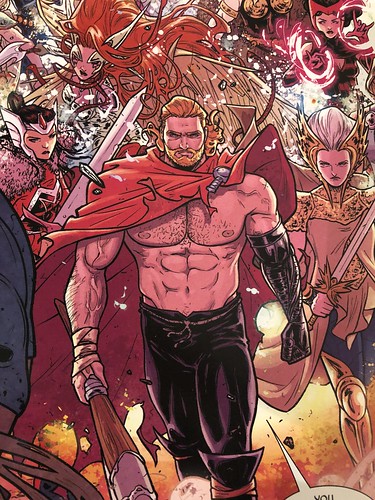
All seven paperbacks of the Mighty Thor, by Jason Aaron. Some of this was prep for the next Thor movie, and some of it was just because this is an outstanding run of comics. If you're not familiar, at the start of the run the Odinson has lost the power to lift Mjolnir, the hammer of Thor. Things are looking dire, when suddenly a new Thor appears and she's lifting the hammer just fine. Who is she? Where did she come from? Since this series is now a few years old, I'll go ahead and give the rest of the spoiler:

The new Thor is Dr. Jane Foster, and she has a problem. She's dying of cancer, and every time she lifts the hammer and becomes Thor she is healed of her chemotherapy, which means that being the mighty Thor is slowly killing her. This puts a ticking clock on the whole series, even as a ticking clock is also placed on Thor and the gods of Asgard, as the destroyer of gods is slowly coming for them. All that stands between them and oblivion is the mighty Thor, but she also stands on the brink of death. This is a story of heroism, sacrifice, family, and acceptance, as well as good old fashioned superheroes punching things. Also, the loss of his hammer leaves the Odinson with a costume of cape, pants, and no shirt, so there's also a lot of this:

Odinson and friends

Truly, a comic with something for everybody. I can only hope this is the costume they go with for Chris Hemsworth in the next movie.

Midnight Nation by J. Michael Straczynski. This was a reread of the first comic I ever bought monthly that wasn't about superheroes. It's a story of loss and redemption starring police officer David Grey, who sees something unexplainable on a call and finds himself on a journey across America's forgotten underside to save his soul, accompanied by a woman who might be an angel or might be a devil meant to lead him to his fate. This was right when Gary Frank's art was in the "very realistic" phase but right before it slipped into "everyone has a grinning rictus of terror and looks at least 40 years older than they should" phase, so it tells the story well. I don't see this book referenced a lot, which is sad because it's really well done.

Orbiter, by Warren Ellis. The space shuttle Venture, missing in space for ten years, crash lands in Florida. It's covered in alien technology, and only one mute crew member remains inside. Where have they been? What happened to them? Why have they returned? Can the trio of specialists brought in to discover the truth solve the mystery? What does it mean for humanity if they do? This is a good science fiction story, and Colleen Doran's art is great. Again, I rarely if ever see people talk about this book, which is sad because it's good.

As for what's next on the comic reading list, I haven't decided yet, but I have a few more things sitting around waiting to be read.

Sunday, April 19, 2020

Books and a Snack

"You must be reading so much during quarantine!"

Someone said this to me the other day, and I'm not sure that all of my friends get that "working from home" doesn't mean "laying around on my couch reading books". I am reading some, though, and the last time I counted up books for my year end tally was at the end of February, so here's everything I've read since then:

Movies (And Other Things) by Shea Serrano is a funny walk through a bunch of movies that Shea and I apparently have in common as favorites. Each chapter asks a question (Who had the worst death in "Kill Bill"? Did the Rockford Peaches make the right decision trading Kit? If all the high school movies were one movie, who would Regina George's friends be?) and then argues the way to the answer along with some funny illustrations. There are some thoughtful points here, and also some reminders that I should see some of these movies again if it's been too long since last time I did.

I like Robert R. McCammon, but Tales from Greystone Bay is too short. Each of the short stories here is a little interesting, but there are only three in the whole book, so I read it in less than a day. All three stories could have been fleshed out a little more, into novellas, and this would have been a lot better.

Harbor, by John Ajvide Lindquist, is an odd sort of horror story, starting out with an ordinary family and slowly building to ancient god-monsters, ghosts, human sacrifice, and destruction. In the middle of Scandinavian winter, Anders and Cecelia take their daughter, Maja, across the frozen channel to see the lighthouse. Somewhere on the way home, in clear weather and with their backs turned for only a second, Maja vanishes. Anders returns to the island a few years later, drunk and broken, and discovers that Maja isn't the only one to disappear from the village, but instead that one person disappears into the sea every year, and has for hundreds of years. There's also a weird subplot about a magic symbiotic insect that lets the host control water, which is the part of this that was really odd. This was marketed as horror, but not really scary or disturbing.

The Fortress at the End of Time, by Joe McDermott, was much more interesting. The entire novel is a long confession from Ronaldo Aldo, an Ensign from Earth stationed at the Citadel, the farthest human colony. Humanity is connected by the Ansible, a faster than light link that lets them transmit things and people along its length, sort of: patterns are sent along to Ansible and then assembled out of raw materials at the other end, so Aldo is actually a clone of Aldo, and if he gets promoted off of the Citadel, the Aldo sent to the next colony will be another clone, leaving the original and the Citadel clone behind. The Citadel is the last outpost of a century old galactic war, forever listening for the enemy's return, and Aldo will do anything to escape from it. As his confession unfolds, we find out exactly how much of anything.

Lev Grossman's Warp is a non-event. The story of Hollis, a recent college graduate still living near his school and struggling to force himself to get a job and become an adult, is like a worse version of "Catcher in the Rye", a feat I didn't think possible.

F. Paul Wilson's The Keep pits evil against evil in the Romanian alps of World War II. A garrison of Nazi soldiers is warned by the village not to spend the night in the Keep, the ancient fortress towering above them, but the soldiers pay them no mind. By the end of the first night, two soldiers are dead, and another dies each night, killed by an enemy that moves through shadows and drains them of blood. Trapped in the middle of the struggle, a Jewish professor of folklore and his daughter must decide whether to side with the evil of the supernatural or the evil of humanity without becoming monsters themselves.

Masked, a story collection edited by Lou Anders, is a fantastic set of superhero stories, written by some of the biggest names in the industry. Authors include Gail Simone, Bill Willingham, Mike Carey, Peter David, and more, and all of the characters are originals. There are some great stories in here, and the one that finishes the book was amazing.

Like I said at the beginning, though, reading isn't all I've been doing. I've also been sitting at my new desk a lot for work. Since my new desk is right next to my kitchen, a problem a lot of my friends are having (I'm not naming names, but one of my friends set up her work from home station on the second floor so that every time she contemplates getting a snack she has to decide if it's worth a trip up and down the stairs), I'm struggling with the idea of having snacks only feet away. I'm also trying to eat better in isolation, going lower carb and looking for healthy snacks, and I landed on nuts. I'm allergic to some kind of nuts, but I love peanuts and cashews. In perusing the nut selection at Kroger, though, I discovered that getting spiced, flavored nuts adds a dollar or two per can, and I can just do that myself for cheap.

So...

Homemade Spiced Nuts

1 egg white
2 cups nuts (unsalted or lightly salted)
1 tablespoon brown sugar (the recipe called for 3, but like I said I'm trying to cut back on carbs)
4 tablespoons total of spices

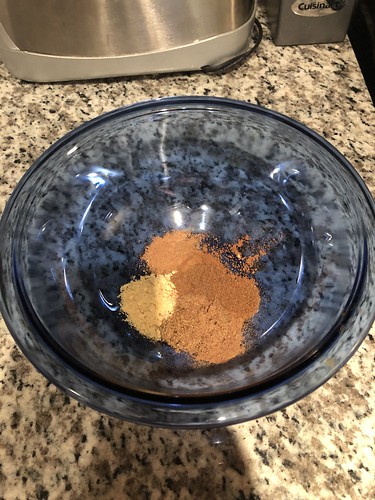
You can use whatever kind of spices you want. The recipe wanted oregano, thyme, parsley, and chili powder, but again, this is up to you and what you have in the cabinet. This time, I wanted something mustard based, and a lot of recipes pair mustard with cinnamon, so I went with dry mustard, cinnamon, nutmeg, and Chinese 5 spice:

Homemade spiced nuts

Preheat your oven to 250 F.

Mix the egg white into the spices:

Homemade spiced nuts

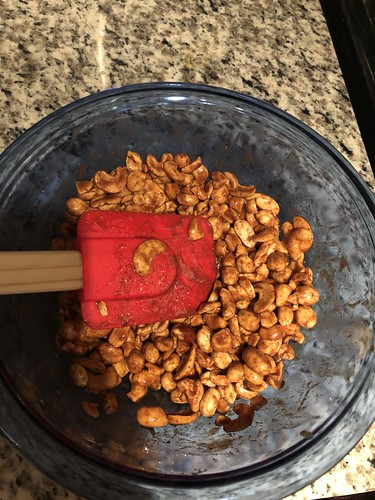
and then add the nuts and stir them around to get them really coated:

Homemade spiced nuts

Spread your nuts out on a cookie sheet:

Homemade spiced nuts

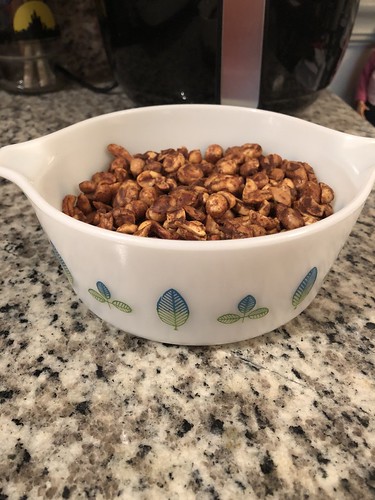
Bake for 15 minutes, then stir them around a little on the sheet (some of them might be stuck together, so break them up a little with the spatula), bake for 15 more minutes, stir again, then bake for 15 more minutes and take them out. They'll be hot and soft, so leave them alone on the cookie sheet for 15 more minutes, then put them into a container:

Homemade spiced nuts

and you have homemade spiced nuts. The recipe said they will keep for 5 days as long as you keep a lid on your container, but these aren't going to last five days.

If you're wondering how mine turned out, they're good, but I can't taste the mustard at all, and it might have been a bit of a waste. They're still good, though, and I've been munching a handful every time I pass my desk even though they are supposed to be for work this week.

For the next batch, I'm thinking of going for an Indian sort of mix, with curry, ginger, and garam masala. That should be low key delicious.