Friday, March 21, 2014

This doesn't look anything like it does on "Revenge"

Yesterday I got to visit four different airports, which is a one day record for me. My ticket said that I was only going to three, but for some reason my Knoxville to Philadelphia flight made a brief stop in Washington, DC, to let some people off of the plane.

That's when it got a little strange.

"Passengers continuing to Philadelphia will also need to leave the plane. Please take all belongings with you."

"Are we getting on a different plane?"

"Please get on the airport shuttle."

I don't argue at the airport, even when it doesn't make any sense. Arguing gets you kicked off the plane or put on a list or renditioned to a cheerless solitary cell in a prison that doesn't exist on any maps, so I just got off the plane and got on the shuttle. The shuttle drove around the tarmac at Reagan National, then reached the terminal, where we got off and were directed to get onto another shuttle. This shuttle also drove around the tarmac, and then we got off of it and back on the same plane.

"Please consult your boarding pass to locate your original seat number."

All that was missing was a cheery rendition of "The Merry Go Round Broke Down" on a circus organ.

Things got a little more absurd when I reached Philadelphia. You know what kind of planes fly from Philadelphia into Islip, New York?

Tiny ones:

plane

That is the smallest plane I've ever flown on. It has propellers. The plane that my dad flew into the bush in Alaska to hunt caribou might have been bigger than that, and that plane landed on grass, in a field. Not only that, but it was filled with people from the city and Long Island with their heavy Brooklyn and Long Island accents, so for the duration of the flight it sounded like I was at Thanksgiving with Dad's family. The resemblance was so strong that later, when the flight crew and I were out at the curb waiting for our rights and the flight attendant loudly asked, "Whay-uh the fuck is the God damn ayuh-port shuttle?" I thought, "Nanny? Is that you? Do you need another can of Meister Brau?"

The resemblance was uncanny.

Sean arrived moments later, and after we exchanged pleasantries he presented me with what I can only describe as Sophie's Choice:

"Do you want to go get something to eat?" Yes. I have eaten a scone today. "Or do you want to go see the Big Duck?"

Or? As in "not both"?

"We can only do one?"

I must have looked stricken, because Sean immediately clarified:

"No, no. We can eat and then go see the Big Duck, or go see the Big Duck and then go eat. They're both right near each other."

Thank God, otherwise I would have been really, really hungry, because there was no way we were skipping the Big Duck:

Big Duck (3)

Originally constructed as a marketing gimmick to sell ducks and duck eggs:

Big Duck (5)

it is now, as advertised on the sign, a museum and gift shop. It is also awesome:

Big Duck (1)

Big Duck (2)

Big Duck (4)

Big Duck (6)

The lady inside and I got to talking about other buildings shaped like things (the architectural term for this is a "duck", in honor of the Big Duck, which is on the National Register of Historic Places) and I noticed that she didn't have any examples from Tennessee even though she had pictures of all sorts of other ducks from around the country.

"You've never heard of the Flying Saucer House by Chattanooga? Or the gas station shaped like an airplane in Powell?"

"No! Send me photos!"

She ended up writing out her address for me, so that I can send her pictures of our odd shaped buildings in Tennessee. I am a cultural ambassador for the Volunteer State, people.

After the Big Duck (which may be how I refer to all experiences from now on; "Well, I was born in 38, BBD" or "I flew back to Tennessee on Day 5, ABD") Sean drove me through South Hampton, the setting for the TV show "Revenge" and the rumored geographical area for Ina Garten sightings. This is where I discovered, once again, that television has lied to me.

"This doesn't look anything like it does on TV."

"That's because they film in Malibu. But look, they used that Pottery Barn as city hall."

There are about three blocks of South Hampton that look like "Revenge", and the entire rest of the town looks like the slightly seedy suburban sprawl outside of any large metropolitan area, except for the beach:

the beach (1)

Endless horizon and crashing waves? Yup:

the beach (2)

the beach (3)

Big houses right up against the water? Yup:

the beach (4)

Peaceful solitude during which you can look for shells and plot the destruction of your enemies? Yup:

shell (1)

shell (2)

That looks just like it does on Sunday nights.

Now, I have to go get showered, so that we can get a New York bagel.

And then see a haunted windmill.

Saturday, March 15, 2014

Tied to New York

I've had a pretty bad cold for the past week, so I haven't gone anywhere, done anything, or cooked anything of interest. I went to work a few times, went to the store a few times, and mostly lay on the couch blowing my nose and watching really awful daytime television.

I'm not kidding about how awful it was.

I watched a TV-edited version of "Burlesque".

I stared into the abyss, and it also stared back into me.

Today I was feeling marginally better, and I needed supplies from the store (in the last five days I have consumed three gallons of orange juice, a gallon of cranberry, and a half gallon of grape; I am full of vitamins, but feel like I'm on some kind of weird juice diet), so I decided to venture out to shop and get the mail. On Saturdays I usually do my rounds of the thrift shops, but today I just wasn't feeling it so I decided to hit the one close to the grocery store. They didn't have any Pyrex, not even the clear kind that I usually don't buy, but I did find an ugly tie that made my eyes glow and my heart sing. It wasn't just me, either. When I brought it to the register, the girl looked at it for a moment.

"Wow. That's... a tie."

"It sure is!"

While I was picking it out, I noticed this other tie:

NYC tie (1)

and thought, "Hey, that's the city seal for Albany!"

I know what the Albany city seal looks like because I used to live there, and I saw a statue of the seal a number of times when I was downtown. Since I will be travelling to New York this week (Long Island, not Albany) I thought that finding this tie today might be an omen, and I was buying another tie already, so I brought this one home, too.

Where I discovered that it's not the seal of Albany.

Here's the tie:

NYC tie (2)

and here's a picture of the statue downtown that I took several years ago:

assiduity

You can see where I got confused. They're similar, but Albany has a ship above the shield, and the stuff on the shield definitely isn't what's represented on the tie. Even if you consider that the tie has a lower level of detail, what's going on in the center is definitely not a beaver above some sheaves of grain. It's... a propeller? Maybe? What would have a propeller in the 1600's?

Then my knowledge of my home state kicked in: New York was originally a Dutch colony.

That's a windmill.
I googled "New York founded in 1625" and discovered that I was close. The tie is a city seal: New York City.

Where I will be next Saturday.

Possibly wearing that tie.

Sunday, March 2, 2014

A Slice of Pie Day with a Scoop of Lois Lansesanity

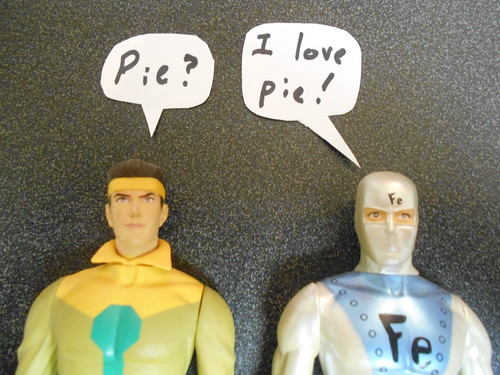
Say, how do you feel about pie?

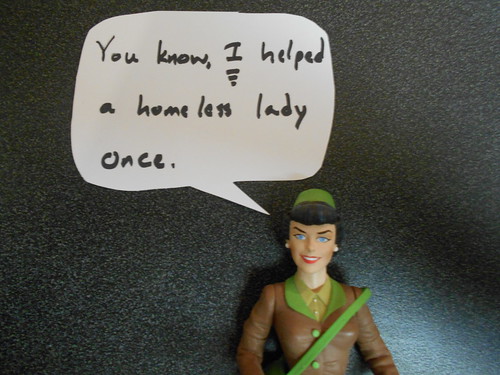
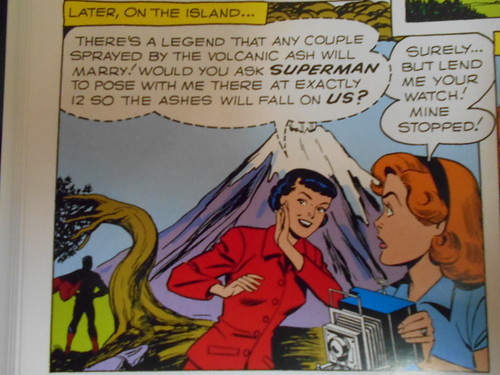
figures in conversation (1)

Oh, good. I hope a lot of my friends feel that way.

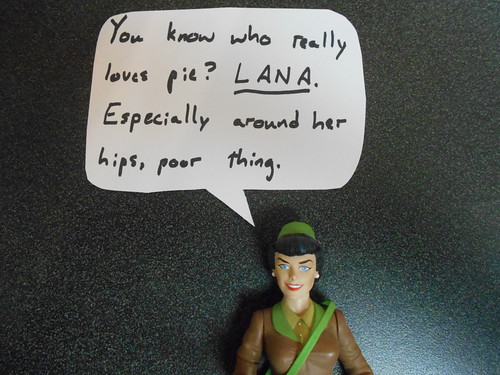
figures in conversation (2)

Lois, that's not very nice.

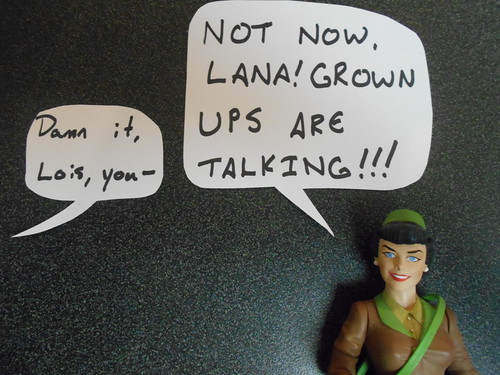
figures in conversation (3)

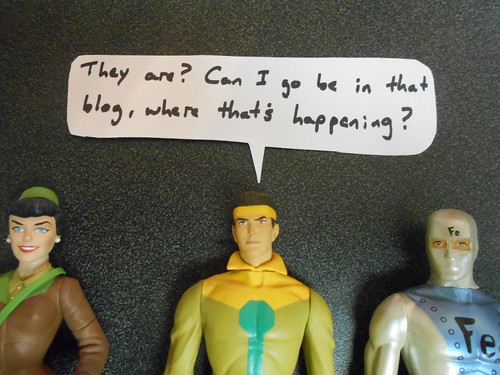
figures in conversation (4)

I'm not even having this conversation.

The reason why I was asking about pie is that I have agreed again this year to participate in Pie Day, a fundraiser for the university's Alternative Break Programs. I did it last year, and even though I'm not going on a break trip this year I still want to help. I may ask people to donate my pies specifically to the trip working with LGBTQ populations in New York City, but I'll probably just have it go into the general fund and let the office allocate my help however they think is best.

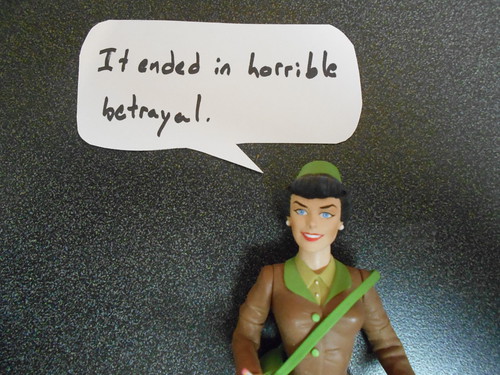
figures in conversation (5)

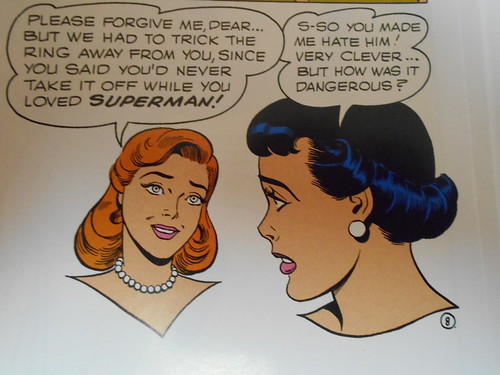
Really, Lois? How did that end up working out?

figures in conversation (6)

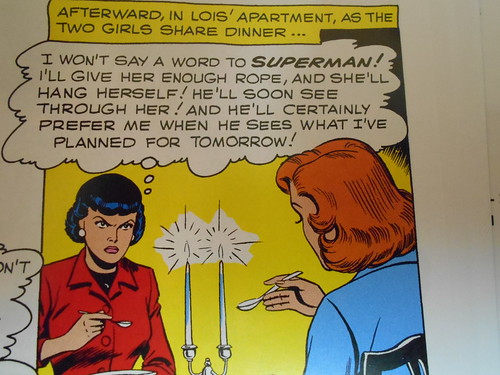
Of course it did.

figures in conversation (7)

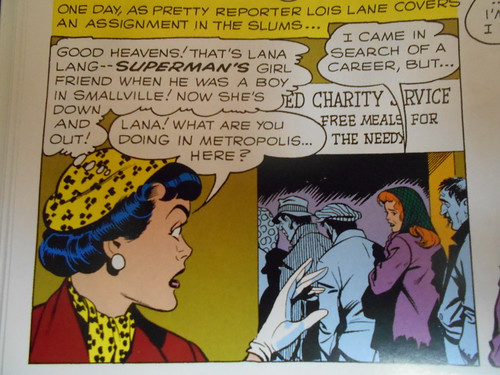
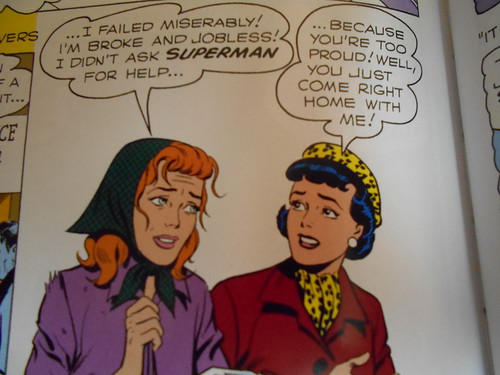
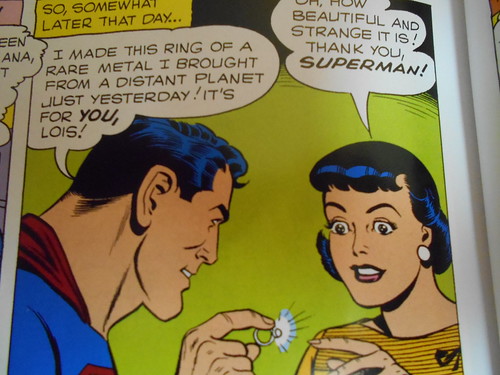
Our story opens in downtown Metropolis, where Lois is covering an assignment "in the slums", because it was totally ok to call economically depressed neighborhoods the slums in 1959. Scanning the line at the soup kitchen, Lois spots a familiar face:

"Superman's Girlfriend Lois Lane" #7

"Superman's Girlfriend Lois Lane" #7

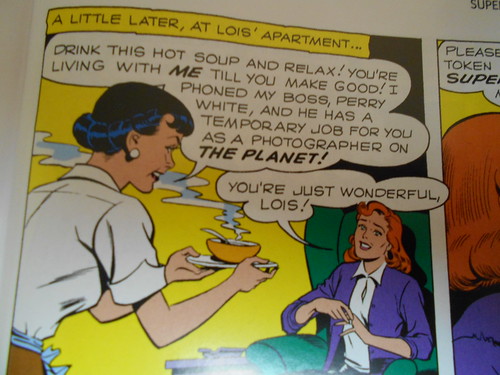
Lois has only met Lana one time before this story, so she doesn't hate her yet. In fact, she's actually helpful:

"Superman's Girlfriend Lois Lane" #7

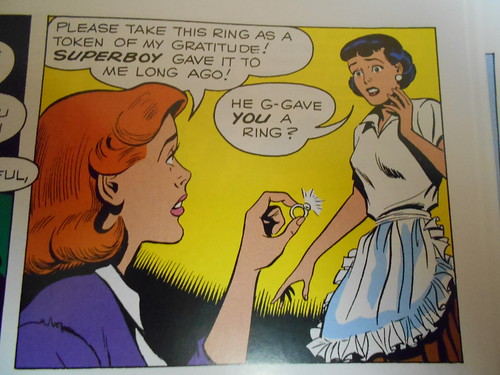
Lana immediately tries to repay Lois' generosity:

"Superman's Girlfriend Lois Lane" #7

And that's the exact moment when a rivalry lasting the rest of their lives is born. (I'm not kidding. Despite the fact that both of them date other men over and over, Lois and Lana will continue fighting over Superman until Lana's horrible death at the hands of Lightning Lord and the Legion of Supervillains, a sad story for another day.)

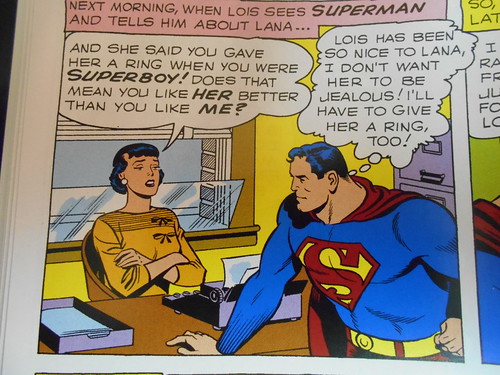
Lana goes on to explain a story of how Superboy gave her the ring to make up for an injury to her finger after a bullet ricocheted off of him, which is a fairly normal occurance in the lives of people around Superboy. Lana treats the ring that she's had since she was a teenager as no big deal, but Lois spends the entire night seething, a fact that's glaringly obvious when she immediately mentions it to Superman the next day:

"Superman's Girlfriend Lois Lane" #7

Seriously, when Superman says, "I don't want her to be jealous" he might as well just say, "I don't want her to be Lois", because we all know that she's insane. He tries to head her off at the pass:

"Superman's Girlfriend Lois Lane" #7

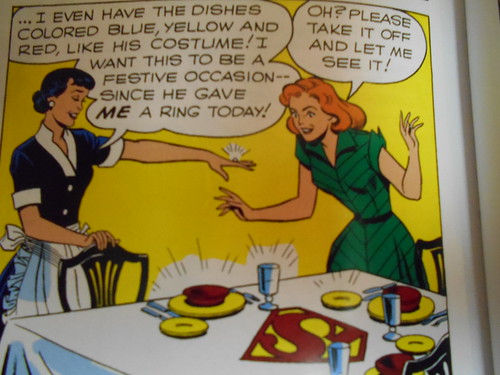
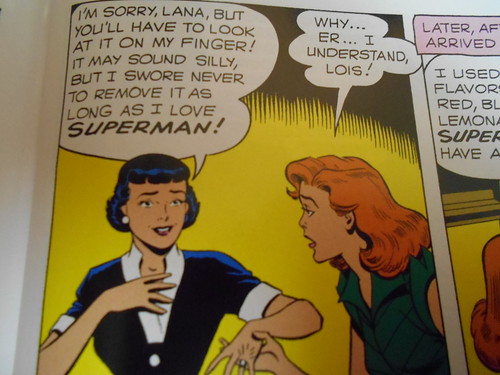
and Lois decides to both plan him a dinner party and immediately brag to Lana:

"Superman's Girlfriend Lois Lane" #7

"Superman's Girlfriend Lois Lane" #7

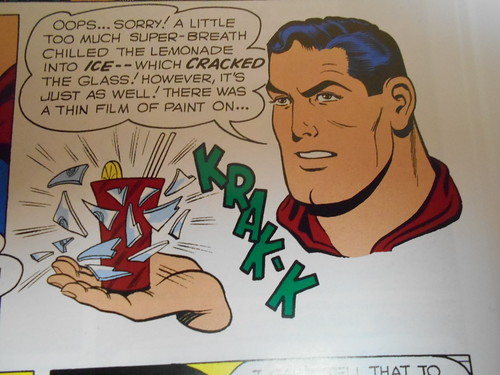
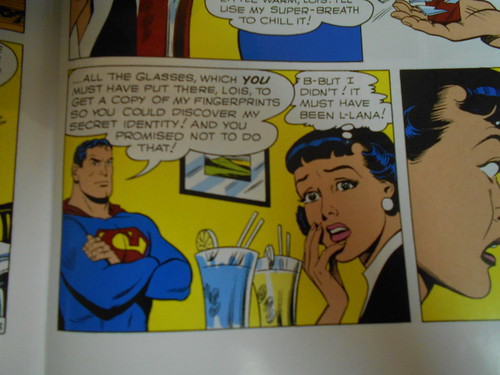
Dinner doesn't go quite according to plan, though. Superman has barely sat down to eat when he suddenly becomes furious and superchills his lemonade with super-breath, destroying the glass. And why would he do such a thing?

"Superman's Girlfriend Lois Lane" #7

"Superman's Girlfriend Lois Lane" #7

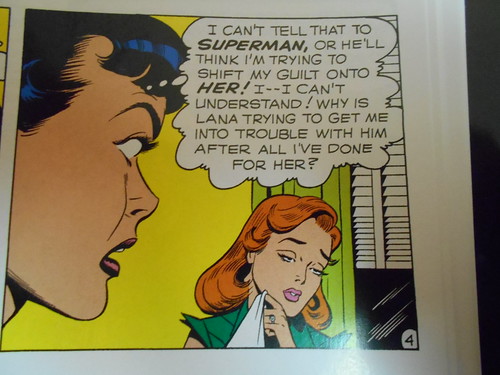
Lana? Dear, sweet, innocent Lana?

"Superman's Girlfriend Lois Lane" #7

Ladies and gentlemen, I give you Lana Lang, Queen of Sabotage. Not only does she manage to ruin the dinner party, but in just one panel she not only conveys complete disinterest in Lois' stupid drama but also does so while flashing her offensive ring at the same time.

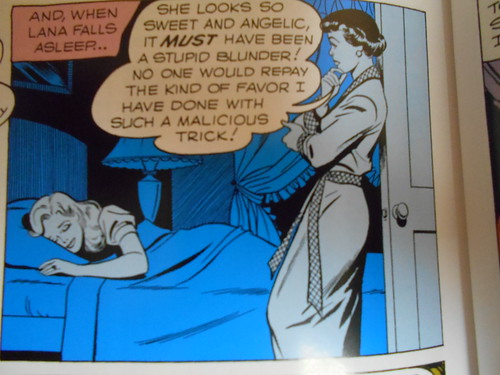
She has no idea, though, that she's dealing with a woman who is completely insane.

"Superman's Girlfriend Lois Lane" #7

Lois is watching you sleep and talking to herself in your bedroom, Lana. GET THE HELL OUT OF THERE. The calls are coming from inside the house. Seriously, imagine waking up in the middle of the night with that freakshow standing over you, babbling to herself.

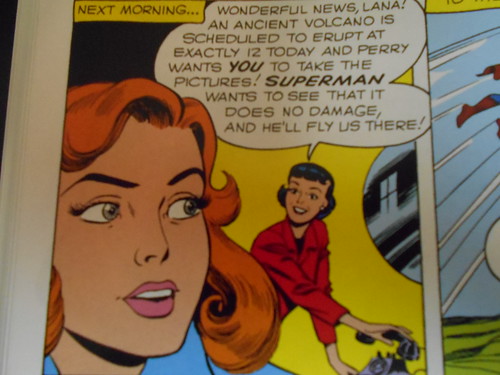
Fortunately, Lois is immediately distracted the next day:

"Superman's Girlfriend Lois Lane" #7

Why does she look so happy?

BECAUSE SHE'S CRAZY.

"Good news, Lana! Thousands of people are about to suffer, and some might even die! Get your camera!"

Lois, being Lois, even manages to turn this impending doom into an opportunity to throw herself at Superman:

"Superman's Girlfriend Lois Lane" #7

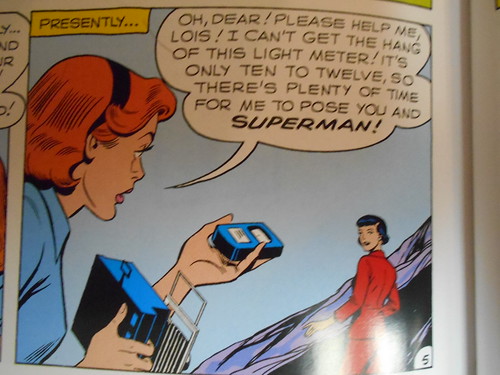
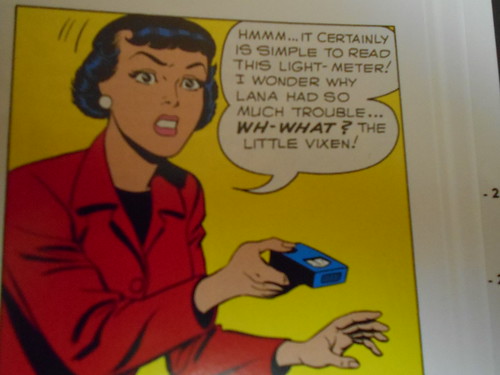
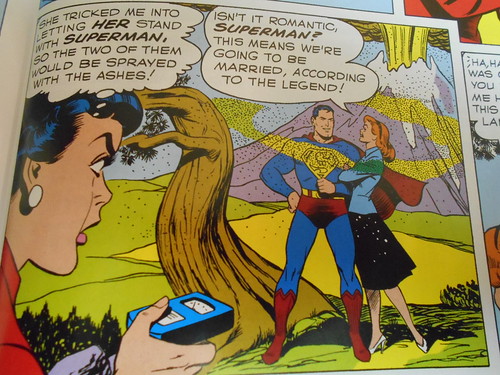
Unfortunately for her, though, Lana remains five moves ahead of her on the chessboard of love:

"Superman's Girlfriend Lois Lane" #7

"Superman's Girlfriend Lois Lane" #7

"Superman's Girlfriend Lois Lane" #7

Lois, you might want to start taking some notes. Or surrender. Lois, being Lois, decides to plot out an even better scheme while death-glaring Lana over dinner:

"Superman's Girlfriend Lois Lane" #7

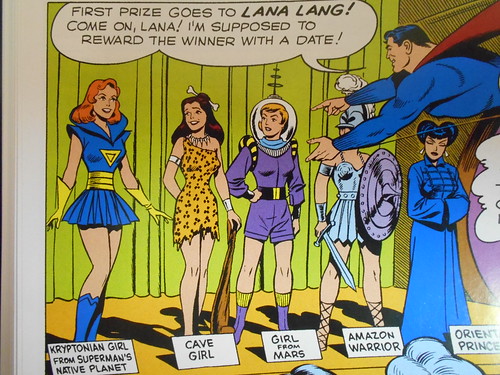
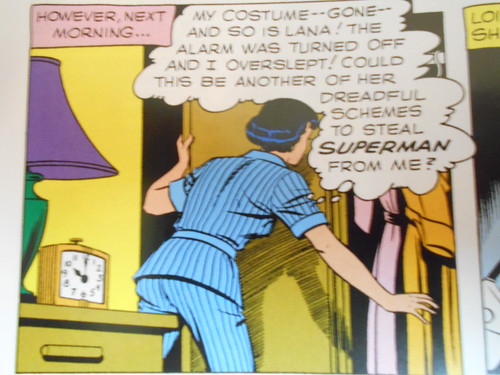
Tomorrow, you see, is a gala event honoring Superman, capped off with a female-only costume contest. Lois stays up all night sewing the perfect winning costume, but once again she's out of her depth, as her all-nighter ends in further disaster:

"Superman's Girlfriend Lois Lane" #7

"Superman's Girlfriend Lois Lane" #7

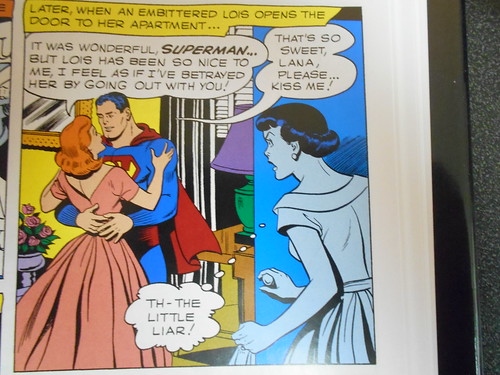
Has Lois finally met her match? And is Lana really the heartless man-stealer that she seems to be?

"Superman's Girlfriend Lois Lane" #7

And why does all of this turn Superman on so much?

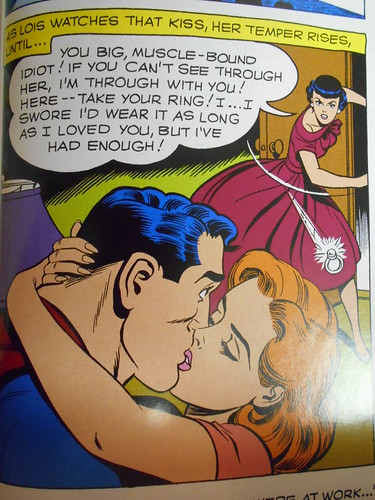
Lois finally reaches the end of her rope:

"Superman's Girlfriend Lois Lane" #7

but it turns out that Lana was just trying to help her:

"Superman's Girlfriend Lois Lane" #7

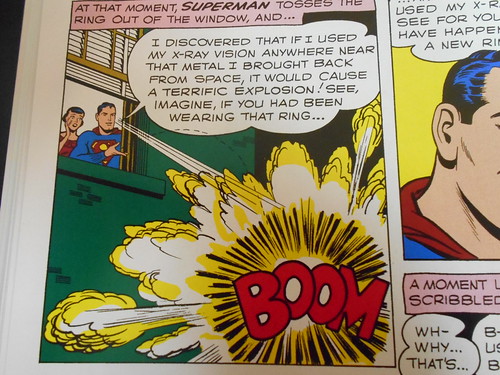
by keeping her from exploding:

"Superman's Girlfriend Lois Lane" #7

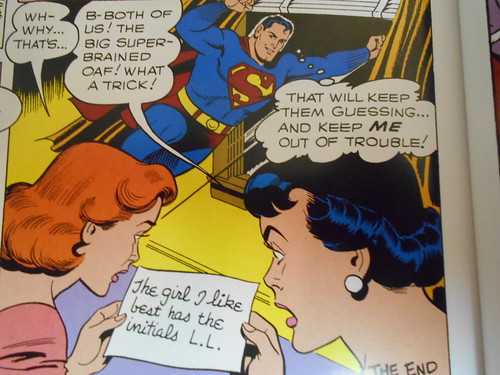
That's somehow not good enough for Lois, though. Now that she's not going to blow up, she demands that Superman write down which one of them he loves the most:

"Superman's Girlfriend Lois Lane" #7

And that's why I said that Superman was turned on by this whole thing.

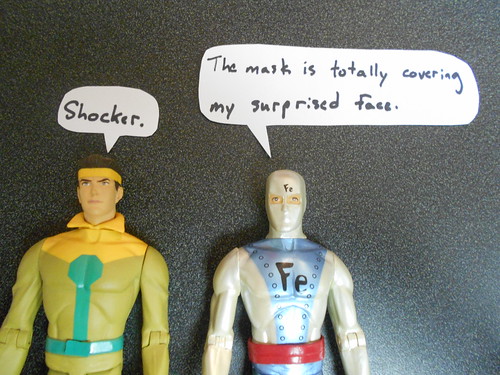
figures in conversation (8)

What? No. That's not the moral of the story at all.
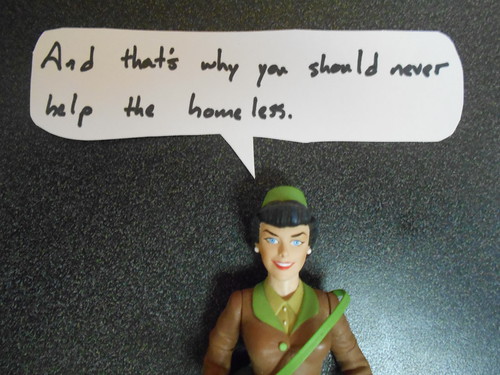
Unless you're Lois.

Thursday, February 13, 2014

Snow Day 2014

I am off work today, because we are having a snow day. A couple of weeks ago we had a snow delay because we got about two inches of snow, which is the most we've ever had while I lived here. Then we had a storm last night that delivered anywhere from three inches (here) to eight inches (the other side of town), and that was it for Knoxville.

I'm definitely not planning to leave the house unless I run out of things to mix vodka with (don't worry, I can walk to the grocery store), but I figured I'd go out and clean off the car in case it snows again tonight or, God forbid, we get freezing rain.

While I was out doing that (in long sleeves and a sweater, since my coat is on the back of my office door, where it is of no help to me in any way) I took a quick walk around the apartment complex to snap some photos.

Behold, the most snow I've ever seen in Knoxville:

February 13, 2014 (1)

February 13, 2014 (2)

February 13, 2014 (3)

February 13, 2014 (4)

February 13, 2014 (5)

February 13, 2014 (6)

February 13, 2014 (7)

February 13, 2014 (8)

February 13, 2014 (9)

That's it for me and outside today, I think.

Saturday, February 8, 2014

Tickets to Nowhere

Do you know where you were on June 23, 1988?

It was a Thursday. Does that help?

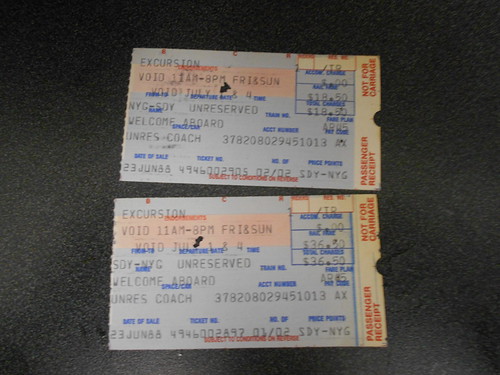
I'm asking because I have an idea that the book I'm currently reading, E.M. Forster's Maurice, was on the train, between New York City and Schenectady. It's just a guess, but a somewhat educated one, based on the pair of ticket stubs that fell out of the book yesterday while I was reading it:


They're round trip tickets, purchased on June 23. I didn't recognize the station designations, so I googled them, and found out that my book can never take this train journey again. While the stop at Schenectady still exists (and is in a terrible part of Schenectady, even by Schenectady standards), NYG was the abbreviation for the New York City Grand Central Station terminal, which Amtrack stopped using in 1991. Trains going to New York City now go to Penn Station, as I used to when I took the train fairly often from Albany to Penn Station in the early 2000's.

Two things occur to me as I look at these weird, random tickets, wondering how this book got to Tennessee and why a pair of 25 year old ticket stubs were still inside:

1) The price of Amtrack tickets has increased quite a bit: cost of the round trip in 1988 ($55) barely covers half the cost of the trip today ($82). On the other hand, Amtrack is still a good value if you don't have access to random dirt cheap tickets on the Megabus. For eighty bucks you can sit in a comfortable chair, have a nice view of Southern New York state along the Hudson Valley, go get a snack from the dining car if you want, and not have to worry about gas, traffic, other drivers, parking, or any of the stress and hassles of taking your own car or getting stabbed to death by other passengers on the Greyhound.

2) Nothing falls out of e-books. I often find little notes, receipts, old grocery lists, bookmarks, and other scraps of paper in used books, like prizes in a Cracker Jack box.

Of course, Cracker Jacks don't still come with little metal or plastic prizes.

But they did in June, 1988.

Saturday, February 1, 2014

I Reread "The Front Runner" Just in Time for The Olympics

I spent most of this week rereading Patricia Nell Warren's The Front Runner, because I had a minor argument with a friend about it. When I was in junior high school, one of my fantasies was that someday, when I was a grown up, I would have friends who read as much as I did and we would talk about books and be smart. At the beginning of this week I was thinking that I should have just stuck with my dream of being an international assassin or an FBI agent instead, because I didn't want to reread this book, which I read for the first and only time in 1997. Anyway, my friend and I argued over whether or not this book was still relevant, with my friend arguing that we can still learn from this and that the feelings still resonate deeply when you read it and me arguing that this book is part of an outdated canon of gay literature that we've moved on from and really only has value as a kind of charmingly quaint antique.

Before we continue, let me say one thing, as I promised I would when I finished reading:

My friend was right about this book, and I was wrong.

I admit it.

I was wrong.

Now, let me lay this out for you. If you ever plan to read this book and you care about spoilers, you should stop reading now.

"The Front Runner", originally published in 1974, is a love story between two men. Harlan is almost 40, coaching track at a tiny private school in upstate New York after being fired from Penn State for suspicion of being gay. He is gay, which he discovered after a failed marriage to a woman, but has a personal rule never to date a student or athlete, and lives a mostly celibate life marked by occasional trips to the city to have one night stands. One night, Billy Sive and two other students show up at his door, having been kicked off of the track team at Oregon State for being gay. They've lost their scholarships, are less than a year from graduating, and two of them, Billy and Vince, are nationally ranked and have a chance at making the 1976 Montreal Olympic team. They need a coach, and they need shelter, and Harlan and the college president agree to take them in. After a rocky period of resistance, Harlan and Billy eventually admit that they've falled in love, and Harlan continues coaching Billy toward the Olympics. Along the way, they are outed, have a commitement ceremony, and Billy eventually makes the Olympic team despite furious protests and bigotry. He wins a gold medal, and then is shot and killed in the stadium by a sniper during his second race.

As I mentioned above, I read "The Front Runner" in 1997, the back half of my senior year in college. My senior year was the year that I had my first boyfriend and really struggled through whether or not I was gay, a brooding and depressed time when I took a lot of walks by myself, took a lot of black and white photos, and tried to figure out why I loved someone who didn't love me and if there was maybe a way to change that while also trying to figure out what I was going to do with my life when I graduated in less than a semester.

This was also the semester that the student union had a room all semester where they gave away books for free. The books were donated by Penguin, and all had slashed or missing covers and were marked "Not For Resale" on a couple of sides. I don't know what the response among regular students was, but among the English majors it was like Halloween and Christmas every day. Someone would whisper right before class started that the free book room got a new shipment, or they'd seen someone unpacking more boxes in the hallway, and as fast as we could we'd get down there to look over the tables, which were divided by subject, and take as many free books as we wanted. Looking over my bookshelves now, I see that I still have a surprising amount of these, somewhere between twenty and thirty. While I picked up books from a number of tables (from where I'm sitting right now I can see a book about vampire folklore, a dictionary of Catholic saints, and a copy of The Odyssey on my shelves, and I know they're all from the free book room), the vast majority of them came from the "Gay and Lesbian" table. My copy of "The Front Runner", which I've been carrying around since 1997 even though I never planned to read it again, did.

I'd never really been exposed to gay literature before this. I'd read books that had a gay character here and there, but never books about gay people being gay. I don't think I even realized that there was a such thing, or that it was published, and I was less than a semester away from graduating college with a double major in education and English. In 1997, we didn't have Amazon. We didn't really have much internet compared to what we have today, and pretty much the only place on television that we saw gay people was MTV and sometimes on Fox. I took these books back to my room and devoured them, but I realize in looking at them now that many of them were written in a very specific context: the immediate aftermath of the AIDS epidemic, when we lost most of a generation of gay men. Because of that, most of these books deal with loss. They're full of survivors and tragedy, and in my mind that connection was made for a long time, that most of gay literature is depressing because "gay" = "tragic", and the people always ended up alone and mourning. Even though "The Front Runner" was written well before many of these other books, it's also a gay tragedy, and I lumped it in with the other books from the early 1990's that I read at the same time.

This is why, when my friend argued last week that the book is still relevant, I immediately disagreed.

"No it's not. It's part of that whole 'being gay is tragic and terrible' school of thought, where it's ok to be gay for a little while but you can't be happy and you have to eventually be punished for deviating from the social norm."

"That's not true. The themes and ideas are still relevant."

"That book is old. I mean, yeah, the coming out theme and the idea of living honestly as who you are is still relevant, but all of that stuff about horrible bigotry and oppression and stuff doesn't really fit. We've come a really long way as a society."

"Really? When did you last read that book, anyway?"

"...1997."

"You should read it again if we're going to have this discussion."

I was so convinced of the validity of my stance that I went straight for my copy as soon as I finished my last book.

And, like I said at the beginning, it turns out that my friend was right, but I was, too.

We've come a long way as a society, but there are still a lot of relevant themes and ideas in this book. People still get fired for being gay; it happened to the women's soccer coach at Bellmont in 2010, long after it happened to Harlan in the book in the 1970's. Athletes still struggle with coming out, and still face bigotry and physical threats. If you're going to argue that point, you haven't been reading the coverage of the upcoming Winter Olympics in Sochi quite closely enough. Or you missed the story in 2012 when a legislator from Maryland asked a professional football player from the Baltimore Ravens to stop publically supporting marriage equality. Or you didn't read any of the online comments that accompanied articles about Tom Daley coming out as bisexual this year. And before you argue against the idea that homophobia is not only acceptable but also celebrated by a vast segment of our society, stop by and count the line of cars at the next Chick-Fil-A Appreciation Day or the number of signatures on the petitions to keep Phil on "Duck Dynasty".

Sure, we've come a long way. Gay and lesbian people openly serve in the armed forces. Several states have marriage equality. There are employment protections and hate crime laws. I live in a world for LGBT people that is markedly different from the one in which I first read "The Front Runner".

I'm just saddened to realize that you could change the dates in the story and still publish this book today.

A lot has changed, but some things haven't changed at all.