After the massive size of last year's report of all the books I read, I started a new project this year, where I give a monthly report. I think it's working out a little better, in that the eight or so friends who actually care what I'm reading can now consider it in smaller doses, but one of them complained this week that she still hadn't made it through my end of the year report from last year:
"It's like a wall of words. It goes on forever, and I get about halfway down and I just can't read anymore."
On the one hand, I get that. Writing that post was exhausting, and reading it probably also is. On the other hand, I kind of wonder how you're going to read a book if you can't make it through a blog entry, but hey, maybe I'm just being a bitch and responding poorly to criticism. That's also possible, and actually probably. With that in mind, though, I figured I might as well sum up the best of the 87 books I read. They're in no particular order, but I figure if they still stand out to me halfway through this year, then they probably actually were pretty good.
1) Peter Bracke's Crystal Lake Memories
I said this about it: Peter Bracke's "Crystal Lake Memories" really is the ultimate book for any fan of the "Friday the 13th" movies. Bracke spent over three years conducting over 200 interviews with producers, distributors, writers, directors, actors, stuntpeople, composers, costumers, makeup artists, and anyone else who worked on the film series, as well as reviewing studio documents and archives. What comes out of that is a fascinating oral history of the series combined with an almost overwhelming collection of images. There's at least one image on every page, but what really makes this book is the recollections and anecdotes from the people involved. While some of it is fascinating from a filmmaking perspective, delving into direction, casting, setting up special effects shots, challenging the ratings board, and funding, the stories of friendship, rivalry, backstabbing, endless takes, endless rewrites, drugs, sex, religion, and everything in between were compelling. I ended up rewatching almost all of the movies while reading this, and it really does make you see them in different ways. Also, that girl who played telekinetic Tina in part 7 is a real bitch. All of the other actors hated her, and she openly hates all of the other actors. Plus she's really, openly homophobic about her leading man.
This is clearly a labor of love for Bracke, because you don't spend years of your life interviewing people about movies that are most often considered trash unless you really, really love those movies. What I also liked about this, besides that it brought me greater enjoyment of the movies in question, is that it also serves as a tutorial on the moviemaking industry. By interviewing wardrobe, makeup, catering, extras, casting agents, producers, directors, writers, actors, audience members, special effects creators, electricians, set designers, cameramen, sound technicians, and everyone else involved in making the "Friday the 13th" movies, Bracke ends up giving a 360 degree education on the way a movie is made, and it's fascinating. Putting that education in the context of films that I already knew made it more interesting and easy to understand, and while this isn't the book for everyone it's definitely a good book for people who plan to work in the film and television industries.
2) John Hersey's Hiroshima
I said this about it: John Hersey's "Hiroshima" was a short, powerful read. While he could easily venture into sensationalism, Hersey sticks with matter of fact, direct accounts from survivors of the city, charting their journeys from minutes before the bomb was dropped to the decades after. Harrowing and often heartbreaking, the book conveys the horrors and consequences of war without being preachy.
I read this because one of my students was talking about reading it on Facebook, and I respect him, so I picked it up. This should be required reading for anyone who talks about war as a solution for the problems and threats facing our nation. I'm not saying we should never go to war, but we should be aware of what we are agreeing to do to other people, and understand that they actually are people who live, and hope, and suffer, and die because of decisions we make. They are human beings, just like we are, and we should think very hard about what we decided that it's necessary to do to them.
3) Laline Paull's The Bees
I said this about it: In Laline Paull's "The Bees", readers are thrust into a matriarchal dystopia where citizens are born to specific roles, deformity and disobedience lead to immediate death, and love of the queen trumps all other concerns. This tiny kingdom of women, where the few men are treated as princes whose only duty is to mate, is your local beehive. Flora 717, a lowly sanitation worker, is born in a time of crisis when the rains are heavy and the summer too short. The hive suffers under this crisis, but there are also hints of trouble within: deformities in the nursery, irregularities in the workers, rumors of illness in the hive, and then there's Flora herself, born with the power of speech and an inquisitive nature not found in her class. Exploring the hive, Flora is drawn deeper into the hidden secrets surrounding the queen even as she tries to protect her own secrets, leading to a confrontation that could destroy her and the hive together. This was a great read, full of detail and tension.
This was a fantastic piece of fiction. On the surface, it seems a little light and inconsequential, but it still sticks out in my head when I look at last year's list as, "Wow, that was a really good book." It was a debut novel from the author, and I look forward to more of her work.
4) Roxane Gay's Bad Feminist
I said this about it: Leonor sent me Roxane Gay's "Bad Feminist", and at first I wasn't really sure I would enjoy it. As a gay white male, a sort-of feminist essay collection by a sometimes-not-completely-hetero woman of color didn't really seem like something that I would really connect with, but I trust my friend's judgment and gave it a try, and I'm glad I did. Sometimes angry and blunt, sometimes funny, and at all times thoughtful and well-researched, I found that Gay and I had a lot more in common than I expected and felt, at times, that we were kindred spirits. We've both struggled with our weight. We've both worked at times in environments where we hear people saying derogatory things about minority groups that we happen to be part of. We've both fallen in love with seemingly perfect men who didn't love us back and were terrible for our self esteem. We also both have odd hobbies, both watch the same trashy television shows even though we know we should feel bad about it, and we both speak out about the things that bother us about our society. While I didn't agree with everything she said throughout the book, I did enjoy reading her thoughts and letting them spur my own introspection, and overall found the book engaging.
I didn't think I would connect with this book, but I found it relevant, resonant, and powerful.
5) Adrian Walker's The End of the World Running Club
I said this about it: My friend Jackie sent me Adrian Walker's "The End of the World Running Club", and it was a great book to read while I'm working on walking. It tells the story of Edgar Hill, an overweight 35 year old father of two living with his wife in a new house in Scotland. He drinks too much, he's not the best dad in the world, and he kind of hates his job, and on top of all of that the apocalypse arrives. The United Kingdom is devastated, and even though Ed and his family survive, he quickly loses them when a rescue chopper evacuates them while he's out foraging for food. His family has been taken to evacuation ships that are leaving in a month, and Ed has no choice but to follow if he's ever going to see them again. Falling in with a random collection of survivors, Ed and his companions must travel the length of a devastated Great Britain before the boats leave, while trying to find food, shelter, and fighting for survival against the remains of society. On top of all of that, Ed has to wage war with himself, with his poor fitness and health, with the mistakes of his past that continue to haunt him, and with maintaining the will and the drive to survive. I don't know if Adrian Walker is a distance runner, but he writes like one. As a person who is currently on my own quest for fitness, the entire book really resonated with me, including the realistic ending that everyone may not like. There are parts of this book that are really bleak (if you're a realist, then humanity behaves exactly the way you expect them to behave after a disaster), but overall it's very hopeful, and I enjoyed it.
I still think about this book while I'm out walking. Sometimes, when I'm tired, or halfway through my planned distance for a walk, quotes from it will surface in my mind and push me forward. It's possible that this book isn't as good as my brain thought it was, and maybe it just came along at the right time in my life when I needed to hear exactly this story, but I don't care. I liked it.
6) Kevin Roose's The Unlikely Disciple
I said this about it: Kevin Roose is a typical Brown University student: he parties, hooks up, drinks, hangs out in coffeeshops, has plenty of gay friends, and is a lifelong liberal from a family of liberals, which is why his family gets very, very worried about him when he decides that rather than go on a study abroad semester, he'll spend a semester undercover at Jerry Falwell's Liberty University instead. While enrolled at "Bible Boot Camp" he'll join a choir, go to nightly prayer meetings, attempt to save spring breakers, take classes that contradict everything he's been taught, and try to follow Liberty's strict 46 page code of conduct. Along the way, he finds both the expected and the unexpected, and does his best to bridge the "God Gap" between himself and the Christian classmates who surround him. "The Unlikely Disciple" was a really good read, at times touching, funny, thought provoking, and even infuriating.
I don't read a lot of books about religion, but it's sometimes a topic that I struggle with personally. I was so intrigued and moved by this book, which I bought at a church book sale, that I immediately ordered a copy for a friend. I haven't seen my own copy in months, because I let someone borrow it and they asked if they could let someone else borrow it, and off it went. The last update I got while walking across campus was a friend in the Haslam College of Business who said, "Hey! I have your book!" I know it has passed through at least three sets of hands already, and I may never see it again, but that's ok. I think people should read this book. I even recommended it as the "Life of the Mind" book that all freshmen read, but it didn't get picked. I may recommend it again next year.
I'm kind of surprised that this list isn't longer, but as I read through last year's list, there are a lot of books that I look at and think, "Yeah, that was pretty good, but..."
These six are the books that didn't have a "but" after them, so they must be the best.
Sunday, June 21, 2015

Thursday, June 11, 2015
Blair Witch Jell-O
When I still lived on Dutch Quad, I ate at the quad dining hall fairly often. We were given a certain number of meals for the week, but if I went down for lunch the lady working usually waved me through without swiping, which meant I could get lunch for free and save my prepaid meals for dinner a few nights a week. Dining hall food is dining hall food: sometimes it's surprisingly good, and there are some recipes that the staff did particularly well.
There were some nights, though, when the cafeteria served what the RA's and I referred to as "Blair Witch Dinner".
If it's been a while since you saw The Blair Witch Project, let me explain: the last third of the movie pretty much consists of the two surviving protagonists running through the woods before jerking to a stop and screaming, "WHAT THE FUCK IS THAT?" in terror while sobbing and pointing. That's pretty much what happened on the nights that the cafeteria served Blair Witch Dinner, too. You'd be dragging your tray down the serving line, talking to whoever you came down with, passing the chicken, passing some potatoes, passing the vegetarian entrée, and then JESUS CHRIST, WHAT IS THAT? WHAT IS IT? OH, GOD, OH, GOD, OH, GOD!
Sheer terror, in the form of food.
Nothing they ever served us at the Dutch Quad Cafeteria, though, ever reached the terror of last week's Antipasto Salad.
I have touched the soul of horror, and it is made of Jell-O.
This all started when I bought that Jell-O cookbook and decided to cook from it. I opened Pandora's Jell-O Box, and visited sorrow upon my kitchen. After successfully completing the Topaz Parfait super-dessert, I decided to try something more challenging, more daring, not stopping to think about how much more intense things could get when I wanted to eat something more challenging, taste-wise, than a dessert made from artificially flavored lemon gelatin and coffee.
I decided to try the Barbecue Salad.
I was initially pretty suspicious of this recipe. After all, it called for canned tomato sauce, vinegar, salt, pepper, and orange gelatin. One of those things is not like the others, a Jet among Sharks, but I assembled my ingredients and a stack of 7 ounce Pyrex 407s, which seemed the perfect size for individual servings of Barbecue Salad:
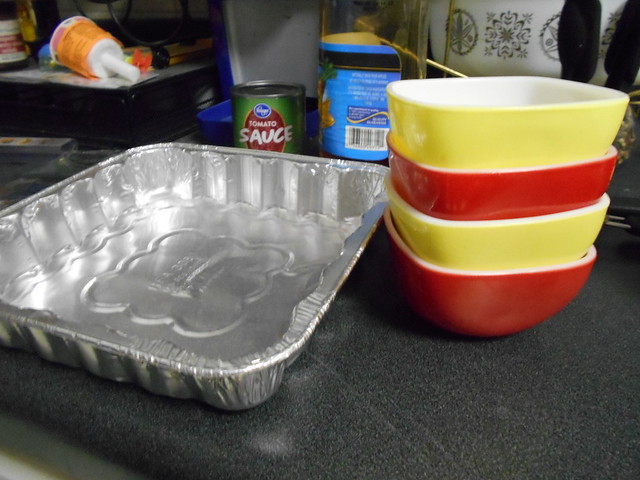
The recipe said it would make three cups, but I opted to use the fourth 407 to stabilize the other three, so that I could move them in and out of the refrigerator to set without them sliding around and spilling. I set about mixing the ingredients:
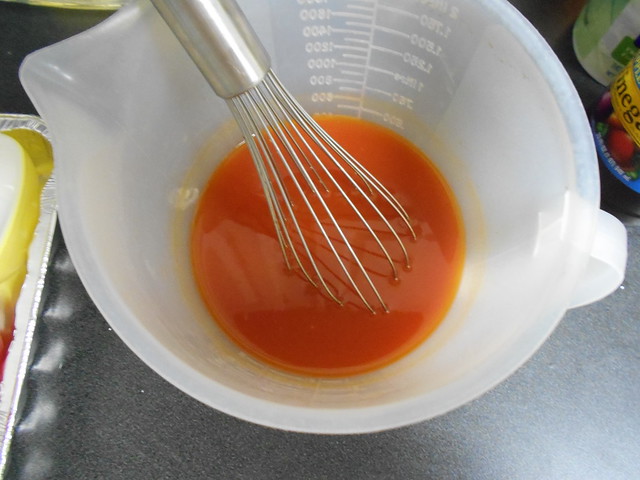
(I really need a 2-4 cup glass measuring cup if I'm going to keep doing things to Jell-O, because the boiling water is melting that plastic one a little more each time) and poured them into the 407s to set overnight in the fridge, after which they looked about like you expect tomato Jell-O to look:
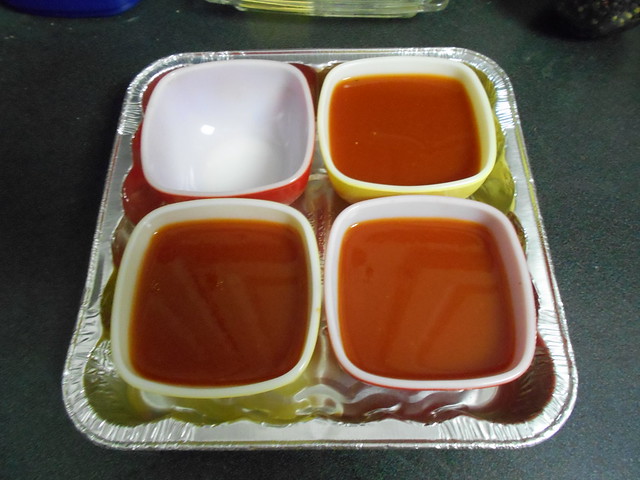
I dipped one of the bowls in a larger bowl of hot water until the Jell-O released from the bowl, and unmolded it onto a Pyrex Ebony plate of spring mix salad greens:
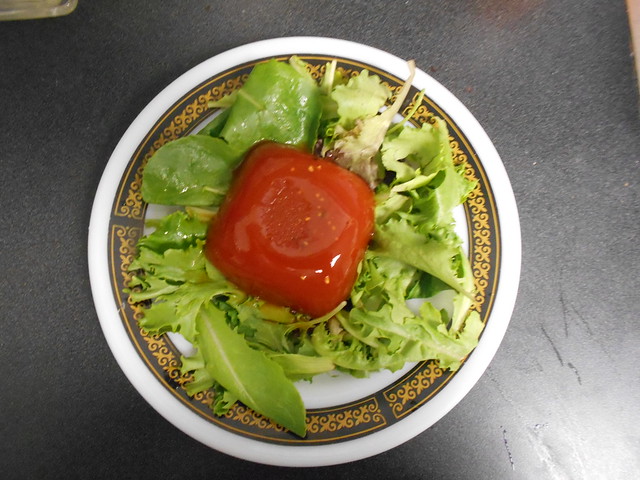
And then I ate it. After a little bit of experimentation, I figured out that the best way to do it was to slice a chunk of the Barbecue Salad off with the fork, spear a few leaves, and then eat the whole forkful at once. Believe it or not, it really wasn't that bad. It was like a really savory salad dressing, and didn't taste like sweet orange Jell-O at all. The combination of vinegar and tomato sauce was really acidic, but on the second night I topped the salad with a dollop of mayonnaise like the cookbook suggested:
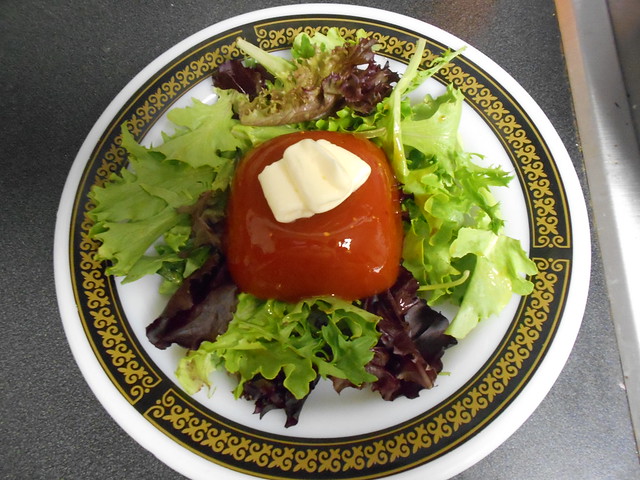
and it really wasn't bad. In fact, after I let it sit for a few minutes so that the Barbecue Salad could lose some of its chill and warm up a little, I was almost completely over the weird texture. I would actually eat this again, despite how disturbing the recipe sounded. Maybe I was wrong about the other recipes, too. Maybe the pictures weren't really as scary as they looked. Maybe I should try another salad, and see if I was again pleasantly surprised.
Maybe I should have quit while I was ahead.
I didn't, though. I pressed onward, turning pages and thinking until I arrived at the Antipasto Salad.
That's where this all goes to hell.
The Antipasto Salad consists of a lot of things you would put in an antipasto (olives, salami, pepperoni, Swiss cheese, celery, and onions, which I omitted), suspended in a mixture of lemon Jell-O, vinegar, and salt. Eager to try, ready to challenge myself in the kitchen and explore new things, I got to dicing:
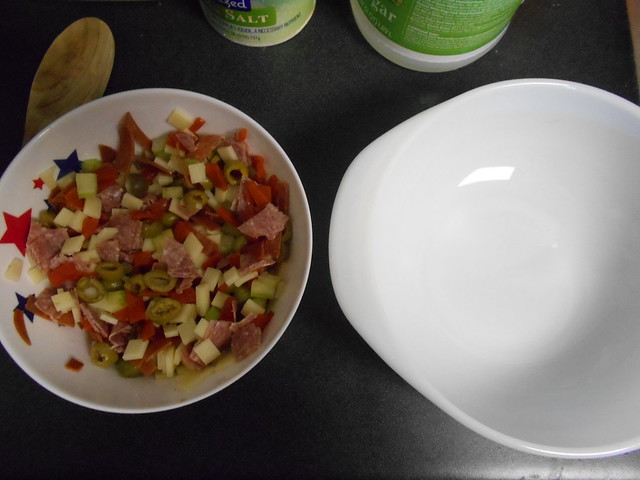
and then got to mixing the other ingredients in a Pyrex Opal 023. Unlike the last recipe, this one actually called for a little bit of technique: after mixing the boiling water, salt, gelatin, and vinegar, I had to add in ice cubes and stir for three to five minutes until the mixture partially thickened.
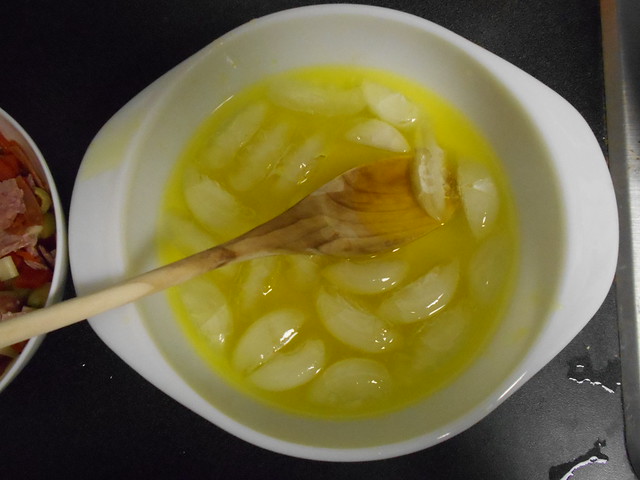
The reason for doing so is that when you add things to the gelatin, you want them suspended in it. Otherwise, they'll just sink to the bottom. After four minutes it was visibly thicker, so I scooped out the remaining ice cubes as instructed, added my ingredients, put the lid on, and put the whole thing in the refrigerator overnight to set. When I finished, it looked about how you would expect a bowl of Jell-O with hunks of cheese, meat, and vegetables in it to look:
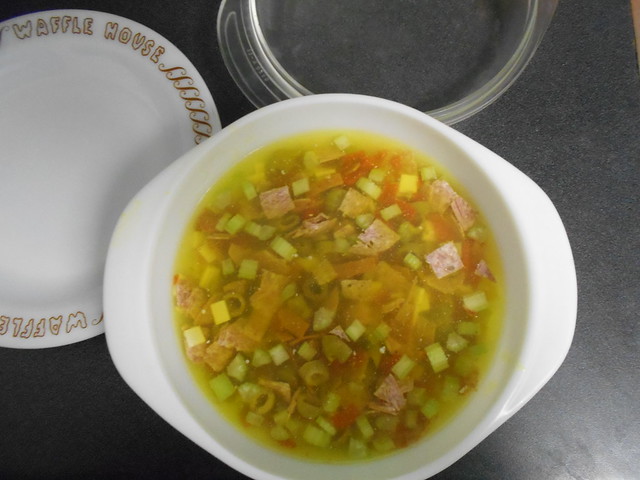
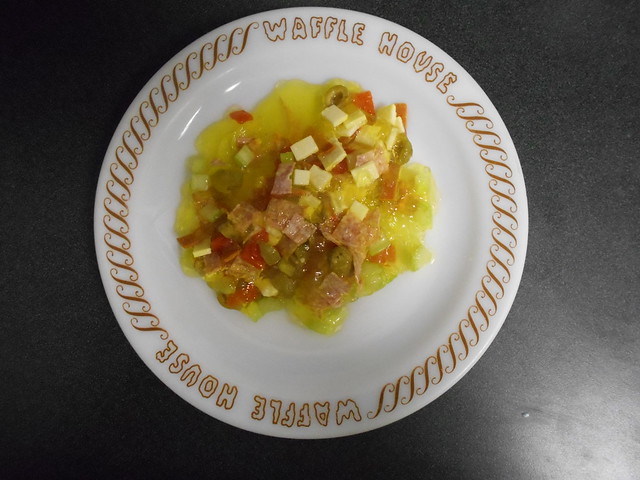
Perfect, right? I scooped a heaping spoonful onto my only Pyrex Waffle House plate:
and that's when things turned bad. The flavor wasn't terrible, and I tried to explain this to my friends. It tasted like a heavily dressed antipasto. The texture, though, is a bridge too far. Do you like chewing cold celery and chunks of cold cheese and cold salami after sucking a mouthful of thick, slimy liquid off of them? If so, this is the dish for you. It's not the dish for me. Right now, it's sitting in the refrigerator missing only that first spoonful.
When I went back to the refrigerator on the second night fully intending to try it again I thought about the chewing, the texture, having that in my mouth and having to chew it and feeling it slide around my teeth and my stomach gave an actual, physical lurch, so hard that I had to grab my kitchen counter.
My body physically recoiled from the memory of the Antipasto Salad.
I grabbed my book, left my apartment, and walked to a nearby restaurant for dinner. I did that again the next night. Since then, I've just pretended that it's not sitting in there, waiting, gelled and ready on the bottom shelf. It's going to be there forever, you know. It's not like it will go bad. The food is sealed in lemon gelatin like flies in amber, but the memory in my head is still squirming and alive.
I tried to put it all behind me, and moved back to one of the dessert chapters. I'd had success with dessert. Dessert is my friend. Dessert would never hurt me like salad would.
Dessert betrayed me, too.
I decided to make the Peach Gem Pie, which is basically Jell-O with peaches in a pie crust. I unrolled a premade pie crust into a Pyrex Visionware pie plate, lined it with parchment paper, and filled it with uncooked rice:
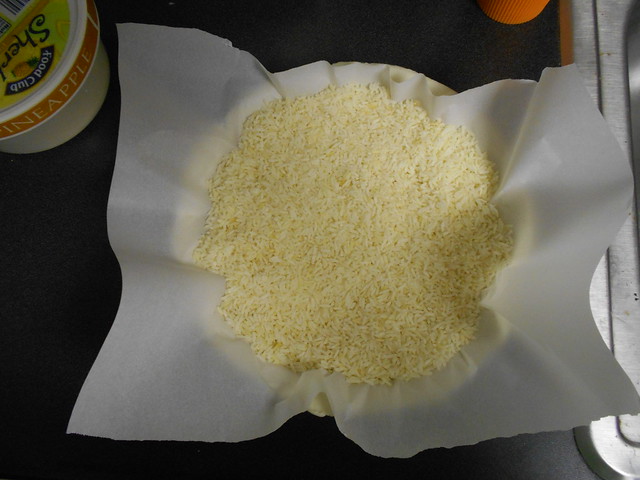
Leaving the rice in there while it bakes keeps the shape of the crust, and the parchment paper keeps it from sticking to the crust as it bakes. I forgot to use it once when I was making a quiche crust and had to pick a whole bunch of uncooked rice out of the bottom of the crust before I could pour in my quiche filling, and since then I've never forgotten again. Once the crust was done I mixed up the gelatin, stirred in some ice until it thickened quite a bit, added the peaches, and let it set. It looks about like you think a pie filled with Jell-O should look:
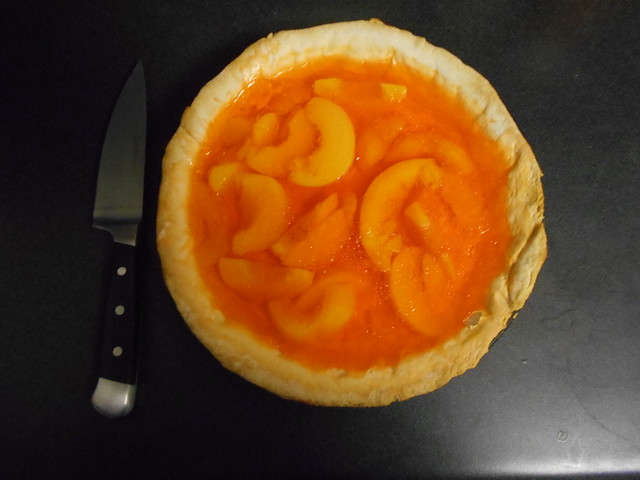
The problem is that the Jell-O made the pie crust soggy. Really soggy. Mushy and soggy. The slice started losing its shape as soon as I plated it on Pyrex Tiburon:
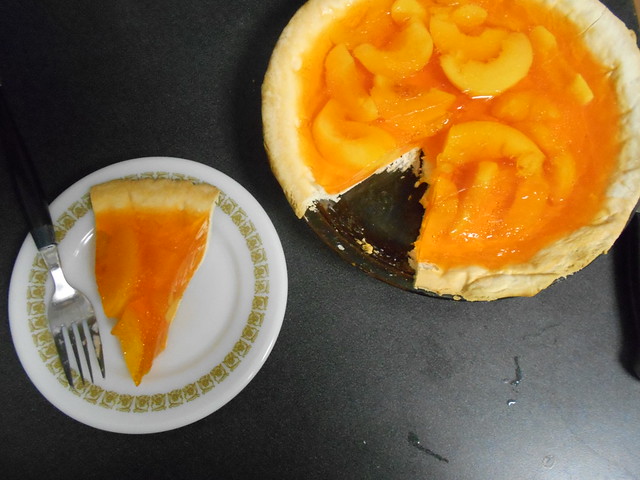
but I ate it anyway.
I've peeled the crust off of every piece since then, and just eaten it as a bowl of Jell-O with peaches.
There were some nights, though, when the cafeteria served what the RA's and I referred to as "Blair Witch Dinner".
If it's been a while since you saw The Blair Witch Project, let me explain: the last third of the movie pretty much consists of the two surviving protagonists running through the woods before jerking to a stop and screaming, "WHAT THE FUCK IS THAT?" in terror while sobbing and pointing. That's pretty much what happened on the nights that the cafeteria served Blair Witch Dinner, too. You'd be dragging your tray down the serving line, talking to whoever you came down with, passing the chicken, passing some potatoes, passing the vegetarian entrée, and then JESUS CHRIST, WHAT IS THAT? WHAT IS IT? OH, GOD, OH, GOD, OH, GOD!
Sheer terror, in the form of food.
Nothing they ever served us at the Dutch Quad Cafeteria, though, ever reached the terror of last week's Antipasto Salad.
I have touched the soul of horror, and it is made of Jell-O.
This all started when I bought that Jell-O cookbook and decided to cook from it. I opened Pandora's Jell-O Box, and visited sorrow upon my kitchen. After successfully completing the Topaz Parfait super-dessert, I decided to try something more challenging, more daring, not stopping to think about how much more intense things could get when I wanted to eat something more challenging, taste-wise, than a dessert made from artificially flavored lemon gelatin and coffee.
I decided to try the Barbecue Salad.
I was initially pretty suspicious of this recipe. After all, it called for canned tomato sauce, vinegar, salt, pepper, and orange gelatin. One of those things is not like the others, a Jet among Sharks, but I assembled my ingredients and a stack of 7 ounce Pyrex 407s, which seemed the perfect size for individual servings of Barbecue Salad:
The recipe said it would make three cups, but I opted to use the fourth 407 to stabilize the other three, so that I could move them in and out of the refrigerator to set without them sliding around and spilling. I set about mixing the ingredients:
(I really need a 2-4 cup glass measuring cup if I'm going to keep doing things to Jell-O, because the boiling water is melting that plastic one a little more each time) and poured them into the 407s to set overnight in the fridge, after which they looked about like you expect tomato Jell-O to look:
I dipped one of the bowls in a larger bowl of hot water until the Jell-O released from the bowl, and unmolded it onto a Pyrex Ebony plate of spring mix salad greens:
And then I ate it. After a little bit of experimentation, I figured out that the best way to do it was to slice a chunk of the Barbecue Salad off with the fork, spear a few leaves, and then eat the whole forkful at once. Believe it or not, it really wasn't that bad. It was like a really savory salad dressing, and didn't taste like sweet orange Jell-O at all. The combination of vinegar and tomato sauce was really acidic, but on the second night I topped the salad with a dollop of mayonnaise like the cookbook suggested:
and it really wasn't bad. In fact, after I let it sit for a few minutes so that the Barbecue Salad could lose some of its chill and warm up a little, I was almost completely over the weird texture. I would actually eat this again, despite how disturbing the recipe sounded. Maybe I was wrong about the other recipes, too. Maybe the pictures weren't really as scary as they looked. Maybe I should try another salad, and see if I was again pleasantly surprised.
Maybe I should have quit while I was ahead.
I didn't, though. I pressed onward, turning pages and thinking until I arrived at the Antipasto Salad.
That's where this all goes to hell.
The Antipasto Salad consists of a lot of things you would put in an antipasto (olives, salami, pepperoni, Swiss cheese, celery, and onions, which I omitted), suspended in a mixture of lemon Jell-O, vinegar, and salt. Eager to try, ready to challenge myself in the kitchen and explore new things, I got to dicing:
and then got to mixing the other ingredients in a Pyrex Opal 023. Unlike the last recipe, this one actually called for a little bit of technique: after mixing the boiling water, salt, gelatin, and vinegar, I had to add in ice cubes and stir for three to five minutes until the mixture partially thickened.
The reason for doing so is that when you add things to the gelatin, you want them suspended in it. Otherwise, they'll just sink to the bottom. After four minutes it was visibly thicker, so I scooped out the remaining ice cubes as instructed, added my ingredients, put the lid on, and put the whole thing in the refrigerator overnight to set. When I finished, it looked about how you would expect a bowl of Jell-O with hunks of cheese, meat, and vegetables in it to look:
Perfect, right? I scooped a heaping spoonful onto my only Pyrex Waffle House plate:
and that's when things turned bad. The flavor wasn't terrible, and I tried to explain this to my friends. It tasted like a heavily dressed antipasto. The texture, though, is a bridge too far. Do you like chewing cold celery and chunks of cold cheese and cold salami after sucking a mouthful of thick, slimy liquid off of them? If so, this is the dish for you. It's not the dish for me. Right now, it's sitting in the refrigerator missing only that first spoonful.
When I went back to the refrigerator on the second night fully intending to try it again I thought about the chewing, the texture, having that in my mouth and having to chew it and feeling it slide around my teeth and my stomach gave an actual, physical lurch, so hard that I had to grab my kitchen counter.
My body physically recoiled from the memory of the Antipasto Salad.
I grabbed my book, left my apartment, and walked to a nearby restaurant for dinner. I did that again the next night. Since then, I've just pretended that it's not sitting in there, waiting, gelled and ready on the bottom shelf. It's going to be there forever, you know. It's not like it will go bad. The food is sealed in lemon gelatin like flies in amber, but the memory in my head is still squirming and alive.
I tried to put it all behind me, and moved back to one of the dessert chapters. I'd had success with dessert. Dessert is my friend. Dessert would never hurt me like salad would.
Dessert betrayed me, too.
I decided to make the Peach Gem Pie, which is basically Jell-O with peaches in a pie crust. I unrolled a premade pie crust into a Pyrex Visionware pie plate, lined it with parchment paper, and filled it with uncooked rice:
Leaving the rice in there while it bakes keeps the shape of the crust, and the parchment paper keeps it from sticking to the crust as it bakes. I forgot to use it once when I was making a quiche crust and had to pick a whole bunch of uncooked rice out of the bottom of the crust before I could pour in my quiche filling, and since then I've never forgotten again. Once the crust was done I mixed up the gelatin, stirred in some ice until it thickened quite a bit, added the peaches, and let it set. It looks about like you think a pie filled with Jell-O should look:
The problem is that the Jell-O made the pie crust soggy. Really soggy. Mushy and soggy. The slice started losing its shape as soon as I plated it on Pyrex Tiburon:
but I ate it anyway.
I've peeled the crust off of every piece since then, and just eaten it as a bowl of Jell-O with peaches.
Wednesday, June 3, 2015
Eleven Months
It has now been eleven months since I decided to change my life and lose weight, and last month kind of ended on a cliffhanger. After the depressing month when I didn't lose any weight something worse happened, and in the tenth month I gained ten pounds and then swore to lose them again. I vowed to get back on the horse, not let it be a permanent setback, and to stay the course.
And I lost five pounds.
I now weigh 225 pounds.
I'm not celebrating, but I will acknowledge my achievement. I returned to my routine, stayed mostly on diet, made my step goals, and lost five pounds, but I'm not really in the mood to congratulate myself because I lost those five pounds already. I'm still mad at myself for spending a month making poor choices and then justifying and rationalizing those poor choices. It's not like I didn't know that I could put weight back on, as there are obvious, logical reasons why I weighed 295 pounds in the first place.
I'm not mad that I backslid. I'm disappointed in myself, yes, but what I'm mad about is the wasted effort. I spent the month losing five pounds that I already lost to get back to where I was two months ago. If I can lose five more pounds this month, then I will be back to where I was in February, but I could have spent those two months moving forward instead. I could have been two months closer to being overweight instead of obese. I could have been two months closer to Venice, but instead I will spend four months making the same progress, and that depresses and disappoints me. I made bad choices, and I have to accept responsibility for them and deal with the fallout, but I'm not happy about it. I'm not happy that I lost five pounds, because I shouldn't have gained ten pounds to begin with.
I cheated myself out of two months of progress.
But hey, I lost five pounds.
I also lost my treadmill.
Yes, in addition to the shoes I've worn down, the shoes I bought to replace them (which I am also about to replace), and dozens of outfits, I've now managed to outwalk my treadmill, too. I guess if one of us was going to break, I'm glad it was the treadmill rather than, you know, me.
I had a feeling this was coming, honestly. A couple of months ago I was finishing up a walk on the treadmill and when I got off I noticed a little plastic wheel on the floor next to the treadmill.
Oh, I thought, picking it up. That's not good.
I didn't see any obvious places that the little wheel fell out of, though, and the treadmill seemed to work fine without it, so I put it out of my mind and continued my routine. Then, a few weeks later, I noticed another little plastic wheel next to the treadmill, but on the other side. Again, the treadmill continued working, so I tried not to worry about it. I did examine it much more closely, and figured out that the little wheels helped the treadmill raise and lower the deck if you want to change the incline. Fortunately, I never walk on an incline, so the loss of the little wheels didn't seem that important. They were a warning, though, a sign that my aging treadmill might not be up to almost a year of steady usage. I chose to ignore the signs, and then the treadmill died.
The other night I turned it on and started walking, or, rather, tried to start walking. As soon as I stepped on the deck, the belt stopped turning. At first I thought, "It's broken. Better throw it away," but then I thought, "Wait... maybe I can fix it." I started consulting the internet, and was offered a range of possible solutions.
Did I need to tighten the belt? No, belt was fine.
Did I need to lubricate the belt? No, that seemed fine, too.
Was the other belt inside the casing that turns the bigger belt that I walk on broken? No, that was fine, too.
My treadmill's engine has given out. It no longer has the power to turn the little belt or the big belt, which probably explains why the treadmill has seemed slower than it says it's moving lately and why it sometimes made a random grinding noise.
The treadmill is dead, and I will have to figure out a day when I have time to move it out to the porch and then have friends come over for a minute to help me get it down the steps and into the dumpster. I'm sure my friends will line up and volunteer for this, because my friends are kind, generous, giving people, the kind of people who might have some upper body strength and might be willing to use it to help send my poor, suffering treadmill off to a farm in the country where it has room to run around and frolic in the sun and has lots of other treadmills to play with. My treadmill is going to a better place, everybody.
I, on the other hand, have been going to the fitness center in my apartment complex.
This situation is not ideal, but it is workable. I don't like the place where my Kindle fits on the fitness center treadmills, because it doesn't cover up the clock and I have to force myself not to look at the terribly slow moving numbers. More importantly, I don't know how I feel about interacting with my neighbors. I'm not used to talking to them, or being in close proximity to them, or wondering if I've been on the treadmill for too long and am supposed to share it with one of them. I don't know these unspoken rules to using a fitness facility, like if you have to bring a towel or if people will tell you when they want to use the machine you're on and if you're supposed to make small talk and who gets to be in charge of the television and what channel it's on.
I guess I'm going to learn them.
Or I'm going to last about a month, and then buy a new treadmill.
And I lost five pounds.
I now weigh 225 pounds.
I'm not celebrating, but I will acknowledge my achievement. I returned to my routine, stayed mostly on diet, made my step goals, and lost five pounds, but I'm not really in the mood to congratulate myself because I lost those five pounds already. I'm still mad at myself for spending a month making poor choices and then justifying and rationalizing those poor choices. It's not like I didn't know that I could put weight back on, as there are obvious, logical reasons why I weighed 295 pounds in the first place.
I'm not mad that I backslid. I'm disappointed in myself, yes, but what I'm mad about is the wasted effort. I spent the month losing five pounds that I already lost to get back to where I was two months ago. If I can lose five more pounds this month, then I will be back to where I was in February, but I could have spent those two months moving forward instead. I could have been two months closer to being overweight instead of obese. I could have been two months closer to Venice, but instead I will spend four months making the same progress, and that depresses and disappoints me. I made bad choices, and I have to accept responsibility for them and deal with the fallout, but I'm not happy about it. I'm not happy that I lost five pounds, because I shouldn't have gained ten pounds to begin with.
I cheated myself out of two months of progress.
But hey, I lost five pounds.
I also lost my treadmill.
Yes, in addition to the shoes I've worn down, the shoes I bought to replace them (which I am also about to replace), and dozens of outfits, I've now managed to outwalk my treadmill, too. I guess if one of us was going to break, I'm glad it was the treadmill rather than, you know, me.
I had a feeling this was coming, honestly. A couple of months ago I was finishing up a walk on the treadmill and when I got off I noticed a little plastic wheel on the floor next to the treadmill.
Oh, I thought, picking it up. That's not good.
I didn't see any obvious places that the little wheel fell out of, though, and the treadmill seemed to work fine without it, so I put it out of my mind and continued my routine. Then, a few weeks later, I noticed another little plastic wheel next to the treadmill, but on the other side. Again, the treadmill continued working, so I tried not to worry about it. I did examine it much more closely, and figured out that the little wheels helped the treadmill raise and lower the deck if you want to change the incline. Fortunately, I never walk on an incline, so the loss of the little wheels didn't seem that important. They were a warning, though, a sign that my aging treadmill might not be up to almost a year of steady usage. I chose to ignore the signs, and then the treadmill died.
The other night I turned it on and started walking, or, rather, tried to start walking. As soon as I stepped on the deck, the belt stopped turning. At first I thought, "It's broken. Better throw it away," but then I thought, "Wait... maybe I can fix it." I started consulting the internet, and was offered a range of possible solutions.
Did I need to tighten the belt? No, belt was fine.
Did I need to lubricate the belt? No, that seemed fine, too.
Was the other belt inside the casing that turns the bigger belt that I walk on broken? No, that was fine, too.
My treadmill's engine has given out. It no longer has the power to turn the little belt or the big belt, which probably explains why the treadmill has seemed slower than it says it's moving lately and why it sometimes made a random grinding noise.
The treadmill is dead, and I will have to figure out a day when I have time to move it out to the porch and then have friends come over for a minute to help me get it down the steps and into the dumpster. I'm sure my friends will line up and volunteer for this, because my friends are kind, generous, giving people, the kind of people who might have some upper body strength and might be willing to use it to help send my poor, suffering treadmill off to a farm in the country where it has room to run around and frolic in the sun and has lots of other treadmills to play with. My treadmill is going to a better place, everybody.
I, on the other hand, have been going to the fitness center in my apartment complex.
This situation is not ideal, but it is workable. I don't like the place where my Kindle fits on the fitness center treadmills, because it doesn't cover up the clock and I have to force myself not to look at the terribly slow moving numbers. More importantly, I don't know how I feel about interacting with my neighbors. I'm not used to talking to them, or being in close proximity to them, or wondering if I've been on the treadmill for too long and am supposed to share it with one of them. I don't know these unspoken rules to using a fitness facility, like if you have to bring a towel or if people will tell you when they want to use the machine you're on and if you're supposed to make small talk and who gets to be in charge of the television and what channel it's on.
I guess I'm going to learn them.
Or I'm going to last about a month, and then buy a new treadmill.
Sunday, May 31, 2015
The Month in Books: May
I've been really, really busy at work this month, so after April's dazzling fifteen book reading total I'm ending May back at a more normal, but probably still above average, reading level: I only read five books this month. I did try an experiment, though, which I will most likely not repeat, and read only non-fiction this month. I don't think I will repeat it because my brain reads better when I bounce back and forth from heavy/things I actually have to think about while reading to light/books that I can mindlessly devour.
I'm not going to finish another book between now and midnight, so here are the five books I read and some thoughts about them:
1) Axel Madsen's The Sewing Circle is out of print, and there's a good reason why: it's just not that good. The story of "Hollywood's greatest secret" (an arguable point in itself), it documents same sex relationships among a circle of actresses, writers, and other members of the film industry during the early years of Hollywood, but the book can't ever seem to decide what kind of tone it takes. Some pages are a matter of fact documentary style study, and other pages seem ripped directly from the tabloids. Not only that, but it doesn't build to anything. Everyone just keeps having relationships with everyone else, and then eventually they die. There's no climax, and it doesn't really push you to draw any conclusions. Is the closet terrible? Well, no, not always. Is it a wise career move? Well, no, not often. Is there a point to reading any of this? Well, no, not really.
When I originally picked this up I was planning to donate it to the OutReach LGBT and Ally Resource Center here on campus (which could really use your donations if you feel like making one), but now that I've read it I decided against it because the students won' know who most of the people mentioned are and this book is so boring and poorly written that it won't make them want to know. This is the most boring thing about Joan Crawford that I've ever read, and they somehow made Marlene Dietrich seem sad and quiet. I don't want the students to read this because I honestly don't want anyone to read this.
2) Jon Krakauer's Missoula was a fast, searing read. While people have tried to argue that the city of Missoula, Montana, doesn't have a problem prosecuting sexual assaults, facts are hard to argue with, and Krakauer documents case after case, a count that ultimately climbs into the hundreds. At the same time, he brings a humanizing tone to the story by framing his investigation with the specific stories of a few cases involving women assaulted by members of the college football team, which was apparently allowed to behave with impunity and without consequences. Sexual assault on college campuses, and the way that colleges respond to it, has been an increasingly debated topic within the past year, and this book highlights the reason why: things have to change.
One of the things I like about Krakauer's writing, and have since I read Into Thin Air, is that his narrative voice doesn't pull any punches. He gives credit where credit is due, but is also more than willing to assign blame when it's needed. While he does allow the reader to draw their own conclusions in some cases, his conclusion is also always obvious, and he doesn't flinch away from uncomfortable truths. This is a topic where too much is hushed up and made polite already, so it's nice to see someone acknowledge the parts of sexual assault that are horrible but also try to move the discussion forward beyond that, and to try to find ways to change things for the better. This is definitely a good read, especially for those working in higher education or with young adults in any capacity, but given the subject matter it probably goes without saying that this may also be triggering for some people.
3) Clayton Delery-Edwards' The Up Stairs Lounge Arson tells the story of the deadliest fire in New Orleans, which also happens to be the deadliest mass murder of LGBT+ people in US history. 32 people died in the burning of the Up Stairs Lounge in 1973, but most people haven't heard about it because the general response at the time was, "It was just a bunch of fags." While times have changed, it is a window into a time not so long ago when being out was illegal, when crimes against gay people were expected and unprosecuted, and when a city can fail to fully investigate the deaths of 32 citizens and most of the public won't care about how those people died because of how they lived.
I'm definitely going to donate this one to the Resource Center, which was my plan when I bought it, because I think knowing the history of the struggle of LGBT+ people in this country is important, especially if that history is well written. (Giving you the side-eye, book #1.) While we have made a lot of progress as a country, though, I also feel that it's worth thinking and discussing how many places and circumstances there are where we still have a long way to go toward achieving equality. In a time when legislators are pushing bills that will allow people to continue discriminating against LGBT+ people even after laws intended to safeguard equality are passed, it's worth looking at the kinds of things that happen when minorities are dehumanized and silenced.
4) As a doctoral student in sociology, Ashley Mears became a model for two agencies, one in New York and one in London, and studied a side of the modeling world that's rarely seen. In Pricing Beauty she breaks down some of the stereotypes about models (average male models, for example, make very little money compared to women and rarely collect a paycheck from their agency) but also shows how the modeling industry illustrates social norms about attractiveness, race, gender, masculinity, sexuality, and the value that we place on creative fields and the creation of art. Throughout the book Mears interviewed models, bookers, clients, photographers, and others associated with the industry, and gives a portrait that could only come from the inside.
I really enjoyed reading this, even if it got a little slow at times, because it made me think a lot about the ways in which our culture views youth, gender, and the worth of creative output and the people who produce it. Is the person who shoots catalog photos an artist? Is the model featured in them, chosen because she is blandly good looking in the most average way possible to appeal to the widest consumer audience, a star? Why is she making so much more than the man standing next to her in the picture? And why are neither of them likely to be a person of color? Even more basic, how do we define attractiveness in the first place? And how do we assign a value to it? The book doesn't answer all of these questions, and doesn't intend to, but it was interesting to think about them, and I'm glad the author asked.
5) There are probably better books about the Penn State scandal than Bill Moushey and Bob Dvorchak's Game Over, but this one was free so this is the one I read. The book reads like they ground it out as soon as they could to make money while the case was still in the news, especially since it ends with Sandusky out on bail and awaiting trial. Given that, this book seems to draw a lot of conclusions rather early in the whole scandal, and is probably not worth picking up now that there are other, presumably more complete books written about everything that happened. Some of the things the authors say are right, such as that this did tarnish Paterno's legacy and have a lasting impact on Penn State, but the point would be better illustrated by books that include things like the removal of Paterno's statue outside the football stadium and the imposition and subsequent partial reversal of the NCAA sanctions against Penn State. This book was probably outdated as soon as it was published, and no longer worth looking at now for people who are curious about the entire sequence of events and outcomes. I didn't hate reading it, but when I realized how outdated it really was I felt bad about wasting my time on it.
The used bookstore probably isn't going to give me any money for it, either.
I'm not going to finish another book between now and midnight, so here are the five books I read and some thoughts about them:
1) Axel Madsen's The Sewing Circle is out of print, and there's a good reason why: it's just not that good. The story of "Hollywood's greatest secret" (an arguable point in itself), it documents same sex relationships among a circle of actresses, writers, and other members of the film industry during the early years of Hollywood, but the book can't ever seem to decide what kind of tone it takes. Some pages are a matter of fact documentary style study, and other pages seem ripped directly from the tabloids. Not only that, but it doesn't build to anything. Everyone just keeps having relationships with everyone else, and then eventually they die. There's no climax, and it doesn't really push you to draw any conclusions. Is the closet terrible? Well, no, not always. Is it a wise career move? Well, no, not often. Is there a point to reading any of this? Well, no, not really.
When I originally picked this up I was planning to donate it to the OutReach LGBT and Ally Resource Center here on campus (which could really use your donations if you feel like making one), but now that I've read it I decided against it because the students won' know who most of the people mentioned are and this book is so boring and poorly written that it won't make them want to know. This is the most boring thing about Joan Crawford that I've ever read, and they somehow made Marlene Dietrich seem sad and quiet. I don't want the students to read this because I honestly don't want anyone to read this.
2) Jon Krakauer's Missoula was a fast, searing read. While people have tried to argue that the city of Missoula, Montana, doesn't have a problem prosecuting sexual assaults, facts are hard to argue with, and Krakauer documents case after case, a count that ultimately climbs into the hundreds. At the same time, he brings a humanizing tone to the story by framing his investigation with the specific stories of a few cases involving women assaulted by members of the college football team, which was apparently allowed to behave with impunity and without consequences. Sexual assault on college campuses, and the way that colleges respond to it, has been an increasingly debated topic within the past year, and this book highlights the reason why: things have to change.
One of the things I like about Krakauer's writing, and have since I read Into Thin Air, is that his narrative voice doesn't pull any punches. He gives credit where credit is due, but is also more than willing to assign blame when it's needed. While he does allow the reader to draw their own conclusions in some cases, his conclusion is also always obvious, and he doesn't flinch away from uncomfortable truths. This is a topic where too much is hushed up and made polite already, so it's nice to see someone acknowledge the parts of sexual assault that are horrible but also try to move the discussion forward beyond that, and to try to find ways to change things for the better. This is definitely a good read, especially for those working in higher education or with young adults in any capacity, but given the subject matter it probably goes without saying that this may also be triggering for some people.
3) Clayton Delery-Edwards' The Up Stairs Lounge Arson tells the story of the deadliest fire in New Orleans, which also happens to be the deadliest mass murder of LGBT+ people in US history. 32 people died in the burning of the Up Stairs Lounge in 1973, but most people haven't heard about it because the general response at the time was, "It was just a bunch of fags." While times have changed, it is a window into a time not so long ago when being out was illegal, when crimes against gay people were expected and unprosecuted, and when a city can fail to fully investigate the deaths of 32 citizens and most of the public won't care about how those people died because of how they lived.
I'm definitely going to donate this one to the Resource Center, which was my plan when I bought it, because I think knowing the history of the struggle of LGBT+ people in this country is important, especially if that history is well written. (Giving you the side-eye, book #1.) While we have made a lot of progress as a country, though, I also feel that it's worth thinking and discussing how many places and circumstances there are where we still have a long way to go toward achieving equality. In a time when legislators are pushing bills that will allow people to continue discriminating against LGBT+ people even after laws intended to safeguard equality are passed, it's worth looking at the kinds of things that happen when minorities are dehumanized and silenced.
4) As a doctoral student in sociology, Ashley Mears became a model for two agencies, one in New York and one in London, and studied a side of the modeling world that's rarely seen. In Pricing Beauty she breaks down some of the stereotypes about models (average male models, for example, make very little money compared to women and rarely collect a paycheck from their agency) but also shows how the modeling industry illustrates social norms about attractiveness, race, gender, masculinity, sexuality, and the value that we place on creative fields and the creation of art. Throughout the book Mears interviewed models, bookers, clients, photographers, and others associated with the industry, and gives a portrait that could only come from the inside.
I really enjoyed reading this, even if it got a little slow at times, because it made me think a lot about the ways in which our culture views youth, gender, and the worth of creative output and the people who produce it. Is the person who shoots catalog photos an artist? Is the model featured in them, chosen because she is blandly good looking in the most average way possible to appeal to the widest consumer audience, a star? Why is she making so much more than the man standing next to her in the picture? And why are neither of them likely to be a person of color? Even more basic, how do we define attractiveness in the first place? And how do we assign a value to it? The book doesn't answer all of these questions, and doesn't intend to, but it was interesting to think about them, and I'm glad the author asked.
5) There are probably better books about the Penn State scandal than Bill Moushey and Bob Dvorchak's Game Over, but this one was free so this is the one I read. The book reads like they ground it out as soon as they could to make money while the case was still in the news, especially since it ends with Sandusky out on bail and awaiting trial. Given that, this book seems to draw a lot of conclusions rather early in the whole scandal, and is probably not worth picking up now that there are other, presumably more complete books written about everything that happened. Some of the things the authors say are right, such as that this did tarnish Paterno's legacy and have a lasting impact on Penn State, but the point would be better illustrated by books that include things like the removal of Paterno's statue outside the football stadium and the imposition and subsequent partial reversal of the NCAA sanctions against Penn State. This book was probably outdated as soon as it was published, and no longer worth looking at now for people who are curious about the entire sequence of events and outcomes. I didn't hate reading it, but when I realized how outdated it really was I felt bad about wasting my time on it.
The used bookstore probably isn't going to give me any money for it, either.
Saturday, May 30, 2015
The New Joys of Jell-O
I've read a lot of books about the birth of "American cuisine". They tend to focus mostly on what that idea even means, incorporating a lot of discussion of regional dishes, farm to table philosophies, and preparations and cooking styles that are updated, modified versions of classical French, Spanish, Italian, and other cuisines. In her book My Life in France, which I read last year, Julia Child mentions that at the time she was shopping Mastering the Art of French Cooking to publishers one of the best-selling cookbooks in the country was based entirely on canned goods, and making fast meals just by opening them. This is a style that still exists today, but for the most part food writers like to gloss over the time when cookbooks like the one I found today at the Friends of the Library book sale were both common and acceptable.
Allow me to present:
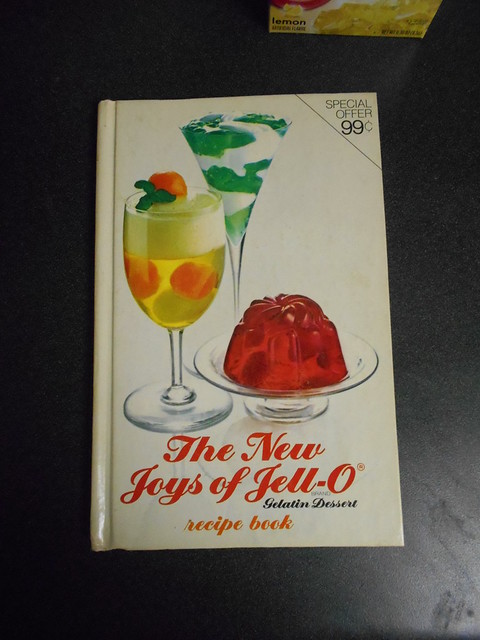
Copyright 1973 by the General Foods Corporation, I turned the pages in fascinated horror. Many of my friends have linked to articles and slideshows on the web showing gelatin horror after gelatin horror, but never did I imagine that I would one day hold a book of recipes for these nightmares in my hands, and that it might only be two dollars.
I was so excited I started reading it in the parking lot.
With my car running.
Even thought the gas light was on.
The New Joys of Jello finds ways to incorporate Jell-O into every meal, although it's really fixated on desserts and salads to the point that there are three different chapters for desserts (Family Desserts, Bring on the Super Desserts, and Centerpiece Desserts) and four for things that claim to be salads (Salads that Help Make the Meal, Sociable Side Salads, Salads for the Slim Life, and Salads for Special Events). There's something in there called Barbecue Salad, which seems to be a lump of barbecue sauce gelatin that you serve on a lettuce leaf with a suggested side of mayonnaise, a recipe that I stared at for at least a minute as I tried to imagine how and why someone might think it was a good idea to make and serve such a thing and who might eat it, and I can't even describe the way reading the Creamy Bleu Cheese Salad recipe made me feel inside other than to say that I felt my stomach give the kind of slow-motion barrel roll normally reserved for astronauts in low gravity or the second before the roller coaster drops at the top of the first giant hill.
Every recipe in this book, especially the ones with photographs, both attracted and repulsed me at the same time. It's like I was a naïve yet fascinated virgin in the Red Room of Pain but all of the kinky sexual torture devices were bowls and platters filled with quivering lumps of gelatin.
I finally decided to start flipping through until I spotted one that I had ingredients on hand for, which meant that eventually it was my turn to bring on the super desserts.
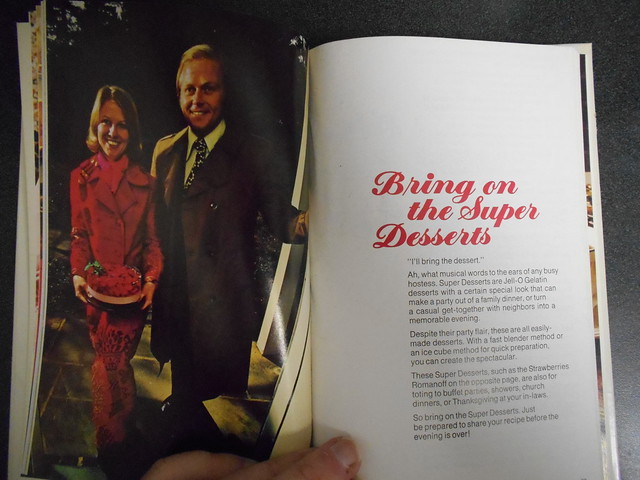
The sort of sad part is that not only did I have the ingredients on hand, but I probably also own that guy's tie, and have probably worn it to work within the last year.
I settled on the Topaz Parfait, which I had everything for except whipped cream. Just in case you want to play along at home:
Topaz Parfait
1 box lemon Jell-O mix
1 cup strong coffee
1/3 cup sugar
1/4 cup dark rum
1/2 cup cold water
Whipped cream (the recipe said to buy a mix for this and prepare as directed, but I just bought a can of Reddi Whip)
I brewed up the coffee in my Keurig, because generating plastic waste with each cup of coffee harkens back to the capitalist spirit that pervaded the country when this book was published, and then brought it to a boil on the stove. Somewhere an Italian American playing a Native American was crying a lone tear at my wastefulness, but I pressed onward, adding the sugar and Jell-O mix and stirring until everything dissolved. Once it did, I removed the pan from the heat, added the water and rum, gave it another stir, and poured it into a 9 inch round glass baking dish. Two hours later, the gelatin half of the Topaz Parfaits had cooled:
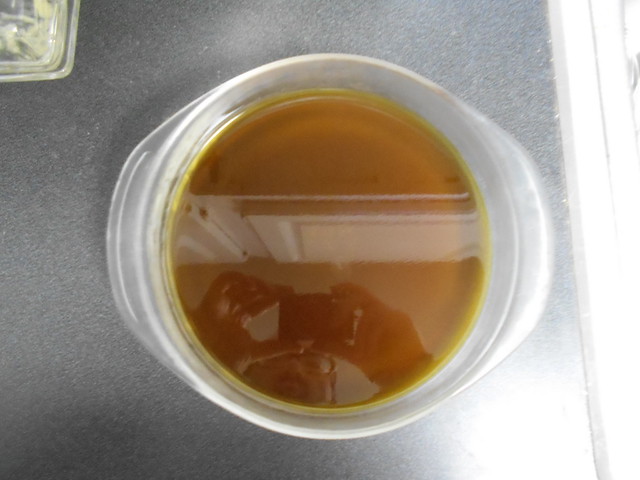
I call that photograph "Topaz Parfait Self Portrait", and pretend that I deliberately included myself in the image.
The Jell-O seemed firm enough to slice when I poked it, so I tried slicing into cubes as directed, but the cubes crumbled a little:
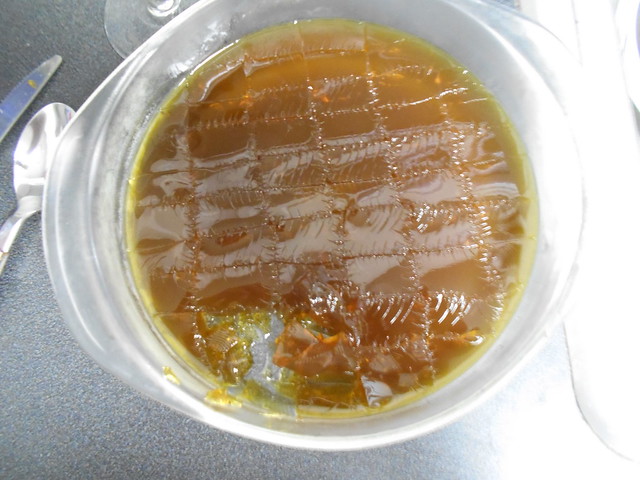
I figured the imaginary guests at my pretend dessert party wouldn't care if the chunks weren't perfectly square and began to layer them in a glass with whipped cream in between. While doing so, I resisted the urge to taste it, but did lean over and inhale deeply.
It smelled like nothing.
No coffee, no lemon, no rum.
I could have been spooning in cubes of inert plastic.
When I was done, I compared my finished product:
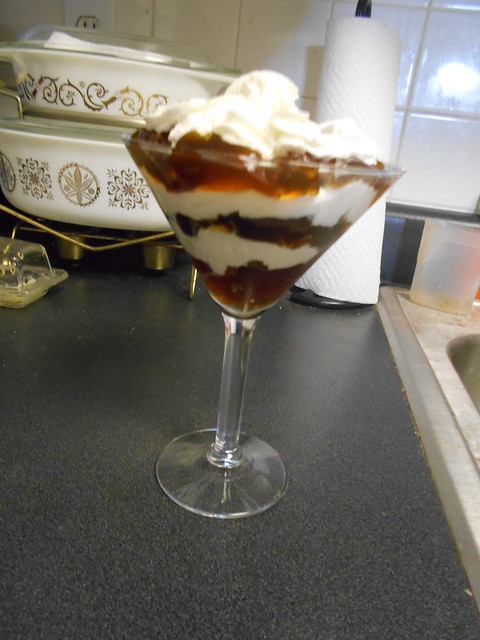
to the picture in the book, where the parfaits were part of a buffet of Super Desserts:
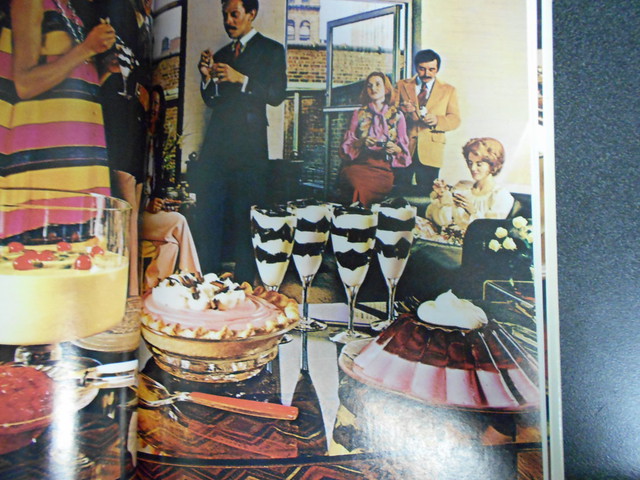
I decided that it was close enough, and dug in a spoon.
It's hard to precisely describe the flavor. It's very sweet, but there's still a bitter coffee undertone. I don't taste lemon at all. I kept taking bites, trying to formulate a better description, and suddenly realized I'd eaten over half of it. It was good, and didn't taste like anything I've ever eaten before. I'm not sure if I would ever bring it to a party, like the cookbook says I should, but I might actually make it again.
Right after I make the eggnog Jell-O thing on the far left in that buffet photo.
And maybe the Barbecue Salad.
Allow me to present:
Copyright 1973 by the General Foods Corporation, I turned the pages in fascinated horror. Many of my friends have linked to articles and slideshows on the web showing gelatin horror after gelatin horror, but never did I imagine that I would one day hold a book of recipes for these nightmares in my hands, and that it might only be two dollars.
I was so excited I started reading it in the parking lot.
With my car running.
Even thought the gas light was on.
The New Joys of Jello finds ways to incorporate Jell-O into every meal, although it's really fixated on desserts and salads to the point that there are three different chapters for desserts (Family Desserts, Bring on the Super Desserts, and Centerpiece Desserts) and four for things that claim to be salads (Salads that Help Make the Meal, Sociable Side Salads, Salads for the Slim Life, and Salads for Special Events). There's something in there called Barbecue Salad, which seems to be a lump of barbecue sauce gelatin that you serve on a lettuce leaf with a suggested side of mayonnaise, a recipe that I stared at for at least a minute as I tried to imagine how and why someone might think it was a good idea to make and serve such a thing and who might eat it, and I can't even describe the way reading the Creamy Bleu Cheese Salad recipe made me feel inside other than to say that I felt my stomach give the kind of slow-motion barrel roll normally reserved for astronauts in low gravity or the second before the roller coaster drops at the top of the first giant hill.
Every recipe in this book, especially the ones with photographs, both attracted and repulsed me at the same time. It's like I was a naïve yet fascinated virgin in the Red Room of Pain but all of the kinky sexual torture devices were bowls and platters filled with quivering lumps of gelatin.
I finally decided to start flipping through until I spotted one that I had ingredients on hand for, which meant that eventually it was my turn to bring on the super desserts.
The sort of sad part is that not only did I have the ingredients on hand, but I probably also own that guy's tie, and have probably worn it to work within the last year.
I settled on the Topaz Parfait, which I had everything for except whipped cream. Just in case you want to play along at home:
Topaz Parfait
1 box lemon Jell-O mix
1 cup strong coffee
1/3 cup sugar
1/4 cup dark rum
1/2 cup cold water
Whipped cream (the recipe said to buy a mix for this and prepare as directed, but I just bought a can of Reddi Whip)
I brewed up the coffee in my Keurig, because generating plastic waste with each cup of coffee harkens back to the capitalist spirit that pervaded the country when this book was published, and then brought it to a boil on the stove. Somewhere an Italian American playing a Native American was crying a lone tear at my wastefulness, but I pressed onward, adding the sugar and Jell-O mix and stirring until everything dissolved. Once it did, I removed the pan from the heat, added the water and rum, gave it another stir, and poured it into a 9 inch round glass baking dish. Two hours later, the gelatin half of the Topaz Parfaits had cooled:
I call that photograph "Topaz Parfait Self Portrait", and pretend that I deliberately included myself in the image.
The Jell-O seemed firm enough to slice when I poked it, so I tried slicing into cubes as directed, but the cubes crumbled a little:
I figured the imaginary guests at my pretend dessert party wouldn't care if the chunks weren't perfectly square and began to layer them in a glass with whipped cream in between. While doing so, I resisted the urge to taste it, but did lean over and inhale deeply.
It smelled like nothing.
No coffee, no lemon, no rum.
I could have been spooning in cubes of inert plastic.
When I was done, I compared my finished product:
to the picture in the book, where the parfaits were part of a buffet of Super Desserts:
I decided that it was close enough, and dug in a spoon.
It's hard to precisely describe the flavor. It's very sweet, but there's still a bitter coffee undertone. I don't taste lemon at all. I kept taking bites, trying to formulate a better description, and suddenly realized I'd eaten over half of it. It was good, and didn't taste like anything I've ever eaten before. I'm not sure if I would ever bring it to a party, like the cookbook says I should, but I might actually make it again.
Right after I make the eggnog Jell-O thing on the far left in that buffet photo.
And maybe the Barbecue Salad.
Tuesday, May 5, 2015
Ten Months
You know what's worse than not losing any weight?
Gaining weight.
I gained ten pounds this month, and now weigh 230. I don't get to start my sentences with "Seventy five pounds ago..." anymore, because I've no longer lost seventy five pounds. I've only lost sixty five, because I managed to find ten of them again and put them back on.
I knew this was going to be a bad month when I finally got on the scale the other day. I took about a week off from meeting my step goal, because I was on vacation. I've been off diet for two months because I was off of it for a month and nothing terrible happened. I didn't gain any weight, so I convinced myself that it was ok to just keep maintaining, except that I didn't just maintain. I had extra snacks. I ate snacks while watching television. I had a big lunch and a big dinner, several times. I let myself get back into bad habits.
And I gained ten pounds.
Venice is ten pounds further away, rather than ten pounds closer. I am still obese, rather than just overweight. I weight 230 pounds, rather than 220.
So, here I am, backsliding. This month I worked against my goals, backslid, and undid some of the really hard work that I've been putting in for the past ten months, or at least for eight of them. I'm not proud of this, and I shouldn't be proud of it, but I'm also not beating myself up over it too much. I am a little, because this was preventable. There's a program, and I've been off the program. Behavior has consequences, and I am sitting around with ten pounds of extra consequences, and I'm not happy about it.
So where do I go from here?
I get back on the horse and start riding. I made fantastic progress for months because I was focused, determined, and dedicated to my process. Ten months ago, I had a choice to surgically constrict my digestive tract or to exercise and I chose the exercise. I argued that I would be able to do this, and for eight months I was doing this.
I just needed a slap in the face to remind me that this thing, my journey, my goal, my quest to become a better person, is not done.
This is a bump in the road. I have a choice to look at it, accept it, and move on, or to sit on my couch and brood and beat myself up over it. I'm going with the first choice, because I really have no choice. I was very clear that I can either lose weight or die, and I still don't want to die. I want to be a healthy person. I want to be able to take stairs, and walk long distances, and go to a store and buy clothing off of a rack and be comfortable with the idea that those clothes will fit me. I don't want to have diabetes, or to have my feet cut off, or to have a heart attack.
I gained ten pounds this month.
Now I'm going to lose them.
Gaining weight.
I gained ten pounds this month, and now weigh 230. I don't get to start my sentences with "Seventy five pounds ago..." anymore, because I've no longer lost seventy five pounds. I've only lost sixty five, because I managed to find ten of them again and put them back on.
I knew this was going to be a bad month when I finally got on the scale the other day. I took about a week off from meeting my step goal, because I was on vacation. I've been off diet for two months because I was off of it for a month and nothing terrible happened. I didn't gain any weight, so I convinced myself that it was ok to just keep maintaining, except that I didn't just maintain. I had extra snacks. I ate snacks while watching television. I had a big lunch and a big dinner, several times. I let myself get back into bad habits.
And I gained ten pounds.
Venice is ten pounds further away, rather than ten pounds closer. I am still obese, rather than just overweight. I weight 230 pounds, rather than 220.
So, here I am, backsliding. This month I worked against my goals, backslid, and undid some of the really hard work that I've been putting in for the past ten months, or at least for eight of them. I'm not proud of this, and I shouldn't be proud of it, but I'm also not beating myself up over it too much. I am a little, because this was preventable. There's a program, and I've been off the program. Behavior has consequences, and I am sitting around with ten pounds of extra consequences, and I'm not happy about it.
So where do I go from here?
I get back on the horse and start riding. I made fantastic progress for months because I was focused, determined, and dedicated to my process. Ten months ago, I had a choice to surgically constrict my digestive tract or to exercise and I chose the exercise. I argued that I would be able to do this, and for eight months I was doing this.
I just needed a slap in the face to remind me that this thing, my journey, my goal, my quest to become a better person, is not done.
This is a bump in the road. I have a choice to look at it, accept it, and move on, or to sit on my couch and brood and beat myself up over it. I'm going with the first choice, because I really have no choice. I was very clear that I can either lose weight or die, and I still don't want to die. I want to be a healthy person. I want to be able to take stairs, and walk long distances, and go to a store and buy clothing off of a rack and be comfortable with the idea that those clothes will fit me. I don't want to have diabetes, or to have my feet cut off, or to have a heart attack.
I gained ten pounds this month.
Now I'm going to lose them.
Friday, May 1, 2015
The Month in Books: April Edition
In January when I read ten books I was all excited and thinking, "Wow, I might actually read 120 books this year if I can keep this pace up!" but then I only read eight books in February and eight books in March and I was thinking, "Oh, hmmm. Maybe eight books a month is a much more reasonable pace. 96 books is a stunningly impressive total for the year, too. Just be happy with that, ok?"
I read 14 books in April, mostly because I had a week of vacation. That means that 120 by the end of the year is once again attainable.
1) I hate to say a book is terrible, but Ben Marcus' The Flame Alphabet was a good idea that was terribly painful to get through. It was so bad that I almost preferred walking on the treadmill with nothing to read rather than keep reading this, but I forced my way through anyway, just to be done with it.
The story takes place in the near future, at a time when the sound of children speaking has become toxic. Eventually, all language, even printed text, follows, and Sam and Claire find themselves with no alternative but to abandon their teenage daughter, Esther. Even though they have to leave her, Sam refuses to give up on somehow keeping their family together, even though Esther's vocal teenage rebellion is slowly killing her parents. The rest of the book meanders through Sam's fruitless struggle to find a cure and to continue practicing a form of Judaism where he goes to a solitary hut in the woods and uses an organic device called a Listener to hear sermons from an underground orange cable that apparently spans the entire world, even though earing the sermons is also killing him.
There are a lot of problems with this book, but the basic ones are that there's never a reason why language became toxic, so the main plot is never resolved. Since it's not a plot driven novel, it then has to depend on the characters, but Sam is the only character given any kind of development, and he's just not that interesting.
It's been a whole month, and I'm still mad about all the time I spent reading this.
2) Laura Still's A Haunted History of Knoxville is a fun tour through the dark side of local history, but it would probably be more interesting for people who live or have lived in Knoxville, since it's written in a way that assumes the reader already knows the local geography. For those that don't, maps would have been helpful, but the book does have a lot of photographs and good basic descriptions. Like any good sized city, Knoxville has a dark and at times shady past, with criminals, trials, disasters, family secrets, and all of the other sorts of scandals and tragedies that allegedly cause a good haunting, and Still does a good job of storytelling and making the past come alive. On the downside, there are a few places where the text could have used a little tighter editorial hand, and the lack of stories about the University of Tennessee campus seems a rather large omission give its prominence in Knoxville. Overall, though, this was an interesting read.
Now that I read it, I kind of want to go on a Knoxville ghost tour. I also really want you to click that link, so you can rock out to the "Ghostbusters" theme song.
3) I've been reading books about Truman Capote since the end of last year, but realized the only things of his that I've actually read are In Cold Blood and some random Christmas story that was in three different English textbooks from seventh to twelfth grade, so I picked up Other Voices, Other Rooms mostly on the grounds that the protagonist and I have the same first name. That's a totally valid reason.
It's the story of young Joel Knox, who is called for by his absentee father after his mother dies. When he arrives at a broken down Southern mansion, his father is nowhere in sight, but he has a stepmother, a drunken uncle, an odd collection of household staff, strange neighbors, and the mystery of what he's doing there and where his father actually is. All of the answers are not forthcoming by the end of the book, and I'm not really sure why this was so acclaimed. Some of the descriptive passages are great and the characters are interesting, but there isn't really much plot.
4) Charles Yu's How to Live Safely in a Science Fictional Universe was interesting, funny, and well-written. A novel of family and regret, it tells the story of a time machine repairman, also named Charles Yu, who lives outside of time for years at a stretch to keep from having to interact with people, kept company by an operating system with low self esteem and a dog that no longer exists. His mother lives out her days in a repeating hour of time and his father vanished into the past, never to be seen again, and Charles drifts through his job, helping stranded time travelers and petting his dog, until the day that he meets his future self.
And shoots him.
Now he's racing to unravel the mystery of why his future self showed up, how long he has before he arrives at the moment when he shoots himself, where his father went, and why his future self was carrying a book called "How To Live Safely in a Science Fictional Universe", written by Charles Yu. I really enjoyed this book, and even though it was a fast read it was still good.
5) Andrew Pyper's The Demonologist introduces the reader to Professor David Ullman, a lifelong scholar of John Milton and "Paradise Lost". His marriage is disintegrating, he struggles with depression, and after years of writing about angels and demons without believing in either, Ullman's daughter, Tess, is abducted by a demon in Venice. Challenged to find her before the new moon, when she'll be doomed to live forever in Hell, Ullman must draw on all of his books, notes, and knowledge to follow a string of clues. Pursued by an agent of the church, he will deal with the living and the dead as time runs out and face demons both actual and personal as he fights to reclaim his daughter. This was a fast, high strung but well written thriller.
6) The protagonist of Fred Venturini's The Heart Does Not Grow Back, Dale Sampson, has a painful, wonderful gift: he can regenerate lost limbs and organs. Traumatized by the high school tragedy that revealed his ability, Dale is depressed and adrift until his best friend convinces him to take his talent to television, and Dale becomes rich and famous as The Samaritan, a man who gives away limbs and organs to people on the transplant list. When the girl who got away in high school comes back into his life, Dale sees a chance to do things over and right past wrongs. The only problem is that she needs something, too: his heart, the one organ of Dale's that will not grow back. Funny, crude, and at times heartbreaking, this is a novel of hope and loss that I was glad I read.
It's been a couple of weeks, but I'm still thinking about this book. I'm wondering if I still will be by the end of the year.
7) Matthew Jacob and Mark Jacob's What the Great Ate was an interesting collection of short facts about famous people and food. There's an extensive bibliography, and a lot of interesting stories, but a few times there are stories about the same person in the same chapter and I wonder why they didn't just group them together by person, rather than scattering them with other people's stories in between. This was fluff, but interesting fluff.
8) Wally Lamb's Wishin' and Hopin' should be a hilarious Christmas movie, but too many people would compare it to "A Christmas Story", so it probably won't be made and you should just read the book instead. I laughed all the way through the holiday adventures of Felix Funicello, third cousin to the famous Annette. After Felix drives his bipolar Catholic school teacher into a breakdown, a new, French Canadian substitute teacher in tight sweaters and short skirts makes waves by taking a hand in the Christmas pageant. She casts Felix as the little drummer boy but pits the rest of the class against each other when a casting struggle for the role of Virgin Mary arises between spoiled, rich teacher's pet Rosalie and new Russian student (and possible Communist!) Zhenya, who wears makeup, plays baseball with the boys at recess, and has boobs. Will they make it to the pageant in one piece? Will Felix's mother win the Pillsbury Bake Off with her Sicilian Shepherd's Pie recipe? Will Felix become famous like his famous third cousin? And will someone please explain the birds and the bees to him so he can stop hearing about it from sailors at the lunch counter?
I loved this book, and had no idea that Wally Lamb could write anything this light and amusing.
9) I'm not sure how I've managed to read multiple addiction memoirs over the years, as it's not normally a topic that interests me, but they keep ending up in my "to be read" pile. The latest was Bill Clegg's Portrait of an Addict as a Young Man, and it tells the story about how Clegg had a nice, affluent life in NYC and then threw it away on drugs. In an epic, seemingly endless crack binge, he loses his job, his home, his partner, and spends his bank account down to zero. Then he goes to rehab, works on apologies, and ends up with a nice, affluent life in NYC. It's sad to read his struggle, but at the end of the book it doesn't really feel like he learned anything. After a couple of hundred pages of crack smoking, gigolos, expensive Manhattan hotels, $3000 suits and cashmere turtlenecks, there are a couple of paragraphs of "well, I may have wrecked some people's lives and some people lost their jobs when my agency was shut down" but that's it. He gets along with his family now but he doesn't really seem to have learned anything, and he's right back in the privileged life he started with.
10) Ryan Brown's Play Dead had a slightly interesting idea: the Killington High Jackrabbits are on their way to their first ever district championship when a prank by their rivals, the Elmwood Heights Badgers, sends the bus carrying the entire team except the quarterback off of a bridge, where they all drown. Blaming himself and struggling with survivor's guilt, the quarterback and the coach's daughter discover that his neighbor, a local witch, is a big football fan, and she can raise the dead. Now he has to lead a squad of flesh eating zombie football players to one last victory, or else the team's souls will be eternally damned.
This book is sometimes funny, but it never really comes together. The horror never seems really scary and most of the non-zombie characters behave in absurd ways that strain belief. If you're reading a zombie novel and thinking about how much it strains credibility, the author is doing a bad job of conveying their story and setting. Worse, the climactic big game is almost an afterthought, rushed through and tacked on at the very end.
11) Shadows Over Main Street, on the other hand, was well written, creepy, and intensely disturbing. It's a collection of stories by various horror writers built around the theme of traditional American small towns mixed with cosmic Lovecraftian horror, and the stories are disturbing and absorbing. It was well worth a read. Even better, it introduced me to a bunch of authors that I've never read before.
12) Peter Straub's Pork Pie Hat was short and somewhat pointless. A grad student in New York City encounters one of his jazz idols at a local club, and talks him into giving an interview. The musician spends the night getting drunk and telling a story about something that happened when he was a child, but I use the word "something" because it really is never quite clear what it was or why it was so disturbing. Later in life the student speculates and tries to put together the pieces, giving the reader at least some resolution, but the disjointed, buried plot that Straub makes out of it with the story within a story structure left me pretty unsatisfied as a reader and thinking, "That's it?" when I got to the end.
13) I didn't realize that Joyce Carol Oates' Sexy was intended for young adults until I looked it up on Amazon, because when and why did JCO start writing young adult novels, but that does explain why I read it so fast. It reads just as well as a story for regular adults, and if they hadn't said that in the summary I wouldn't have noticed.
It tells the story of high school jock Darren Flynn, a swimmer and diver, who girls describe (depending on the girl) as either "sexy but shy" or "shy but sexy". Darren's a nice guy who follows rules and tries to keep his head down until the day in November when something (or maybe actually nothing) happens with his English teacher. From that point on, Darren isn't sure what kind of guy he is, or who anyone else is, either: his parents, his teammates, his coach, his English teacher, and everyone else around him aren't who he thought they were before the thing happened (or didn't happen), and he struggles to come to terms with that and define himself in the world the thing that happened (or didn't) created.
This was an interesting read. It's just complicated, and I feel weird saying, "I liked this" when parts of it really bothered me, but that may be the sign of a good book, I guess? Also, my mind is still trying to grapple with the idea of Joyce Carol Oates sitting back in her living room and thinking, "I think I'll write a book for children. Sexy children. Who have sex. Yes, that'll be a fun Monday, I think."
14) Gary Braunbeck's Mr. Hands was interesting at times, but also a little run of the mill horror at times. Overall, I liked it, but I don't know that I would really recommend it to friends like, "Wow, you should pick up this really great book that I just finished!", because it was just kind of ok.
It tells a convoluted story of a psychic serial killer, a wooden figurine with giant hands, a lady named Lucy who has suffered a string of personal tragedies, and Sarah, Lucy's daughter. Sarah loves her little figurine, which she names Mr. Hands, but after she's murdered Lucy discovers that the figurine controls a larger, much more violent Mr. Hands, and Lucy begins to use Mr. Hands to deliver her own brand of justice to the rest of the world. Once she unleashes him, will she be able to keep Mr. Hands under control? And will he prove as easy to stop as he was to start? And why is a random vagrant in a bar the one telling us the entire story?
I liked this, but it tied up a little too quickly and neatly at the end for me.
For May, I'm planning to read only non-fiction. I'll report back on how it goes.
I read 14 books in April, mostly because I had a week of vacation. That means that 120 by the end of the year is once again attainable.
1) I hate to say a book is terrible, but Ben Marcus' The Flame Alphabet was a good idea that was terribly painful to get through. It was so bad that I almost preferred walking on the treadmill with nothing to read rather than keep reading this, but I forced my way through anyway, just to be done with it.
The story takes place in the near future, at a time when the sound of children speaking has become toxic. Eventually, all language, even printed text, follows, and Sam and Claire find themselves with no alternative but to abandon their teenage daughter, Esther. Even though they have to leave her, Sam refuses to give up on somehow keeping their family together, even though Esther's vocal teenage rebellion is slowly killing her parents. The rest of the book meanders through Sam's fruitless struggle to find a cure and to continue practicing a form of Judaism where he goes to a solitary hut in the woods and uses an organic device called a Listener to hear sermons from an underground orange cable that apparently spans the entire world, even though earing the sermons is also killing him.
There are a lot of problems with this book, but the basic ones are that there's never a reason why language became toxic, so the main plot is never resolved. Since it's not a plot driven novel, it then has to depend on the characters, but Sam is the only character given any kind of development, and he's just not that interesting.
It's been a whole month, and I'm still mad about all the time I spent reading this.
2) Laura Still's A Haunted History of Knoxville is a fun tour through the dark side of local history, but it would probably be more interesting for people who live or have lived in Knoxville, since it's written in a way that assumes the reader already knows the local geography. For those that don't, maps would have been helpful, but the book does have a lot of photographs and good basic descriptions. Like any good sized city, Knoxville has a dark and at times shady past, with criminals, trials, disasters, family secrets, and all of the other sorts of scandals and tragedies that allegedly cause a good haunting, and Still does a good job of storytelling and making the past come alive. On the downside, there are a few places where the text could have used a little tighter editorial hand, and the lack of stories about the University of Tennessee campus seems a rather large omission give its prominence in Knoxville. Overall, though, this was an interesting read.
Now that I read it, I kind of want to go on a Knoxville ghost tour. I also really want you to click that link, so you can rock out to the "Ghostbusters" theme song.
3) I've been reading books about Truman Capote since the end of last year, but realized the only things of his that I've actually read are In Cold Blood and some random Christmas story that was in three different English textbooks from seventh to twelfth grade, so I picked up Other Voices, Other Rooms mostly on the grounds that the protagonist and I have the same first name. That's a totally valid reason.
It's the story of young Joel Knox, who is called for by his absentee father after his mother dies. When he arrives at a broken down Southern mansion, his father is nowhere in sight, but he has a stepmother, a drunken uncle, an odd collection of household staff, strange neighbors, and the mystery of what he's doing there and where his father actually is. All of the answers are not forthcoming by the end of the book, and I'm not really sure why this was so acclaimed. Some of the descriptive passages are great and the characters are interesting, but there isn't really much plot.
4) Charles Yu's How to Live Safely in a Science Fictional Universe was interesting, funny, and well-written. A novel of family and regret, it tells the story of a time machine repairman, also named Charles Yu, who lives outside of time for years at a stretch to keep from having to interact with people, kept company by an operating system with low self esteem and a dog that no longer exists. His mother lives out her days in a repeating hour of time and his father vanished into the past, never to be seen again, and Charles drifts through his job, helping stranded time travelers and petting his dog, until the day that he meets his future self.
And shoots him.
Now he's racing to unravel the mystery of why his future self showed up, how long he has before he arrives at the moment when he shoots himself, where his father went, and why his future self was carrying a book called "How To Live Safely in a Science Fictional Universe", written by Charles Yu. I really enjoyed this book, and even though it was a fast read it was still good.
5) Andrew Pyper's The Demonologist introduces the reader to Professor David Ullman, a lifelong scholar of John Milton and "Paradise Lost". His marriage is disintegrating, he struggles with depression, and after years of writing about angels and demons without believing in either, Ullman's daughter, Tess, is abducted by a demon in Venice. Challenged to find her before the new moon, when she'll be doomed to live forever in Hell, Ullman must draw on all of his books, notes, and knowledge to follow a string of clues. Pursued by an agent of the church, he will deal with the living and the dead as time runs out and face demons both actual and personal as he fights to reclaim his daughter. This was a fast, high strung but well written thriller.
6) The protagonist of Fred Venturini's The Heart Does Not Grow Back, Dale Sampson, has a painful, wonderful gift: he can regenerate lost limbs and organs. Traumatized by the high school tragedy that revealed his ability, Dale is depressed and adrift until his best friend convinces him to take his talent to television, and Dale becomes rich and famous as The Samaritan, a man who gives away limbs and organs to people on the transplant list. When the girl who got away in high school comes back into his life, Dale sees a chance to do things over and right past wrongs. The only problem is that she needs something, too: his heart, the one organ of Dale's that will not grow back. Funny, crude, and at times heartbreaking, this is a novel of hope and loss that I was glad I read.
It's been a couple of weeks, but I'm still thinking about this book. I'm wondering if I still will be by the end of the year.
7) Matthew Jacob and Mark Jacob's What the Great Ate was an interesting collection of short facts about famous people and food. There's an extensive bibliography, and a lot of interesting stories, but a few times there are stories about the same person in the same chapter and I wonder why they didn't just group them together by person, rather than scattering them with other people's stories in between. This was fluff, but interesting fluff.
8) Wally Lamb's Wishin' and Hopin' should be a hilarious Christmas movie, but too many people would compare it to "A Christmas Story", so it probably won't be made and you should just read the book instead. I laughed all the way through the holiday adventures of Felix Funicello, third cousin to the famous Annette. After Felix drives his bipolar Catholic school teacher into a breakdown, a new, French Canadian substitute teacher in tight sweaters and short skirts makes waves by taking a hand in the Christmas pageant. She casts Felix as the little drummer boy but pits the rest of the class against each other when a casting struggle for the role of Virgin Mary arises between spoiled, rich teacher's pet Rosalie and new Russian student (and possible Communist!) Zhenya, who wears makeup, plays baseball with the boys at recess, and has boobs. Will they make it to the pageant in one piece? Will Felix's mother win the Pillsbury Bake Off with her Sicilian Shepherd's Pie recipe? Will Felix become famous like his famous third cousin? And will someone please explain the birds and the bees to him so he can stop hearing about it from sailors at the lunch counter?
I loved this book, and had no idea that Wally Lamb could write anything this light and amusing.
9) I'm not sure how I've managed to read multiple addiction memoirs over the years, as it's not normally a topic that interests me, but they keep ending up in my "to be read" pile. The latest was Bill Clegg's Portrait of an Addict as a Young Man, and it tells the story about how Clegg had a nice, affluent life in NYC and then threw it away on drugs. In an epic, seemingly endless crack binge, he loses his job, his home, his partner, and spends his bank account down to zero. Then he goes to rehab, works on apologies, and ends up with a nice, affluent life in NYC. It's sad to read his struggle, but at the end of the book it doesn't really feel like he learned anything. After a couple of hundred pages of crack smoking, gigolos, expensive Manhattan hotels, $3000 suits and cashmere turtlenecks, there are a couple of paragraphs of "well, I may have wrecked some people's lives and some people lost their jobs when my agency was shut down" but that's it. He gets along with his family now but he doesn't really seem to have learned anything, and he's right back in the privileged life he started with.
10) Ryan Brown's Play Dead had a slightly interesting idea: the Killington High Jackrabbits are on their way to their first ever district championship when a prank by their rivals, the Elmwood Heights Badgers, sends the bus carrying the entire team except the quarterback off of a bridge, where they all drown. Blaming himself and struggling with survivor's guilt, the quarterback and the coach's daughter discover that his neighbor, a local witch, is a big football fan, and she can raise the dead. Now he has to lead a squad of flesh eating zombie football players to one last victory, or else the team's souls will be eternally damned.
This book is sometimes funny, but it never really comes together. The horror never seems really scary and most of the non-zombie characters behave in absurd ways that strain belief. If you're reading a zombie novel and thinking about how much it strains credibility, the author is doing a bad job of conveying their story and setting. Worse, the climactic big game is almost an afterthought, rushed through and tacked on at the very end.
11) Shadows Over Main Street, on the other hand, was well written, creepy, and intensely disturbing. It's a collection of stories by various horror writers built around the theme of traditional American small towns mixed with cosmic Lovecraftian horror, and the stories are disturbing and absorbing. It was well worth a read. Even better, it introduced me to a bunch of authors that I've never read before.
12) Peter Straub's Pork Pie Hat was short and somewhat pointless. A grad student in New York City encounters one of his jazz idols at a local club, and talks him into giving an interview. The musician spends the night getting drunk and telling a story about something that happened when he was a child, but I use the word "something" because it really is never quite clear what it was or why it was so disturbing. Later in life the student speculates and tries to put together the pieces, giving the reader at least some resolution, but the disjointed, buried plot that Straub makes out of it with the story within a story structure left me pretty unsatisfied as a reader and thinking, "That's it?" when I got to the end.
13) I didn't realize that Joyce Carol Oates' Sexy was intended for young adults until I looked it up on Amazon, because when and why did JCO start writing young adult novels, but that does explain why I read it so fast. It reads just as well as a story for regular adults, and if they hadn't said that in the summary I wouldn't have noticed.
It tells the story of high school jock Darren Flynn, a swimmer and diver, who girls describe (depending on the girl) as either "sexy but shy" or "shy but sexy". Darren's a nice guy who follows rules and tries to keep his head down until the day in November when something (or maybe actually nothing) happens with his English teacher. From that point on, Darren isn't sure what kind of guy he is, or who anyone else is, either: his parents, his teammates, his coach, his English teacher, and everyone else around him aren't who he thought they were before the thing happened (or didn't happen), and he struggles to come to terms with that and define himself in the world the thing that happened (or didn't) created.
This was an interesting read. It's just complicated, and I feel weird saying, "I liked this" when parts of it really bothered me, but that may be the sign of a good book, I guess? Also, my mind is still trying to grapple with the idea of Joyce Carol Oates sitting back in her living room and thinking, "I think I'll write a book for children. Sexy children. Who have sex. Yes, that'll be a fun Monday, I think."
14) Gary Braunbeck's Mr. Hands was interesting at times, but also a little run of the mill horror at times. Overall, I liked it, but I don't know that I would really recommend it to friends like, "Wow, you should pick up this really great book that I just finished!", because it was just kind of ok.
It tells a convoluted story of a psychic serial killer, a wooden figurine with giant hands, a lady named Lucy who has suffered a string of personal tragedies, and Sarah, Lucy's daughter. Sarah loves her little figurine, which she names Mr. Hands, but after she's murdered Lucy discovers that the figurine controls a larger, much more violent Mr. Hands, and Lucy begins to use Mr. Hands to deliver her own brand of justice to the rest of the world. Once she unleashes him, will she be able to keep Mr. Hands under control? And will he prove as easy to stop as he was to start? And why is a random vagrant in a bar the one telling us the entire story?
I liked this, but it tied up a little too quickly and neatly at the end for me.
For May, I'm planning to read only non-fiction. I'll report back on how it goes.
Subscribe to:
Posts (Atom)