I swore that this was the year I was going to get back to blogging, but it turns out that being in lockdown and going on a low carb diet where you rarely cook anything fun or exciting doesn't really leave a lot to blog about. My friends think that I'm reading a ton, but I have to admit that sometimes it's been a little difficult to focus on reading. Sometimes I just sit and watch TV, something I never used to do, and sometimes I just go to bed at 9 PM because I'm just done for the day.
I'm still reading some stuff, though, so here's a list of the books that I've read since April and a few thoughts about them:
Norse Mythology, by Neil Gaiman, is exactly what it says it is: a collection of stories from Norse mythology. Most of the reason I read this was as a companion to that reading of "The Mighty Thor" that I did a few months ago. I like the Thor movies, and I love "The Mighty Thor", so it was nice to read something that adds a little depth to both of those things that I already liked, and Neil Gaiman's writing is always a pleasure.
Growing Things and Other Stories, by Paul Tremblay, was a collection of somewhat unsettling, often disturbing short stories. Some of the stories tie into his novels, which I've started to become a fan of, but most of them are stand-alone short works. Oddly, I thought the title story was one of the weaker ones, but overall this was a decent collection of things to read in small bites, and might be great if you like horror but have trouble concentrating right now. On the other hand, we're starting to live in a story that could be in this book, so maybe it's not really the best idea.
Some Hell, by Patrick Nathan, tells the story of a family dissolving after the father's suicide. He leaves behind a collection of notebooks, and as the family members secretly read them to try to understand, they spiral in different, but equally destructive, directions. I'm going to go ahead and give a spoiler about the ending, though, so skip to the next paragraph now if you don't want to know what I think. OK, if you're still here, I have to tell you that the ending is a huge let down, because it feels like the author didn't know where to go. Everyone is at a crisis point, and then they suddenly all die in an earthquake, and that's the end.
I've never read fiction by Roxanne Gay before, and I didn't read the dust jacket for Difficult Women, so I didn't realize that this was a collection of short stories. The first one is told in the first person, and I was reading it thinking, "Oh my God, I had no idea she survived this kind of trauma. How did this not come up when I read that other book by her?", but then someone used the narrator's first name and I was like, "Oh. I'm stupid." The women in these stories are labeled difficult, but most of them were just women trying to live their lives in the face of adversity.
I went into The Ballad of Songbirds and Snakes, Suzanne Collins' "Hunger Games" prequel, with reservations, because I was worried that this story was going to be an attempt to paint President Snow, one of the villains of the previous books, as sympathetic and misunderstood. At first, it seems like that is the story that Collins is telling, on the surface, but the deeper into this you get, the more you see that she subtly chips away at that message. Snow talks continuously about how the wealthy Capitol citizens suffered through the war, trying to put them on the same level of sympathy as the poverty stricken Districts, but there's also a constant series of references to an incident where one of his rich neighbor families eats their maid. The rich literally eat the poor to survive, and Collins makes sure you never forget that through the book. Snow is lauded for being well-bred and honorable, but he also cheats, lies, and sells out his fiends at every turn, convincing himself that he's doing it in service of a higher good. Snow might come out of this book thinking he's a good person, but the reader doesn't, and I'm ok with that.
Beautiful You, by Chuck Palahniuk, had a lot of sex, but you can't really tell the story of a Steve Jobs type who tries to take over the world with nanite-infested sex toys without a lot of sex. Most of the sex is very clinical, and some of it definitely borders on distasteful, but it's a Palahniuk book and in this case it's also kind of the point.
Now, let me do you a favor: don't bother buying or even reading the free version of John Bolton's The Room Where It Happened. It's dull. All the good parts have already been covered by the media, leaving behind 500 pages of boring.
This weekend I finished Carol Goodman's The Sea of Lost Girls, and it was comforting in the same way that Mary Higgins Clark's books are comforting. If you've read a few, you know what you're getting: a solid, entertaining read with a few themes in common with her other books. There's always a mysterious death in the past that has some sort of ties to a death in the present, a female protagonist is always in danger, things are never what they seem, and there's usually a secret baby somewhere along the way. All the books don't have these elements, but they have enough of them that if you like them, you like each book the author gives you, and I like Goodman's books. Oddly, I always think, "This would be a great read for a plane," but I don't think I've ever read one while traveling.
Now, we're halfway through the year and I'm only at 21 books. I'm going to have to pick things up a little if we're getting to 52, but I'm on track to beat last year's total, so... fingers crossed, but not crossed so much that I can't turn pages.
Sunday, July 5, 2020

Sunday, May 17, 2020
The Comics of Lockdown
New comics are about to return the comic store, after several weeks of absence during the current lockdown situations. My store mailed me the last couple of weeks' worth of books before publishing and delivery ceased, and I supported them during the closure by purchasing a large gift card to help keep money coming in. Now that things are starting up again, the gift card will give me a few more weeks worth of books, which they will also mail, but this long absence from reading new books has given me and my comic reading friends some time to catch up on beloved older books or to check out books that we hadn't read before.
So, what have I been reading? Well, in no particular order:
Check, Please! Book 2, by Ngozi Ukazu. Even though this is a web series, I somehow held out from reading the series and instead have been waiting for this book since my friend George sent me the first one a year or so ago. This was worth the wait, and I'm not kidding when I say I laughed, I cried (a lot; this thing had my emotions all over the place), and I read it again as soon as I finished.
The series follows the four year college journey of Eric "Bitty" Bittle, the figure skating son of a football coach. He's an expert baker, and walks onto the university hockey team due to his speed and spins, but is also hampered by his fear of physical contact on the ice. There are mixed reviews on Amazon, because some people are jackholes about profanity and gay relationships, but as a person who enjoys hockey, college settings, baking, and dynamic art styles, this book is wonderful. Reading the first one made me happy, and reading the second made me happier. I really cannot say enough good things about this.
Gotham High by Melissa De La Cruz. Boy was this a lot of noise about nothing. A reimagining of the Batman universe as a high school where Bruce Wayne, Selina Kyle, Jack Napier, and Harvey Dent are students, the racist and homophobic portions of the Bat-universe fanbase were all up in arms before this came out because a) almost every character is a racial or sexual minority in the story, and b) it was originally reported that many characters in the book would be sexually fluid, and that Bruce and Jack (Batman and the Joker) would "cross boundaries" during a threeway with Selina (Catwoman). That doesn't actually happen in the book. Really, this is just a regular Batman story of kidnappings, robbery, forgery, and other crimes both petty and major, in a slightly different setting. The art is decent, and the story is entertaining, but I was hoping for all the allegedly shocking controversy, so I was disappointed.
All seven paperbacks of the Mighty Thor, by Jason Aaron. Some of this was prep for the next Thor movie, and some of it was just because this is an outstanding run of comics. If you're not familiar, at the start of the run the Odinson has lost the power to lift Mjolnir, the hammer of Thor. Things are looking dire, when suddenly a new Thor appears and she's lifting the hammer just fine. Who is she? Where did she come from? Since this series is now a few years old, I'll go ahead and give the rest of the spoiler:
The new Thor is Dr. Jane Foster, and she has a problem. She's dying of cancer, and every time she lifts the hammer and becomes Thor she is healed of her chemotherapy, which means that being the mighty Thor is slowly killing her. This puts a ticking clock on the whole series, even as a ticking clock is also placed on Thor and the gods of Asgard, as the destroyer of gods is slowly coming for them. All that stands between them and oblivion is the mighty Thor, but she also stands on the brink of death. This is a story of heroism, sacrifice, family, and acceptance, as well as good old fashioned superheroes punching things. Also, the loss of his hammer leaves the Odinson with a costume of cape, pants, and no shirt, so there's also a lot of this:
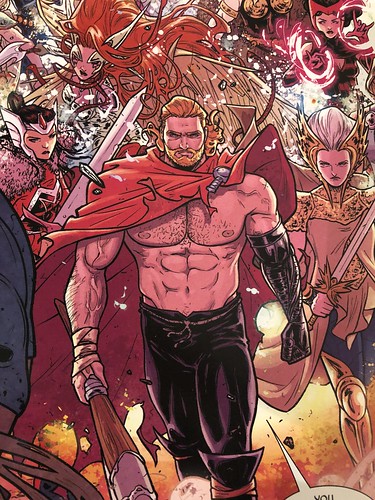
Truly, a comic with something for everybody. I can only hope this is the costume they go with for Chris Hemsworth in the next movie.
Midnight Nation by J. Michael Straczynski. This was a reread of the first comic I ever bought monthly that wasn't about superheroes. It's a story of loss and redemption starring police officer David Grey, who sees something unexplainable on a call and finds himself on a journey across America's forgotten underside to save his soul, accompanied by a woman who might be an angel or might be a devil meant to lead him to his fate. This was right when Gary Frank's art was in the "very realistic" phase but right before it slipped into "everyone has a grinning rictus of terror and looks at least 40 years older than they should" phase, so it tells the story well. I don't see this book referenced a lot, which is sad because it's really well done.
Orbiter, by Warren Ellis. The space shuttle Venture, missing in space for ten years, crash lands in Florida. It's covered in alien technology, and only one mute crew member remains inside. Where have they been? What happened to them? Why have they returned? Can the trio of specialists brought in to discover the truth solve the mystery? What does it mean for humanity if they do? This is a good science fiction story, and Colleen Doran's art is great. Again, I rarely if ever see people talk about this book, which is sad because it's good.
As for what's next on the comic reading list, I haven't decided yet, but I have a few more things sitting around waiting to be read.
So, what have I been reading? Well, in no particular order:
Check, Please! Book 2, by Ngozi Ukazu. Even though this is a web series, I somehow held out from reading the series and instead have been waiting for this book since my friend George sent me the first one a year or so ago. This was worth the wait, and I'm not kidding when I say I laughed, I cried (a lot; this thing had my emotions all over the place), and I read it again as soon as I finished.
The series follows the four year college journey of Eric "Bitty" Bittle, the figure skating son of a football coach. He's an expert baker, and walks onto the university hockey team due to his speed and spins, but is also hampered by his fear of physical contact on the ice. There are mixed reviews on Amazon, because some people are jackholes about profanity and gay relationships, but as a person who enjoys hockey, college settings, baking, and dynamic art styles, this book is wonderful. Reading the first one made me happy, and reading the second made me happier. I really cannot say enough good things about this.
Gotham High by Melissa De La Cruz. Boy was this a lot of noise about nothing. A reimagining of the Batman universe as a high school where Bruce Wayne, Selina Kyle, Jack Napier, and Harvey Dent are students, the racist and homophobic portions of the Bat-universe fanbase were all up in arms before this came out because a) almost every character is a racial or sexual minority in the story, and b) it was originally reported that many characters in the book would be sexually fluid, and that Bruce and Jack (Batman and the Joker) would "cross boundaries" during a threeway with Selina (Catwoman). That doesn't actually happen in the book. Really, this is just a regular Batman story of kidnappings, robbery, forgery, and other crimes both petty and major, in a slightly different setting. The art is decent, and the story is entertaining, but I was hoping for all the allegedly shocking controversy, so I was disappointed.
All seven paperbacks of the Mighty Thor, by Jason Aaron. Some of this was prep for the next Thor movie, and some of it was just because this is an outstanding run of comics. If you're not familiar, at the start of the run the Odinson has lost the power to lift Mjolnir, the hammer of Thor. Things are looking dire, when suddenly a new Thor appears and she's lifting the hammer just fine. Who is she? Where did she come from? Since this series is now a few years old, I'll go ahead and give the rest of the spoiler:
The new Thor is Dr. Jane Foster, and she has a problem. She's dying of cancer, and every time she lifts the hammer and becomes Thor she is healed of her chemotherapy, which means that being the mighty Thor is slowly killing her. This puts a ticking clock on the whole series, even as a ticking clock is also placed on Thor and the gods of Asgard, as the destroyer of gods is slowly coming for them. All that stands between them and oblivion is the mighty Thor, but she also stands on the brink of death. This is a story of heroism, sacrifice, family, and acceptance, as well as good old fashioned superheroes punching things. Also, the loss of his hammer leaves the Odinson with a costume of cape, pants, and no shirt, so there's also a lot of this:
Truly, a comic with something for everybody. I can only hope this is the costume they go with for Chris Hemsworth in the next movie.
Midnight Nation by J. Michael Straczynski. This was a reread of the first comic I ever bought monthly that wasn't about superheroes. It's a story of loss and redemption starring police officer David Grey, who sees something unexplainable on a call and finds himself on a journey across America's forgotten underside to save his soul, accompanied by a woman who might be an angel or might be a devil meant to lead him to his fate. This was right when Gary Frank's art was in the "very realistic" phase but right before it slipped into "everyone has a grinning rictus of terror and looks at least 40 years older than they should" phase, so it tells the story well. I don't see this book referenced a lot, which is sad because it's really well done.
Orbiter, by Warren Ellis. The space shuttle Venture, missing in space for ten years, crash lands in Florida. It's covered in alien technology, and only one mute crew member remains inside. Where have they been? What happened to them? Why have they returned? Can the trio of specialists brought in to discover the truth solve the mystery? What does it mean for humanity if they do? This is a good science fiction story, and Colleen Doran's art is great. Again, I rarely if ever see people talk about this book, which is sad because it's good.
As for what's next on the comic reading list, I haven't decided yet, but I have a few more things sitting around waiting to be read.
Sunday, April 19, 2020
Books and a Snack
"You must be reading so much during quarantine!"
Someone said this to me the other day, and I'm not sure that all of my friends get that "working from home" doesn't mean "laying around on my couch reading books". I am reading some, though, and the last time I counted up books for my year end tally was at the end of February, so here's everything I've read since then:
Movies (And Other Things) by Shea Serrano is a funny walk through a bunch of movies that Shea and I apparently have in common as favorites. Each chapter asks a question (Who had the worst death in "Kill Bill"? Did the Rockford Peaches make the right decision trading Kit? If all the high school movies were one movie, who would Regina George's friends be?) and then argues the way to the answer along with some funny illustrations. There are some thoughtful points here, and also some reminders that I should see some of these movies again if it's been too long since last time I did.
I like Robert R. McCammon, but Tales from Greystone Bay is too short. Each of the short stories here is a little interesting, but there are only three in the whole book, so I read it in less than a day. All three stories could have been fleshed out a little more, into novellas, and this would have been a lot better.
Harbor, by John Ajvide Lindquist, is an odd sort of horror story, starting out with an ordinary family and slowly building to ancient god-monsters, ghosts, human sacrifice, and destruction. In the middle of Scandinavian winter, Anders and Cecelia take their daughter, Maja, across the frozen channel to see the lighthouse. Somewhere on the way home, in clear weather and with their backs turned for only a second, Maja vanishes. Anders returns to the island a few years later, drunk and broken, and discovers that Maja isn't the only one to disappear from the village, but instead that one person disappears into the sea every year, and has for hundreds of years. There's also a weird subplot about a magic symbiotic insect that lets the host control water, which is the part of this that was really odd. This was marketed as horror, but not really scary or disturbing.
The Fortress at the End of Time, by Joe McDermott, was much more interesting. The entire novel is a long confession from Ronaldo Aldo, an Ensign from Earth stationed at the Citadel, the farthest human colony. Humanity is connected by the Ansible, a faster than light link that lets them transmit things and people along its length, sort of: patterns are sent along to Ansible and then assembled out of raw materials at the other end, so Aldo is actually a clone of Aldo, and if he gets promoted off of the Citadel, the Aldo sent to the next colony will be another clone, leaving the original and the Citadel clone behind. The Citadel is the last outpost of a century old galactic war, forever listening for the enemy's return, and Aldo will do anything to escape from it. As his confession unfolds, we find out exactly how much of anything.
Lev Grossman's Warp is a non-event. The story of Hollis, a recent college graduate still living near his school and struggling to force himself to get a job and become an adult, is like a worse version of "Catcher in the Rye", a feat I didn't think possible.
F. Paul Wilson's The Keep pits evil against evil in the Romanian alps of World War II. A garrison of Nazi soldiers is warned by the village not to spend the night in the Keep, the ancient fortress towering above them, but the soldiers pay them no mind. By the end of the first night, two soldiers are dead, and another dies each night, killed by an enemy that moves through shadows and drains them of blood. Trapped in the middle of the struggle, a Jewish professor of folklore and his daughter must decide whether to side with the evil of the supernatural or the evil of humanity without becoming monsters themselves.
Masked, a story collection edited by Lou Anders, is a fantastic set of superhero stories, written by some of the biggest names in the industry. Authors include Gail Simone, Bill Willingham, Mike Carey, Peter David, and more, and all of the characters are originals. There are some great stories in here, and the one that finishes the book was amazing.
Like I said at the beginning, though, reading isn't all I've been doing. I've also been sitting at my new desk a lot for work. Since my new desk is right next to my kitchen, a problem a lot of my friends are having (I'm not naming names, but one of my friends set up her work from home station on the second floor so that every time she contemplates getting a snack she has to decide if it's worth a trip up and down the stairs), I'm struggling with the idea of having snacks only feet away. I'm also trying to eat better in isolation, going lower carb and looking for healthy snacks, and I landed on nuts. I'm allergic to some kind of nuts, but I love peanuts and cashews. In perusing the nut selection at Kroger, though, I discovered that getting spiced, flavored nuts adds a dollar or two per can, and I can just do that myself for cheap.
So...
Homemade Spiced Nuts
1 egg white
2 cups nuts (unsalted or lightly salted)
1 tablespoon brown sugar (the recipe called for 3, but like I said I'm trying to cut back on carbs)
4 tablespoons total of spices
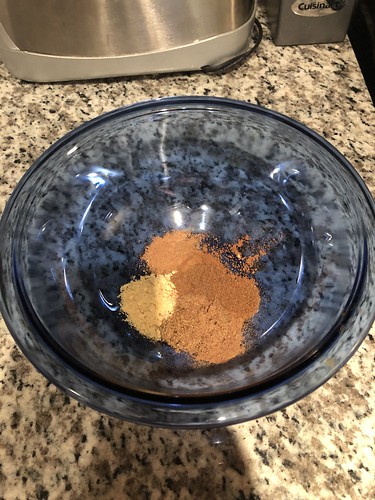
You can use whatever kind of spices you want. The recipe wanted oregano, thyme, parsley, and chili powder, but again, this is up to you and what you have in the cabinet. This time, I wanted something mustard based, and a lot of recipes pair mustard with cinnamon, so I went with dry mustard, cinnamon, nutmeg, and Chinese 5 spice:
Preheat your oven to 250 F.
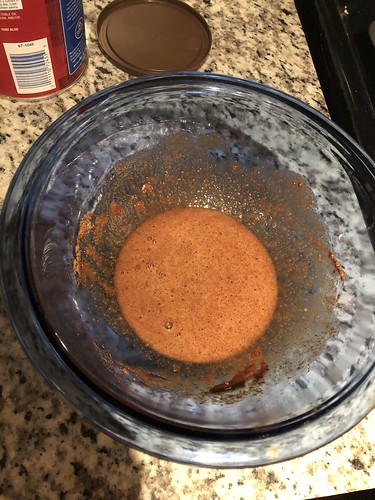
Mix the egg white into the spices:
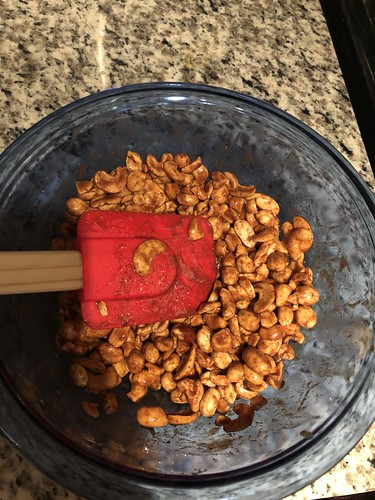
and then add the nuts and stir them around to get them really coated:
Spread your nuts out on a cookie sheet:

Bake for 15 minutes, then stir them around a little on the sheet (some of them might be stuck together, so break them up a little with the spatula), bake for 15 more minutes, stir again, then bake for 15 more minutes and take them out. They'll be hot and soft, so leave them alone on the cookie sheet for 15 more minutes, then put them into a container:
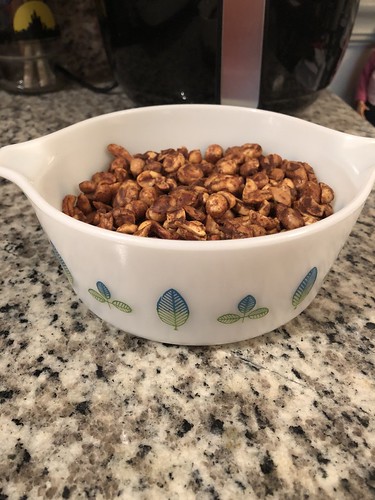
and you have homemade spiced nuts. The recipe said they will keep for 5 days as long as you keep a lid on your container, but these aren't going to last five days.
If you're wondering how mine turned out, they're good, but I can't taste the mustard at all, and it might have been a bit of a waste. They're still good, though, and I've been munching a handful every time I pass my desk even though they are supposed to be for work this week.
For the next batch, I'm thinking of going for an Indian sort of mix, with curry, ginger, and garam masala. That should be low key delicious.
Someone said this to me the other day, and I'm not sure that all of my friends get that "working from home" doesn't mean "laying around on my couch reading books". I am reading some, though, and the last time I counted up books for my year end tally was at the end of February, so here's everything I've read since then:
Movies (And Other Things) by Shea Serrano is a funny walk through a bunch of movies that Shea and I apparently have in common as favorites. Each chapter asks a question (Who had the worst death in "Kill Bill"? Did the Rockford Peaches make the right decision trading Kit? If all the high school movies were one movie, who would Regina George's friends be?) and then argues the way to the answer along with some funny illustrations. There are some thoughtful points here, and also some reminders that I should see some of these movies again if it's been too long since last time I did.
I like Robert R. McCammon, but Tales from Greystone Bay is too short. Each of the short stories here is a little interesting, but there are only three in the whole book, so I read it in less than a day. All three stories could have been fleshed out a little more, into novellas, and this would have been a lot better.
Harbor, by John Ajvide Lindquist, is an odd sort of horror story, starting out with an ordinary family and slowly building to ancient god-monsters, ghosts, human sacrifice, and destruction. In the middle of Scandinavian winter, Anders and Cecelia take their daughter, Maja, across the frozen channel to see the lighthouse. Somewhere on the way home, in clear weather and with their backs turned for only a second, Maja vanishes. Anders returns to the island a few years later, drunk and broken, and discovers that Maja isn't the only one to disappear from the village, but instead that one person disappears into the sea every year, and has for hundreds of years. There's also a weird subplot about a magic symbiotic insect that lets the host control water, which is the part of this that was really odd. This was marketed as horror, but not really scary or disturbing.
The Fortress at the End of Time, by Joe McDermott, was much more interesting. The entire novel is a long confession from Ronaldo Aldo, an Ensign from Earth stationed at the Citadel, the farthest human colony. Humanity is connected by the Ansible, a faster than light link that lets them transmit things and people along its length, sort of: patterns are sent along to Ansible and then assembled out of raw materials at the other end, so Aldo is actually a clone of Aldo, and if he gets promoted off of the Citadel, the Aldo sent to the next colony will be another clone, leaving the original and the Citadel clone behind. The Citadel is the last outpost of a century old galactic war, forever listening for the enemy's return, and Aldo will do anything to escape from it. As his confession unfolds, we find out exactly how much of anything.
Lev Grossman's Warp is a non-event. The story of Hollis, a recent college graduate still living near his school and struggling to force himself to get a job and become an adult, is like a worse version of "Catcher in the Rye", a feat I didn't think possible.
F. Paul Wilson's The Keep pits evil against evil in the Romanian alps of World War II. A garrison of Nazi soldiers is warned by the village not to spend the night in the Keep, the ancient fortress towering above them, but the soldiers pay them no mind. By the end of the first night, two soldiers are dead, and another dies each night, killed by an enemy that moves through shadows and drains them of blood. Trapped in the middle of the struggle, a Jewish professor of folklore and his daughter must decide whether to side with the evil of the supernatural or the evil of humanity without becoming monsters themselves.
Masked, a story collection edited by Lou Anders, is a fantastic set of superhero stories, written by some of the biggest names in the industry. Authors include Gail Simone, Bill Willingham, Mike Carey, Peter David, and more, and all of the characters are originals. There are some great stories in here, and the one that finishes the book was amazing.
Like I said at the beginning, though, reading isn't all I've been doing. I've also been sitting at my new desk a lot for work. Since my new desk is right next to my kitchen, a problem a lot of my friends are having (I'm not naming names, but one of my friends set up her work from home station on the second floor so that every time she contemplates getting a snack she has to decide if it's worth a trip up and down the stairs), I'm struggling with the idea of having snacks only feet away. I'm also trying to eat better in isolation, going lower carb and looking for healthy snacks, and I landed on nuts. I'm allergic to some kind of nuts, but I love peanuts and cashews. In perusing the nut selection at Kroger, though, I discovered that getting spiced, flavored nuts adds a dollar or two per can, and I can just do that myself for cheap.
So...
Homemade Spiced Nuts
1 egg white
2 cups nuts (unsalted or lightly salted)
1 tablespoon brown sugar (the recipe called for 3, but like I said I'm trying to cut back on carbs)
4 tablespoons total of spices
You can use whatever kind of spices you want. The recipe wanted oregano, thyme, parsley, and chili powder, but again, this is up to you and what you have in the cabinet. This time, I wanted something mustard based, and a lot of recipes pair mustard with cinnamon, so I went with dry mustard, cinnamon, nutmeg, and Chinese 5 spice:
Preheat your oven to 250 F.
Mix the egg white into the spices:
and then add the nuts and stir them around to get them really coated:
Spread your nuts out on a cookie sheet:
Bake for 15 minutes, then stir them around a little on the sheet (some of them might be stuck together, so break them up a little with the spatula), bake for 15 more minutes, stir again, then bake for 15 more minutes and take them out. They'll be hot and soft, so leave them alone on the cookie sheet for 15 more minutes, then put them into a container:
and you have homemade spiced nuts. The recipe said they will keep for 5 days as long as you keep a lid on your container, but these aren't going to last five days.
If you're wondering how mine turned out, they're good, but I can't taste the mustard at all, and it might have been a bit of a waste. They're still good, though, and I've been munching a handful every time I pass my desk even though they are supposed to be for work this week.
For the next batch, I'm thinking of going for an Indian sort of mix, with curry, ginger, and garam masala. That should be low key delicious.
Sunday, April 12, 2020
The Rainbow Ribbon Mold
We get Good Friday off from work. We don't call it Good Friday, because there's a separation of church and state, so instead we actually get Spring Recess off. It's a floating holiday that always just happens to land on Good Friday every year, but never happens to land on Passover, Purim, Vesak, or any other religious holiday that occurs in Spring. There also aren't any floating holidays on our calendars that land on those days, so we don't get them off.
Since we had Friday off, for whatever reason, I spent the morning assembling a desk to take zoom calls at, rather than taking zoom calls. Working from home has been an interesting experience so far, but I really needed a work space, rather than a recliner and TV tray. I don't have a dining room set, because I live alone, so I ordered a folding table from Amazon. Amazon shipped my folding table from Indianapolis to Nashville, and then lost track of it on the three hour drive from Nashville to Knoxville, so after they refunded it I ordered a desk that I put together on Friday morning. I only hit myself in the head with a piece of the desk one time, so assembly went fairly well.
Now that I have a desk, I've suddenly started eating at it, and feeling like I need to sit at it and do projects and things. Since I didn't want to do work on the weekend, as I am trying really hard to separate work activities and home activities while both are taking place in the same place, I looked around my apartment for other projects I could do at my desk.
Rather than write a novel, I decided to make Jello.
Like most totally normal home cooks, I have ten Jello cookbooks, dating back several decades. In reading them at my desk, I noticed two important things:
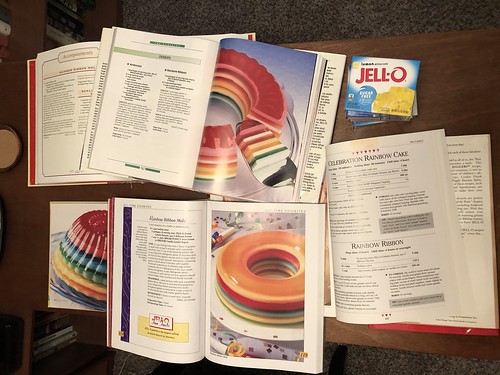
1) Almost all of them feature the Rainbow Ribbon Mold, and
2) the Rainbow Ribbon Mold only requires two ingredients, which I have here in the house during lockdown.
The Rainbow Ribbon Mold recipe calls for 5 flavors of Jello and sour cream, although you could make it in five layers with the same flavor of Jello as long as you have five boxes. The only real challenge to the recipe is the time and patience required, and God knows that now is a great time to work on patience.
I assembled my five boxes of Jello (I had six, in case the mold turned out to be bigger than I thought, but it turned out to be smaller, so I only got through ROYG, rather than ROYGBV) my mold, a Tupperware Jello mold that my friend Donna sent me a few years ago, when I was experimenting with Jello more often, and a collection of measuring cups of various sizes for easy microwaving and pouring.
The recipe is fairly easy: you make a box of Jello (using less water than the box instructions specify so that your Jello stays firm), and then half of it goes into the mold to set in a layer. The other half gets mixed with a few tablespoons of sour cream, to make a color-tinted creamy layer, and when the first half is set you spoon the creamy layer on top of the clear layer. After the creamy layer sets, you repeat the process.
Being an impatient person who needs to learn patience, I tried to rush the first layer setting by putting the mold in an ice bath. The mold would float evenly, though, so I had to give up on this idea or else end up with badly crooked layers.

Instead, I got a book, and started setting the timer, over and over, figuring out from the red layers how long it would be:
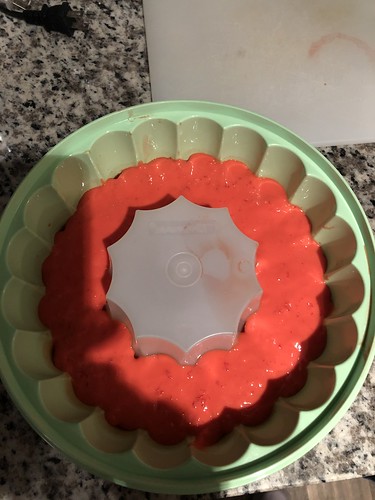
After the red layer, I fell into a routine:
1) Microwave water for clear layer. Mix in Jello, and put that container in the fridge for about twenty minutes.
2) Check consistency of foam layer by dropping one droplet of clear onto it. If it's ready, measure out clear layer, then carefully add it to the mold. Do not pour it directly into the mold, because the force of the pour may punch through the foam layer. Either spoon it in, or pour it onto a spoon over the mold to blunt the pour.
3) Put the rest of the clear in the fridge for ten minutes. Microwave and mix the next color, and let it cool on the counter for a bit.
4) Take out the rest of the current clear layer and mix in the sour cream to make the next foam layer. Set timer for ten more minutes, but do not put foam layer back in fridge or it will firm up too much.
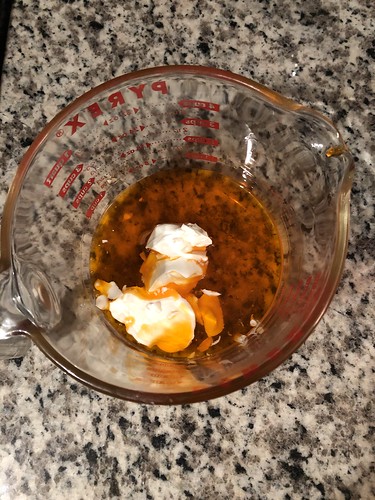
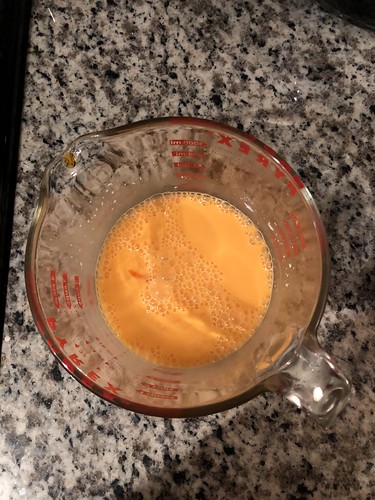
5) Check consistency of the clear layer in the mold, and add foam layer. Set timer for ten more minutes.
6) After ten minutes, put the next color in the fridge and set the timer for ten more minutes. Wash the measuring cup you used for the foam layer you just added. I used a 4 cup and an 8 cup to mix the Jello in, and a one cup for other measuring.
7) You're now back at Step 2.
The mold stays in the fridge almost the entire time, and after the first layer the setting time between layers is a little shorter because you're putting the Jello onto a cold surface. Even with all that, you may need a few extra minutes on each set based on your fridge. When I finally finished all the layers, I put the lid on the mold and ignored it for six hours.
And then it was time to unmold.
To unmold, you dip the mold into a bowl of hot water for a few seconds, but that's the tricky part: too long in the hot water, and your Jello starts to melt. Too short, and it won't release from the mold. You have to try to guess as best you can in an interval of only 5 to 10 seconds, and sometimes you hit it and sometimes you don't. I dipped, put a plate over the top of the mold, and turned it over.
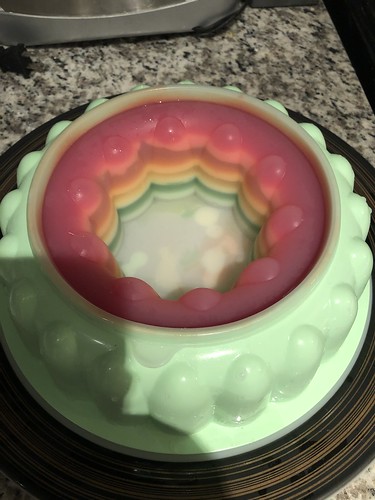
Layers! Red, orange, yellow, and green! If I'd used my Bundt pan, which is deeper, I would have gotten blue in there, too. The mold still wasn't out of the mold, though. Would my layers survive?
I didn't quite dip long enough. A little of the green foam, which was the bottom layer on the plate after being the top layer in the mold:
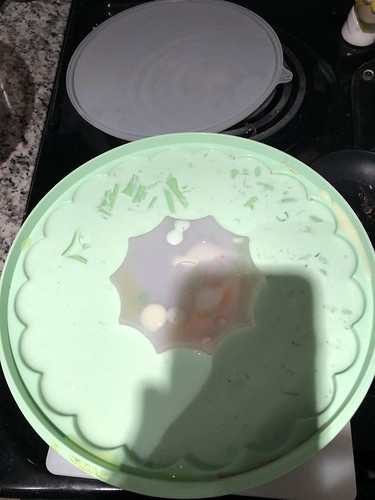
came off and stuck to the mold.

Still, I think I was pretty successful with my showstopper.


Several friends asked how it tastes, and it just tastes like fruity Jello. The sour cream has no flavor at all, most likely because the flavor of Jello is so strong, and you can't really taste the individual Jello flavors when you're getting several in each bite. If you use the sugar-free Jello, this probably even counts as diet food.
Just be sure you have a book and a lot of time to sit around between settings.
Since we had Friday off, for whatever reason, I spent the morning assembling a desk to take zoom calls at, rather than taking zoom calls. Working from home has been an interesting experience so far, but I really needed a work space, rather than a recliner and TV tray. I don't have a dining room set, because I live alone, so I ordered a folding table from Amazon. Amazon shipped my folding table from Indianapolis to Nashville, and then lost track of it on the three hour drive from Nashville to Knoxville, so after they refunded it I ordered a desk that I put together on Friday morning. I only hit myself in the head with a piece of the desk one time, so assembly went fairly well.
Now that I have a desk, I've suddenly started eating at it, and feeling like I need to sit at it and do projects and things. Since I didn't want to do work on the weekend, as I am trying really hard to separate work activities and home activities while both are taking place in the same place, I looked around my apartment for other projects I could do at my desk.
Rather than write a novel, I decided to make Jello.
Like most totally normal home cooks, I have ten Jello cookbooks, dating back several decades. In reading them at my desk, I noticed two important things:
1) Almost all of them feature the Rainbow Ribbon Mold, and
2) the Rainbow Ribbon Mold only requires two ingredients, which I have here in the house during lockdown.
The Rainbow Ribbon Mold recipe calls for 5 flavors of Jello and sour cream, although you could make it in five layers with the same flavor of Jello as long as you have five boxes. The only real challenge to the recipe is the time and patience required, and God knows that now is a great time to work on patience.
I assembled my five boxes of Jello (I had six, in case the mold turned out to be bigger than I thought, but it turned out to be smaller, so I only got through ROYG, rather than ROYGBV) my mold, a Tupperware Jello mold that my friend Donna sent me a few years ago, when I was experimenting with Jello more often, and a collection of measuring cups of various sizes for easy microwaving and pouring.
The recipe is fairly easy: you make a box of Jello (using less water than the box instructions specify so that your Jello stays firm), and then half of it goes into the mold to set in a layer. The other half gets mixed with a few tablespoons of sour cream, to make a color-tinted creamy layer, and when the first half is set you spoon the creamy layer on top of the clear layer. After the creamy layer sets, you repeat the process.
Being an impatient person who needs to learn patience, I tried to rush the first layer setting by putting the mold in an ice bath. The mold would float evenly, though, so I had to give up on this idea or else end up with badly crooked layers.
Instead, I got a book, and started setting the timer, over and over, figuring out from the red layers how long it would be:
After the red layer, I fell into a routine:
1) Microwave water for clear layer. Mix in Jello, and put that container in the fridge for about twenty minutes.
2) Check consistency of foam layer by dropping one droplet of clear onto it. If it's ready, measure out clear layer, then carefully add it to the mold. Do not pour it directly into the mold, because the force of the pour may punch through the foam layer. Either spoon it in, or pour it onto a spoon over the mold to blunt the pour.
3) Put the rest of the clear in the fridge for ten minutes. Microwave and mix the next color, and let it cool on the counter for a bit.
4) Take out the rest of the current clear layer and mix in the sour cream to make the next foam layer. Set timer for ten more minutes, but do not put foam layer back in fridge or it will firm up too much.
5) Check consistency of the clear layer in the mold, and add foam layer. Set timer for ten more minutes.
6) After ten minutes, put the next color in the fridge and set the timer for ten more minutes. Wash the measuring cup you used for the foam layer you just added. I used a 4 cup and an 8 cup to mix the Jello in, and a one cup for other measuring.
7) You're now back at Step 2.
The mold stays in the fridge almost the entire time, and after the first layer the setting time between layers is a little shorter because you're putting the Jello onto a cold surface. Even with all that, you may need a few extra minutes on each set based on your fridge. When I finally finished all the layers, I put the lid on the mold and ignored it for six hours.
And then it was time to unmold.
To unmold, you dip the mold into a bowl of hot water for a few seconds, but that's the tricky part: too long in the hot water, and your Jello starts to melt. Too short, and it won't release from the mold. You have to try to guess as best you can in an interval of only 5 to 10 seconds, and sometimes you hit it and sometimes you don't. I dipped, put a plate over the top of the mold, and turned it over.
Layers! Red, orange, yellow, and green! If I'd used my Bundt pan, which is deeper, I would have gotten blue in there, too. The mold still wasn't out of the mold, though. Would my layers survive?
I didn't quite dip long enough. A little of the green foam, which was the bottom layer on the plate after being the top layer in the mold:
came off and stuck to the mold.
Still, I think I was pretty successful with my showstopper.
Several friends asked how it tastes, and it just tastes like fruity Jello. The sour cream has no flavor at all, most likely because the flavor of Jello is so strong, and you can't really taste the individual Jello flavors when you're getting several in each bite. If you use the sugar-free Jello, this probably even counts as diet food.
Just be sure you have a book and a lot of time to sit around between settings.
Saturday, April 4, 2020
Dueling Bread Bakes
Are you making banana bread this weekend?
I'm asking because it seems like everyone's quarantine bananas went past ripe at the same time this week, since five people I know were making banana bread yesterday. I found out because I was also making banana bread yesterday, and when I mentioned it in texts or on social media, everyone else chimed in. My friend Kathryn and I compared recipes, and ended up both using the same one, a basic, easy to follow recipe from the Food Network. Kathryn decided to put chocolate chips in hers, and I opted not to, but other than that we both followed the same recipe.
When we compared breads, though, an odd thing happened.
Kathryn's bread:

is much lighter in color than my bread:
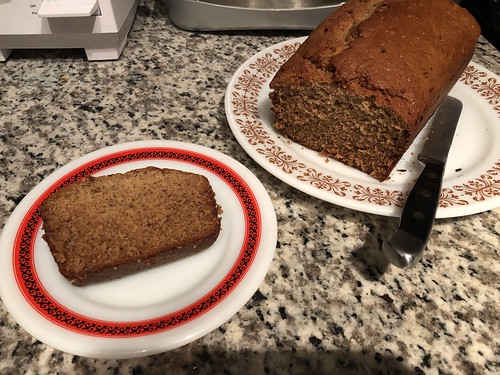
Both of us were very intrigued by this, so we started comparing notes.
Pan: Kathryn used a metal pan, and I used a vintage glass Pyrex pan. I don't have any metal loaf pans, and Kathryn doesn't have any glass ones.
Baking time: I baked mine for an hour and ten minutes, and Kathryn baked hers for an hour.
Cooling time: Kathryn cooled hers for fifteen minutes in the pan, then for 45 minutes on a cooling rack. I cooled mine for an hour in the pan.
Other than those three things, we couldn't spot any other differences, so today we turned to our friend Stacy, a much better and more experienced baker than me and, possibly, Kathryn. (I don't want to say for sure that Stacy is a better baker than Kathryn because I've never directly compared, so we'll just say she's better than me and leave it there.) Stacy offered the following ideas:
1) Different baking times are definitely a factor.
2) Even though we both set our ovens to what we think is the same temperature, our ovens are not precisely calibrated, and there may actually be differences. This never occurred to me, but it makes sense.
3) One of us may have had riper bananas, which would have more sugar.
4) The chocolate chips increased the volume of Kathryn's loaf, so we should have had different baking times. Stacy thinks Kathryn should have had a longer baking time, not a shorter one, which could support the idea that our oven temperatures are a little different, or raises the possibility that mine may actually be a little bit overbaked. (I raised that possibility. Stacy did not.)
Both of us agree that our bread tastes good, but we both live alone, so there are no second opinions.
You'll have to take our word for it.
I'm asking because it seems like everyone's quarantine bananas went past ripe at the same time this week, since five people I know were making banana bread yesterday. I found out because I was also making banana bread yesterday, and when I mentioned it in texts or on social media, everyone else chimed in. My friend Kathryn and I compared recipes, and ended up both using the same one, a basic, easy to follow recipe from the Food Network. Kathryn decided to put chocolate chips in hers, and I opted not to, but other than that we both followed the same recipe.
When we compared breads, though, an odd thing happened.
Kathryn's bread:
is much lighter in color than my bread:
Both of us were very intrigued by this, so we started comparing notes.
Pan: Kathryn used a metal pan, and I used a vintage glass Pyrex pan. I don't have any metal loaf pans, and Kathryn doesn't have any glass ones.
Baking time: I baked mine for an hour and ten minutes, and Kathryn baked hers for an hour.
Cooling time: Kathryn cooled hers for fifteen minutes in the pan, then for 45 minutes on a cooling rack. I cooled mine for an hour in the pan.
Other than those three things, we couldn't spot any other differences, so today we turned to our friend Stacy, a much better and more experienced baker than me and, possibly, Kathryn. (I don't want to say for sure that Stacy is a better baker than Kathryn because I've never directly compared, so we'll just say she's better than me and leave it there.) Stacy offered the following ideas:
1) Different baking times are definitely a factor.
2) Even though we both set our ovens to what we think is the same temperature, our ovens are not precisely calibrated, and there may actually be differences. This never occurred to me, but it makes sense.
3) One of us may have had riper bananas, which would have more sugar.
4) The chocolate chips increased the volume of Kathryn's loaf, so we should have had different baking times. Stacy thinks Kathryn should have had a longer baking time, not a shorter one, which could support the idea that our oven temperatures are a little different, or raises the possibility that mine may actually be a little bit overbaked. (I raised that possibility. Stacy did not.)
Both of us agree that our bread tastes good, but we both live alone, so there are no second opinions.
You'll have to take our word for it.
Sunday, March 29, 2020
"Gotta use up this flour..."
Back at the beginning of the month, which seems an incredibly distant time in light of current circumstances but turns out to be less than 30 days ago, I baked a fancy banana bread for my friends. They enjoyed it, and ate it all, but it used up almost all of the flour I had in the house. I added flour to my grocery list without a second thought, but that was the week when Knoxville decided to start panic buying, and it has taken until this past Wednesday to have flour in stock at Kroger again.
The last bag of flour.
It turned out to be a 5 pound bag, which is larger than my flour cannister will hold. I'm sure there are people who just sit the bag of flour in their cabinet and think nothing of it, but I'm always worried that if I leave the flour just sitting in the bag then bugs of some kind (weevils? mites? centipedes, which are not a bug but are an arthropod?) will get into it, even though I've never seen a bug in my kitchen. Unwilling to leave this flour just sitting out as an insect buffet after I waited almost a month to be able to buy it, I decided that I would use it up this weekend instead.
The first thing I made was scones. I've been using the same scone recipe since 2011, but my recipe is for pear and goat cheese scones, and I didn't have any pears in the house. I did have an apple, though, so I decided on apple cheddar scones instead.
I chunked up my apple:

peeled and finely diced it, and lumped everything into my scone batter:

and baked them. I didn't bother shaping them, and instead just made them like haystacks of dough:
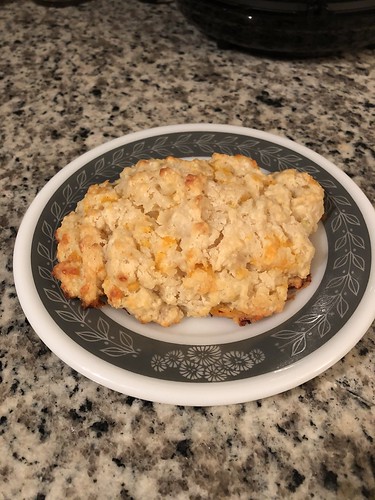
and they came out fine.
That didn't use up enough flour, though, so I thought about what else I could make, and decided on a quick bread. Years ago, Food Network Magazine published a 50 Quick Breads recipe guide in the magazine, and I've never gone wrong using it. I looked around the pantry and saw half a bag of dried figs leftover from when I made a flatbread with figs on it and an almost empty bottle of honey (I had a spare right behind it), so I decided to make the honey bread (number 30) and add the figs to it. Calling this a bread is misleading, though, because it's really a fig and honey poundcake.
The batter came together quickly and fairly easily, and then I decided to try something new. Every time I make a bread with things in it, most of the things sink to the bottom. I've seen people on Food Network talk about how you have to toss your add ins in flour, so that they suspend in the dough rather than sinking, but I've never actually tried it. I saved back an eighth of a cup of the flour that was supposed to go into the batter and tossed the diced figs in it:
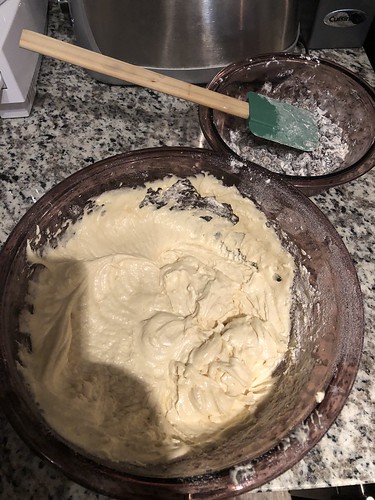
The figs were folded into the batter, the batter went into the loaf pan:

(Look! You can see figs floating near the top!) and it worked:

Fig and honey bread with figs in pretty much every bite. I can't really taste the honey, but I can taste the figs, and I love figs, so this is delicious. Next time I have dinner at a friend's house I might even bring this as dessert.
I figured this was enough baking, and decided to pause until Sunday.
This morning I was originally planning to make chocolate chip cookies, but they called for a lot of eggs, and I was worried about using up too many eggs in one weekend. I also used a crap ton of butter this weekend between the baking and a lemon pasta dish, but I had extra butter in the freezer, so I wasn't as worried about that. Changing gears, I decided to make shortbread cookies instead, because I've made them once before, they use the same amount of butter and flour as the chocolate chip cookies, and they only use one egg.
I couldn't remember what recipe I used when I made these before, but a quick google search turned up this really easy one, and it mostly worked with one minor snag.
After mixing up the dough:
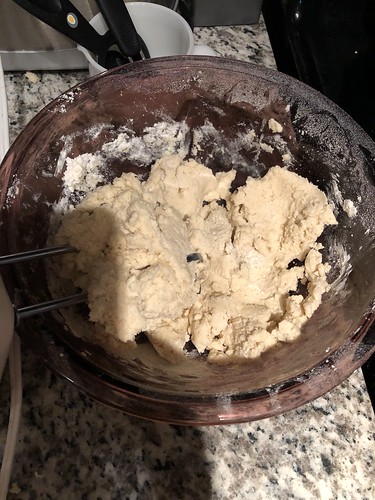
I went to eject the mixer blades so I could get the dough out of them, and I accidentally hit spin instead. Little pieces of dough, all over the counter and the stove:

I guess it got mixed a little more than I intended it to.
I got the dough back together in the bowl, pressing it into a ball with my hands, and then dumped it onto my floured countertop. Learning from my recent troubles with piecrust I floured my rolling pin and rolled the dough out to the right thickness. Once that was done, I used my hands to shape it into a square to cut out evenly sized cookies:

I cut them into triangles and got them to the cookie sheet with a minimum of trouble, then separated an egg to make an egg white wash for the top:
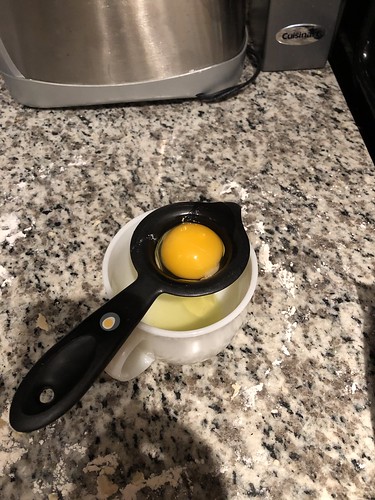
The recipe said to put sanding sugar on top, but I didn't have any. I did have leftover gold colored sugar from making Unicorn Fudge a few years ago, so I used that instead, and it actually came out really pretty:

It's sparkly and shiny, and gave the tops a nice crunch.
Tomorrow night, I'll probably make some banana bread, because I have bananas to use up, too.
The last bag of flour.
It turned out to be a 5 pound bag, which is larger than my flour cannister will hold. I'm sure there are people who just sit the bag of flour in their cabinet and think nothing of it, but I'm always worried that if I leave the flour just sitting in the bag then bugs of some kind (weevils? mites? centipedes, which are not a bug but are an arthropod?) will get into it, even though I've never seen a bug in my kitchen. Unwilling to leave this flour just sitting out as an insect buffet after I waited almost a month to be able to buy it, I decided that I would use it up this weekend instead.
The first thing I made was scones. I've been using the same scone recipe since 2011, but my recipe is for pear and goat cheese scones, and I didn't have any pears in the house. I did have an apple, though, so I decided on apple cheddar scones instead.
I chunked up my apple:
peeled and finely diced it, and lumped everything into my scone batter:
and baked them. I didn't bother shaping them, and instead just made them like haystacks of dough:
and they came out fine.
That didn't use up enough flour, though, so I thought about what else I could make, and decided on a quick bread. Years ago, Food Network Magazine published a 50 Quick Breads recipe guide in the magazine, and I've never gone wrong using it. I looked around the pantry and saw half a bag of dried figs leftover from when I made a flatbread with figs on it and an almost empty bottle of honey (I had a spare right behind it), so I decided to make the honey bread (number 30) and add the figs to it. Calling this a bread is misleading, though, because it's really a fig and honey poundcake.
The batter came together quickly and fairly easily, and then I decided to try something new. Every time I make a bread with things in it, most of the things sink to the bottom. I've seen people on Food Network talk about how you have to toss your add ins in flour, so that they suspend in the dough rather than sinking, but I've never actually tried it. I saved back an eighth of a cup of the flour that was supposed to go into the batter and tossed the diced figs in it:
The figs were folded into the batter, the batter went into the loaf pan:
(Look! You can see figs floating near the top!) and it worked:
Fig and honey bread with figs in pretty much every bite. I can't really taste the honey, but I can taste the figs, and I love figs, so this is delicious. Next time I have dinner at a friend's house I might even bring this as dessert.
I figured this was enough baking, and decided to pause until Sunday.
This morning I was originally planning to make chocolate chip cookies, but they called for a lot of eggs, and I was worried about using up too many eggs in one weekend. I also used a crap ton of butter this weekend between the baking and a lemon pasta dish, but I had extra butter in the freezer, so I wasn't as worried about that. Changing gears, I decided to make shortbread cookies instead, because I've made them once before, they use the same amount of butter and flour as the chocolate chip cookies, and they only use one egg.
I couldn't remember what recipe I used when I made these before, but a quick google search turned up this really easy one, and it mostly worked with one minor snag.
After mixing up the dough:
I went to eject the mixer blades so I could get the dough out of them, and I accidentally hit spin instead. Little pieces of dough, all over the counter and the stove:
I guess it got mixed a little more than I intended it to.
I got the dough back together in the bowl, pressing it into a ball with my hands, and then dumped it onto my floured countertop. Learning from my recent troubles with piecrust I floured my rolling pin and rolled the dough out to the right thickness. Once that was done, I used my hands to shape it into a square to cut out evenly sized cookies:
I cut them into triangles and got them to the cookie sheet with a minimum of trouble, then separated an egg to make an egg white wash for the top:
The recipe said to put sanding sugar on top, but I didn't have any. I did have leftover gold colored sugar from making Unicorn Fudge a few years ago, so I used that instead, and it actually came out really pretty:
It's sparkly and shiny, and gave the tops a nice crunch.
Tomorrow night, I'll probably make some banana bread, because I have bananas to use up, too.
Sunday, March 15, 2020
A Greek Tragedy on Pi Day
So many of the best Greek tragedies, and really tragedies in general, rest on the idea of hubris. Generally one thinks of hubris, if one thinks of it at all, as a folly of youth, but I'm here to tell you a tale of hubris from yesterday morning, starring me and a pie crust.
Our story begins, as so many do, with a tiny act. See, a few months ago I bought my friend a Harry Potter spatula at Williams Sonoma, and let them email my receipt rather than printing a paper one. Since that day, I receive one to three emails from Williams Sonoma a day telling me about sales and reasons why I should rush to their store to by four hundred dollar toasters and hundred dollar mixing bowls. Yesterday morning, for Pi Day, they sent me one about "6 Pie Essentials", which I casually deleted and then tweeted about.
Thanks for your thoughtful email, Williams Sonoma, but I don't really need 6 pie-making essentials right now.
Please email when you have toilet paper.
The stage is now set to move on with our story.
Around lunch time yesterday, after a morning of cleaning, laundry, reading, and video games, I realized that I didn't have any pie to celebrate Pi Day. I thought about running to the store to pick up a small one, but then remembered that I'm supposed to be practicing social distancing right now, and trying to stay in my apartment instead of running out to the store whenever the impulse hits me.
"What if I just made a pie?" I thought, surveying the contents of my cabinets. Mixed in with a dozen boxes of Jello, I noticed a box of instant chocolate pudding and pie filling. "All I need, really, is a pie crust. People make pie crust all the time. How hard can it be? I mean, I own a hundred cookbooks. One of them must have a recipe."
So, hours after casually mocking the idea that there are pie essentials that I might need help with (making pie crust is probably one of them), I decide to make a pie.
Hubris.
Now, on with our tragedy. I started by surveying the book case where I keep most of my cookbooks:

My parents got that bookcase as a wedding gift. It has survived a dozen moves over the years, and the only damage is a chip in the corner of one of the sliding door panels. It holds most of my cookbooks, although there is a shelf of overflow cookbooks in the second bedroom, which I sometimes grandly refer to as The Library. I picked through for a few minutes, and found a basic recipe for pie crust. I had all the ingredients, so I preheated the oven and got started on the pie crust.
The recipe said that the butter needed to be really cold, so I cubed it and then put it in the freezer for ten minutes:

Then I prepared to cut the butter into the flour and salt:

After adding the ice cold water, the recipe insisted that I now had pie dough.
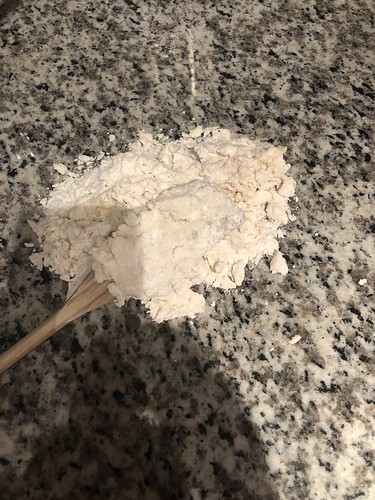
It didn't look like pie dough. It looked like a pile of sad ruins, but I had now used butter and flour on it during our time of social distance, which meant I shouldn't waste it to just make pudding. I soldiered onward, and followed the instructions, which said to roll out my dough.
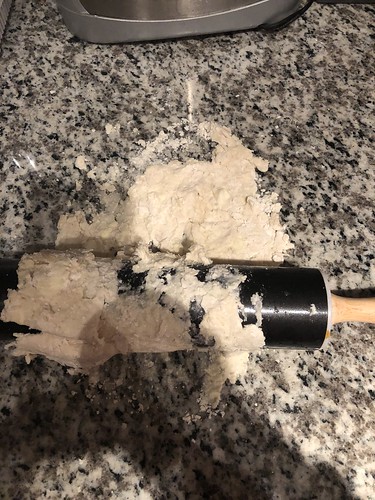
The recipe gave no indication that the dough could stick to the rolling pin. When I talked to my mom this morning about it she casually said, "Oh, you didn't put enough flour on your rolling pin," but the recipe didn't say to put any flour on the rolling pin. I pointed this out, and mom added, "Everyone knows you put flour on the rolling pin."
I guess everyone doesn't know, but maybe it was one of the six essential tips that I, in my hubris, deleted and mocked.
Eventually, I gave up on trying to roll out the dough, and just plopped it into the pan and pressed it into shape with my fingers.
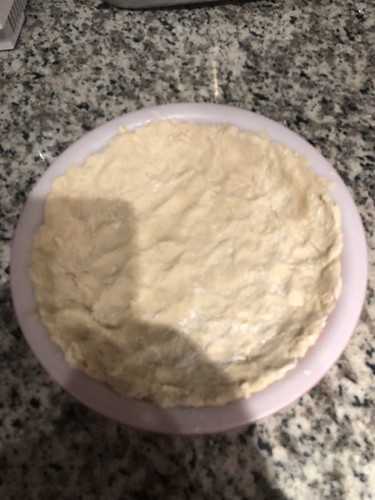
This is not ideal pie crust.
I baked it anyway and it came out even worse.
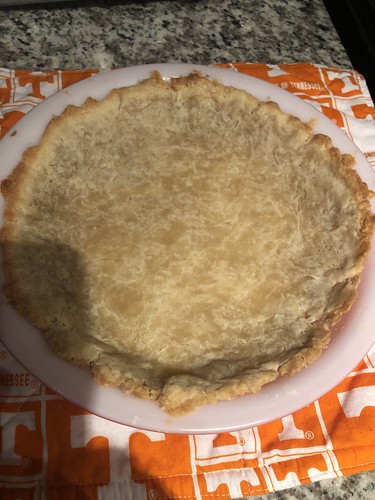
Actual bakers are probably staring at that in horror, but I was all in at this point. I waited for it to cool, then filled it with my newly mixed chocolate pie filling and put it in the fridge. The finished product looked mostly like a pie, with sloppy edges.

It sliced right up, though:


and it tastes fine.
It would probably taste a little better if I'd followed those six essential pie tips, though.
Our story begins, as so many do, with a tiny act. See, a few months ago I bought my friend a Harry Potter spatula at Williams Sonoma, and let them email my receipt rather than printing a paper one. Since that day, I receive one to three emails from Williams Sonoma a day telling me about sales and reasons why I should rush to their store to by four hundred dollar toasters and hundred dollar mixing bowls. Yesterday morning, for Pi Day, they sent me one about "6 Pie Essentials", which I casually deleted and then tweeted about.
Thanks for your thoughtful email, Williams Sonoma, but I don't really need 6 pie-making essentials right now.
Please email when you have toilet paper.
The stage is now set to move on with our story.
Around lunch time yesterday, after a morning of cleaning, laundry, reading, and video games, I realized that I didn't have any pie to celebrate Pi Day. I thought about running to the store to pick up a small one, but then remembered that I'm supposed to be practicing social distancing right now, and trying to stay in my apartment instead of running out to the store whenever the impulse hits me.
"What if I just made a pie?" I thought, surveying the contents of my cabinets. Mixed in with a dozen boxes of Jello, I noticed a box of instant chocolate pudding and pie filling. "All I need, really, is a pie crust. People make pie crust all the time. How hard can it be? I mean, I own a hundred cookbooks. One of them must have a recipe."
So, hours after casually mocking the idea that there are pie essentials that I might need help with (making pie crust is probably one of them), I decide to make a pie.
Hubris.
Now, on with our tragedy. I started by surveying the book case where I keep most of my cookbooks:
My parents got that bookcase as a wedding gift. It has survived a dozen moves over the years, and the only damage is a chip in the corner of one of the sliding door panels. It holds most of my cookbooks, although there is a shelf of overflow cookbooks in the second bedroom, which I sometimes grandly refer to as The Library. I picked through for a few minutes, and found a basic recipe for pie crust. I had all the ingredients, so I preheated the oven and got started on the pie crust.
The recipe said that the butter needed to be really cold, so I cubed it and then put it in the freezer for ten minutes:
Then I prepared to cut the butter into the flour and salt:
After adding the ice cold water, the recipe insisted that I now had pie dough.
It didn't look like pie dough. It looked like a pile of sad ruins, but I had now used butter and flour on it during our time of social distance, which meant I shouldn't waste it to just make pudding. I soldiered onward, and followed the instructions, which said to roll out my dough.
The recipe gave no indication that the dough could stick to the rolling pin. When I talked to my mom this morning about it she casually said, "Oh, you didn't put enough flour on your rolling pin," but the recipe didn't say to put any flour on the rolling pin. I pointed this out, and mom added, "Everyone knows you put flour on the rolling pin."
I guess everyone doesn't know, but maybe it was one of the six essential tips that I, in my hubris, deleted and mocked.
Eventually, I gave up on trying to roll out the dough, and just plopped it into the pan and pressed it into shape with my fingers.
This is not ideal pie crust.
I baked it anyway and it came out even worse.
Actual bakers are probably staring at that in horror, but I was all in at this point. I waited for it to cool, then filled it with my newly mixed chocolate pie filling and put it in the fridge. The finished product looked mostly like a pie, with sloppy edges.
It sliced right up, though:
and it tastes fine.
It would probably taste a little better if I'd followed those six essential pie tips, though.
Subscribe to:
Posts (Atom)