It's been three years since Trump was elected. In those three years, I have posted on social media, I have donated to Democratic candidates, I have written to legislators (even though I live in Tennessee and asking our state legislators to do anything against Trump is about as useful as slamming my hand in the car door on purpose), I've gone to marches, I've gone to protests, I've cut people out of my life, and very little has changed. Yes, Democrats were able to take back the House in the last election, but they're not actually able to do anything there with Republicans in control of the Senate, but that's all we've gotten accomplished and it hasn't been enough.
For the past several months, I've had a feeling building in me that I have not done enough.
We all know that I'm not having kids, ever. Some of my friends have kids, though, and someday those kids might look at me (they'd be in their thirties at this point, past the age of jam hands and acting out in restaurants) and say, "What did you do to help stop Trump?" and I feel like I wanted to be able to give some kind of an answer besides, "I tweeted a lot," so when the Warren campaign called me and asked if I wanted to volunteer, I said yes.
And that's how I ended up knocking on doors alone in 27 degree weather at 9 AM on a Saturday.
The call to volunteer didn't come out of nowhere. Both the Warren and the Sanders campaigns have been texting me. I've been having a lot of really good conversations with the Warren texters about health care, student loan debt, consumer protection, actually taxing businesses, saving the middle class, and salvaging the remains of the Presidency, and I've been avoiding conversations with the Sanders people by staring awkwardly at the phone and hoping they believe that I'm just really super busy and can't talk right now but totally might text them back later. While texting with the Warren people they mentioned that there are opportunities for volunteers, like canvassing, texting, and phone banking, and I eventually said, "Sure, go ahead and have someone call me about that."
I'll admit, I tried really hard to get phonebanking or texting, but they had plenty of people to do that already.
"What we really need are canvassers. To knock on doors."
"Just random doors? Like, knocking on strangers' doors?"
"No, no. There are lists of people who have polled as Democratic voters, or donated, or expressed interest in Democrats online, so you're not knocking on hostile doors. We really, really need people to canvass before Super Tuesday."
"I..., well, I..."
FLASH FORWARD:
It is 20 years from now, and one of my friends' kids who is now an adult but I don't know their age in twenty years because I have no idea how old they actually are right now looks at me with big, wide eyes and asks, "What did you do to help stop Trump?"
"Oh, you know, they wanted me to talk to strangers but it was supposed to be cold on Saturday so I just tweeted out some early voting location information, and that's how we ended up in a fascist theocracy like in 'V for Vendetta'. Now, eat your Soylent Green, and I'll tell you about how we have always been at war with EastAsia."
"I'LL DO IT. I WILL CANVASS ON SATURDAY FROM 9 TO 11."
"Great! I'll send you some instructions this week, and then call to confirm."
The instructions were to go meet up at a campaign volunteer's house near me, and being the person that I am I got there twenty minutes early while they were still setting up signs in the yard and the guy's wife was still in her robe. I also met my first dog of the day, their rescue, who has a bit of a short term memory loss and thought I was a new person to meet each time she left and re-entered the room. It was delightful. I've never canvassed before, but in my head it was going to involve clipboards and checkmarks. This turns out not to be the case. Instead, you download an app onto your phone, and it tells you where to go and then who to ask for. We ran through it a couple times, and then I got a stack of informative postcards and was ready to go.
"Who's going with me?"
"Nobody else is signed up for the 9 AM shift."
"I'm going to talk to strangers by myself?"
"It'll be fine! Come back at 11!"
For a minute, as I walked to my car, I was nervous about knocking on strangers' doors, interrupting their Saturday mornings, and then trying asking them questions and trying to tell them about the Warren campaign. What if they got mad? What if they all decided they were voting for Trump instead? What if, this being Tennessee, they had guns and tried to chase me off their suburban land? I took a deep breath, remembered that I am from New York and have talked to a number of hostile residents of New Jersey as if they were actual human beings, and set out to canvass.
It actually went pretty well. In many cases, there were multiple houses on the same street, so I could park in the middle and walk up and down. I met a ton of dogs, all of whom were friendly, and I ended up peering at a ton of Ring doorbell cameras and pointing at my Warren postcard for people who would not come to the door. Several people thanked me for being out canvassing, but out of 30 or so people that I actually got to speak to (a lot of people had cars in their driveways but no one would answer the door; I marked them as "not home" so that someone would call or knock on their door again in the future), only two had decided on Warren. One had decided on Trump, although she didn't seem like an evil fascist racist wall-builder, two were set on Bernie, and everyone else said they were undecided. Many of the undecideds also said they were planning to early vote, so I hope they make up their minds soon.
Only one person closed their door on me while I was trying to tell them about early voting. They smiled when they did it, but that doesn't make it less rude.
Overall, it was a good experience.
But I told the volunteer that I'm probably busy next week and won't be able to do it again.
Next weekend is someone else's turn.
Showing posts with label politics. Show all posts
Showing posts with label politics. Show all posts
Sunday, February 23, 2020

Sunday, January 22, 2017
I Went to a Women's March
I didn't plan to go to a march yesterday, and as such was completely unprepared. I didn't have a fun shirt, or time to make a sign. It was raining, so if I'd made a sign, I would have also had to laminate it, and I didn't have time to do that either, since I didn't have a sign to begin with. I didn't have a hat or set of cat ears, and ended up grabbing my Pride hat instead because I'm bald and have to have a hat to be outside for more than an hour. I wore the wrong shoes, since I was planning to wear a different outfit, then realized that the shirt I wanted to wear is in the laundry, and then had to get out the door to make it to the march on time and picked a pair of shoes that sort of went but really didn't.
Spending too much time thinking about the shoes I'm going to march in is probably one of the many reasons why I don't organize marches.
I support all the reasons people were marching, and I support all the people marching. I am horrified that our country elected a self-admitted sexual assaulter, liar, racist, and Islamophobe under the most openly homophobic party platform in US history, but it never occurred to me that I should go to a march on Saturday. I knew they were happening, knew we had one locally, and knew people who were going, but it just never occurred to me that I should go, too, until a funny thing happened: I spent an hour looking at Twitter and Facebook while procrastinating going for a walk. I saw people holding hands, people linking arms, people raising their voices, and people refusing to quietly let this blanket of ideological darkness and barely disguised fascism roll over us, and I thought, "That's where I should be. With those people."
So I went.
It rained most of the time, and it was crowded, but an odd thing happened: no one bumped me. No one shoved. None of the things that I hate about crowds made me feel like I was overwhelmed by a crowd of 2500+ people in a tiny area of downtown Knoxville. Everyone was excited, and yet also somehow very Southern: people were polite, the march waited at corners for crosswalk signals to change, we thanked the police as we passed them, and people picked up after themselves.
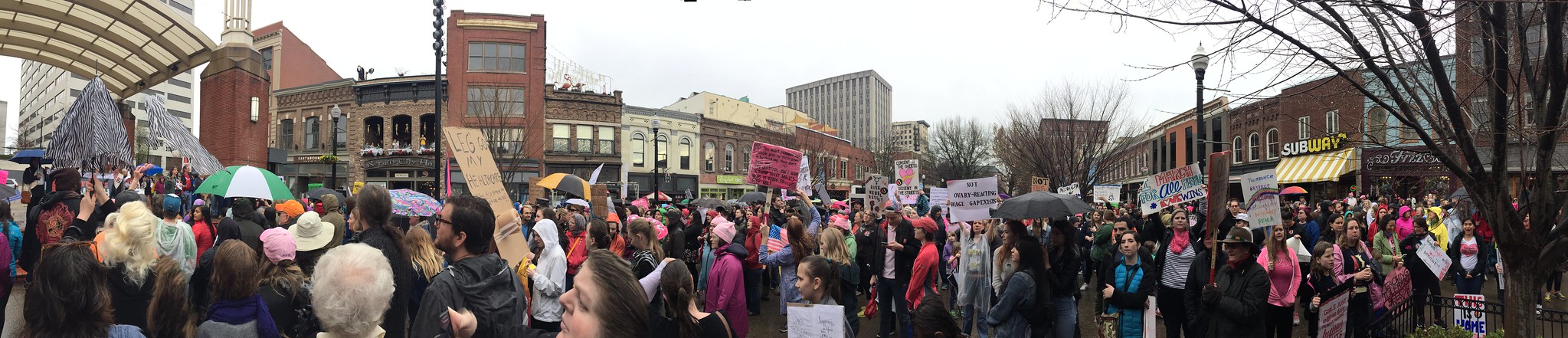
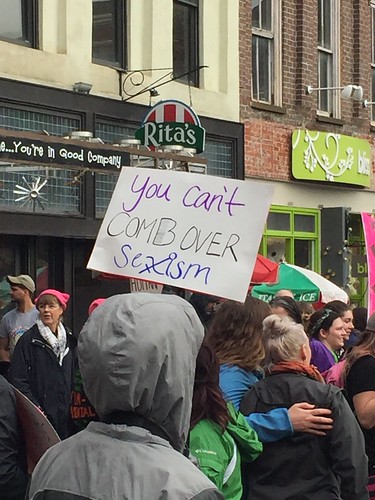
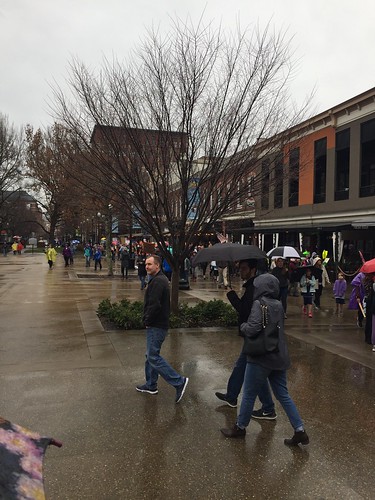
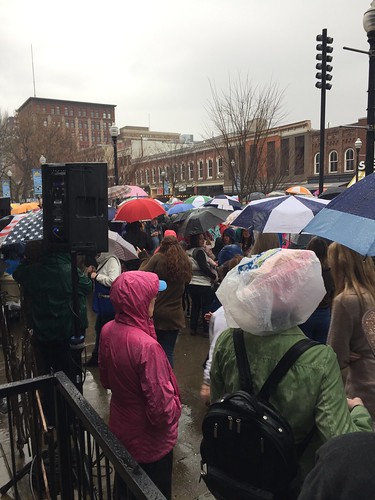
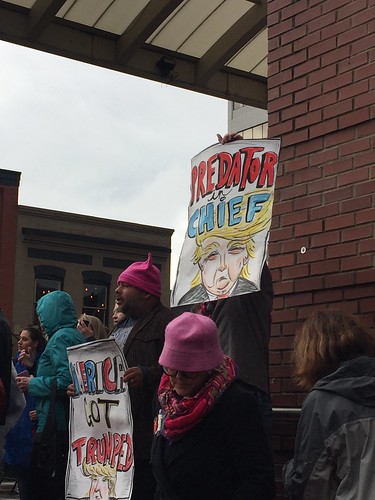
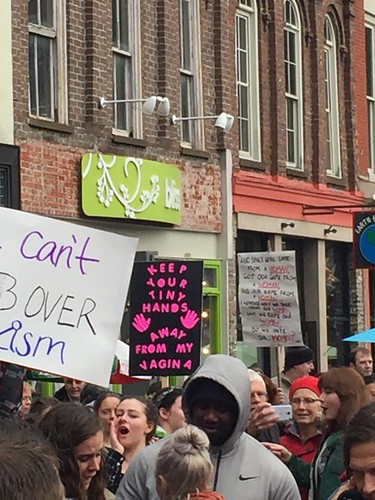
We sang, and we chanted, and we marched.
And now we have some elections in 2018 to get to work on.
Spending too much time thinking about the shoes I'm going to march in is probably one of the many reasons why I don't organize marches.
I support all the reasons people were marching, and I support all the people marching. I am horrified that our country elected a self-admitted sexual assaulter, liar, racist, and Islamophobe under the most openly homophobic party platform in US history, but it never occurred to me that I should go to a march on Saturday. I knew they were happening, knew we had one locally, and knew people who were going, but it just never occurred to me that I should go, too, until a funny thing happened: I spent an hour looking at Twitter and Facebook while procrastinating going for a walk. I saw people holding hands, people linking arms, people raising their voices, and people refusing to quietly let this blanket of ideological darkness and barely disguised fascism roll over us, and I thought, "That's where I should be. With those people."
So I went.
It rained most of the time, and it was crowded, but an odd thing happened: no one bumped me. No one shoved. None of the things that I hate about crowds made me feel like I was overwhelmed by a crowd of 2500+ people in a tiny area of downtown Knoxville. Everyone was excited, and yet also somehow very Southern: people were polite, the march waited at corners for crosswalk signals to change, we thanked the police as we passed them, and people picked up after themselves.
We sang, and we chanted, and we marched.
And now we have some elections in 2018 to get to work on.
Sunday, May 1, 2011
Policy Debate
I don't have anything against Senator Campfield, the current state senator and former state representative for my district. I don't agree with his positions or his ideas on LGBT issues, though, which is why I felt the need to email him recently about SB49, the "Don't Say Gay" bill that comes up for a vote on May 5. Senator Campfield tried to pass this bill a number of times as a representative, and now that he's a senator he's trying to pass it again. As a constituent who disagrees with the idea behind the bill, I decided to express my thoughts.
Our email exchange is below. I haven't added or removed anything.
Senator Campfield,
Given that you are sponsoring this bill, I can already guess at how you intend to vote on it, but as a constituent living in your district I did want to say that I disagree.
You've offered no solid, documented examples of homosexuality being taught at any time in any school, anywhere in the state. Additionally, no school district has stated that they intend to add that content to their elementary and middle school lesson plans, so there seems to be no need for this bill.
The (hopefully) unintended consequences of it, on the other hand, could prove very damaging. Children of same gender parents would be unable to discuss their families in school, sending a message to them that their family is somehow shameful. In a time when LGBT teen suicides are receiving national attention, with some of the victims as young as 11 years old (Carl Joseph Walker-Hoover in April 2009), your bill would prevent students struggling with those issues from seeking counseling or resources at school. If they are also not receiving support at home, where are they supposed to turn?
When you were running for your current office, I received a large volume of campaign mail which described you as a fan of small government and a person who would focus on job creation. This bill doesn't seem to have anything to do with either of those concepts.
Please take the time to consider the damage that you are about to inflict on children who are already struggling with their identities and self worth, and withdraw your sponsorship from this bill.
While I appreciate your passion, I still feel it is a parents responsibility to decide when a child is ready to grasp such a complex issue as sexuality and what they want to tell the child about that complex subject.
All children develop mentally at different rates. I do not feel a teacher with an agenda (Be it pro or con) is the appropriate person to decide "Now is the time" for an entire class just because they may think one way or another on an issue and want to espouse it. I doubt you would want a teacher who said "Homosexuality is evil, dirty and wrong" just because they felt it was appropriate and that is what they thought the children needed and were ready to hear.
We are falling behind the rest of the world in math, science, and English amongst other things. This will be just one less issue teachers have to worry about teaching as part of their curricula.
Yours in service, Sen. Stacey Campfield
Senator Campfield,
I appreciate your taking the time to respond, but your response still leaves me with questions.
If the responsibility of helping children to grasp issues of sexuality lies with the parents, then why doesn't your bill prevent the teaching of any kind of sexuality? Shouldn't any mention of heterosexuality also be restricted in the classroom, then?
And if you're worried about the math, science, and English curricula, (which, based on national testing statistics, I agree that Tennessee should be worried about), then why doesn't your bill focus on better techniques and strategies for teaching math, science, and English? It's not as if any school district anywhere in the state is neglecting to teach those in favor of a curriculum about homosexuality instead. By putting the focus on homosexuality, you're actually clouding the issue, and giving people the idea that it's your main concern, rather than math, science, and English. Why not put the focus where it should be?
While there is a scientific need to mention the basics of heterosexuality when teaching the basics of reproduction (XY chromosomes, etc.) there is no scientific need to mention homosexuality as homosexuals do not naturally reproduce.
Neither do infertile heterosexual couples, but you don't currently sponsor any bills banning the teaching of subject matter dealing with adoption or in-vitro fertilization. Besides, if you're making scientific evidence the basis of what is and is not included in the science curriculum, then you're asking schools to overlook the fact that homosexual behavior has been documented in over 500 species. How is the science curriculum improved by censoring scientific evidence?
It is not clear as to its scientific significance.
That's true, but isn't part of the purpose of schooling to teach students critical thinking skills that will enable them to help determine whether it's scientifically significant? By curtailing discussion, your bill prevents them from reaching a conclusion. Is that the way we should treat all unknowns in science? If so, you'll need to write several dozen more bills.
Regardless, you still haven't addressed my original point about unintended consequences of your bill. Will it prevent students from seeking counseling and teachers from making referrals to appropriate resources dealing with LGBT topics? And if so, do you intend to add any amendments before the bill comes up for a vote to insure that the ability of teachers and guidance counselors to help students struggling with LGBT issues is not impeded?
I sent that last one a few hours ago, and so far he hasn't written back. Given that he spent the entirety of the exchange ignoring most of my points, I don't really expect him to, but if he does I'll update this. For now I'm going to get moving on the rest of my day, and hope that people in the rest of the state are contacting senators for their districts, who might actually listen.
Edited to add: Senator Campfield replied to my last message today.
After minds are developed enough for it yes.
I don't even know how to respond to that. I asked four questions in my last email to him, and got only that one sentence in response. I'm not even sure which question that answers.
Our email exchange is below. I haven't added or removed anything.
Senator Campfield,
Given that you are sponsoring this bill, I can already guess at how you intend to vote on it, but as a constituent living in your district I did want to say that I disagree.
You've offered no solid, documented examples of homosexuality being taught at any time in any school, anywhere in the state. Additionally, no school district has stated that they intend to add that content to their elementary and middle school lesson plans, so there seems to be no need for this bill.
The (hopefully) unintended consequences of it, on the other hand, could prove very damaging. Children of same gender parents would be unable to discuss their families in school, sending a message to them that their family is somehow shameful. In a time when LGBT teen suicides are receiving national attention, with some of the victims as young as 11 years old (Carl Joseph Walker-Hoover in April 2009), your bill would prevent students struggling with those issues from seeking counseling or resources at school. If they are also not receiving support at home, where are they supposed to turn?
When you were running for your current office, I received a large volume of campaign mail which described you as a fan of small government and a person who would focus on job creation. This bill doesn't seem to have anything to do with either of those concepts.
Please take the time to consider the damage that you are about to inflict on children who are already struggling with their identities and self worth, and withdraw your sponsorship from this bill.
While I appreciate your passion, I still feel it is a parents responsibility to decide when a child is ready to grasp such a complex issue as sexuality and what they want to tell the child about that complex subject.
All children develop mentally at different rates. I do not feel a teacher with an agenda (Be it pro or con) is the appropriate person to decide "Now is the time" for an entire class just because they may think one way or another on an issue and want to espouse it. I doubt you would want a teacher who said "Homosexuality is evil, dirty and wrong" just because they felt it was appropriate and that is what they thought the children needed and were ready to hear.
We are falling behind the rest of the world in math, science, and English amongst other things. This will be just one less issue teachers have to worry about teaching as part of their curricula.
Yours in service, Sen. Stacey Campfield
Senator Campfield,
I appreciate your taking the time to respond, but your response still leaves me with questions.
If the responsibility of helping children to grasp issues of sexuality lies with the parents, then why doesn't your bill prevent the teaching of any kind of sexuality? Shouldn't any mention of heterosexuality also be restricted in the classroom, then?
And if you're worried about the math, science, and English curricula, (which, based on national testing statistics, I agree that Tennessee should be worried about), then why doesn't your bill focus on better techniques and strategies for teaching math, science, and English? It's not as if any school district anywhere in the state is neglecting to teach those in favor of a curriculum about homosexuality instead. By putting the focus on homosexuality, you're actually clouding the issue, and giving people the idea that it's your main concern, rather than math, science, and English. Why not put the focus where it should be?
While there is a scientific need to mention the basics of heterosexuality when teaching the basics of reproduction (XY chromosomes, etc.) there is no scientific need to mention homosexuality as homosexuals do not naturally reproduce.
Neither do infertile heterosexual couples, but you don't currently sponsor any bills banning the teaching of subject matter dealing with adoption or in-vitro fertilization. Besides, if you're making scientific evidence the basis of what is and is not included in the science curriculum, then you're asking schools to overlook the fact that homosexual behavior has been documented in over 500 species. How is the science curriculum improved by censoring scientific evidence?
It is not clear as to its scientific significance.
That's true, but isn't part of the purpose of schooling to teach students critical thinking skills that will enable them to help determine whether it's scientifically significant? By curtailing discussion, your bill prevents them from reaching a conclusion. Is that the way we should treat all unknowns in science? If so, you'll need to write several dozen more bills.
Regardless, you still haven't addressed my original point about unintended consequences of your bill. Will it prevent students from seeking counseling and teachers from making referrals to appropriate resources dealing with LGBT topics? And if so, do you intend to add any amendments before the bill comes up for a vote to insure that the ability of teachers and guidance counselors to help students struggling with LGBT issues is not impeded?
I sent that last one a few hours ago, and so far he hasn't written back. Given that he spent the entirety of the exchange ignoring most of my points, I don't really expect him to, but if he does I'll update this. For now I'm going to get moving on the rest of my day, and hope that people in the rest of the state are contacting senators for their districts, who might actually listen.
Edited to add: Senator Campfield replied to my last message today.
After minds are developed enough for it yes.
I don't even know how to respond to that. I asked four questions in my last email to him, and got only that one sentence in response. I'm not even sure which question that answers.
Sunday, January 16, 2011
Art is Not a Crime!
Dean Koontz and I might be breaking up after our fifteen or so years together as author and reader. This is probably not entirely shocking, as the things that you like in high school don't always turn out to be the things that you like forever, which is part of the reason why I no longer have a mullet, for example. (I also no longer have a mullet because I no longer have hair. I could try to grow some in, and I might be able to handle the party in the back part, but there is never again going to be business in the front unless it's a lot of short, sparsely placed business.)
Whether or not I've liked Koontz's books for the past ten years or so has been kind of hit or miss based on the book. I no longer get his new ones as soon as they come out, and no longer make sure I get them in hardcover so that they last longer. Despite that, he still has a little over two shelves of one of my bookcases:

even though he doesn't have quite as much room as Stephen King does. (Stephen King is another one that I've been going back and forth on. Ever since Dreamcatcher I feel like his quality has been all over the map, but I continue to give him a chance. Last year I read two of his books and liked one but not the other, so the verdict is still out.)
What's bothering me about Dean Koontz, more than the unsatisfying conclusions of many of his more recent works, is this link that my friend Jackie shared. If you don't want to click it and then come back, I'll summarize: Dean Koontz is taking all of the money I'm spending on his books and giving it to the Republican party. And not just any Republicans; he's giving it to the likes of Michelle "Gays Are Targetting Our Children" Bachman and Christine "I'm Not a Witch" O'Donnell. These are not people that I want to give money to. If they were, I would do it myself.
It makes me not want to give Dean Koontz any money any more, but then I'm not sure if I'm being fair if I take a stance like that. At the end of Art School Confidential, where I took the title of this entry from, one of the characters asks if we should judge an artist by their personal political beliefs. It's a question I also considered last year when I read that Dorothy Parker biography last year, as Parker had trouble throughout her life because of her onetime support of the Communist Party.
I had no trouble boycotting Target for supporting anti-gay candidates and sending them letters about it, but Target is a company and Dean Koontz is a person. (And, actually, I did have trouble boycotting Target, because I like a lot of their stuff.) People have the right to support whomever they want, but does that mean I have to let them do it with money that I give them? And what does that say about my feelings about art itself? I can boycott Target's products because I don't like the company's actions, but if I boycott an author for the same reason am I saying that their work is also a product? Or is art in a different category? Once created, does a book (or painting, or photograph, etc.) stand alone on its own merits, or does it always remain an extension of the author?
I thought reviewing some of my other history of politcally motivated boycotts would help. In no particular order:
1) I stopped using e-bay when Meg Whitman, e-bay CEO, campaigned for Mitt Romney. I sent e-bay an email letting them know why I would no longer be using the site, and they responded that Whitman was acting as a private citizen, within her rights. I disagreed, as she was identifying herself as "Meg Whitman, CEO of E-bay", not "Meg Whitman, private citizen and campaign volunteer". Like it or not, she was dragging e-bay into it, and if e-bay was going to pay her salary and then she was going to use that salary to support anti-gay, anti-abortion, abstinence-only Mitt "Dog Torturer" Romney then I wasn't going to give e-bay any more money to pay her with. Oddly, even though I'd been a steady e-bay user and Whitman ended up stepping down, I still use it less than once a year.
2) I was considering buying a DVD copy of Dreamgirls a few years ago when Proposition 8 passed in California and the Hollywood backlash against people who had financially supported it began. When Richard Raddon, the director of the gay-friendly L.A. Film Festival, was revealed to have given $1500 in support of Prop 8, there were calls from the gay community for Raddon to step down. Bill Condon, the writer and director of "Dreamgirls", defended Raddon, saying that the financial support was based on religion, not politics, and that holding his political contributions against him amounted to religious discrimination. I disagreed. Your religion is between you and your church until you take your religion to the ballot box and use your religion as a reason to deny other people civil rights. At that point, it is no longer a matter of religion and is instead of matter of politics. While I wasn't planning to attend the L.A. Film Festival any time in the near future, I did send a letter explaining why I thought Raddon should make amends to the gay community after taking money from them and using it agains them, and I also expressed my disapproval with Condon's view by never buying that copy of "Dreamgirls", because I felt that defending people who work against the community is the same as working against the community yourself.
3) I've never read any of Orson Scott Card's work, even though friends have recommended it, because Card is vocally opposed to gay marriage. He's even accepted an appointment to the board of the National Organization for Marriage, which means that other than his public writing on the subject he is now actively working against gay marriage on a national level. I want nothing to do with him on the basis of that, and won't even pick up his books from the library or at the used bookstore. I like science fiction, and I might be missing out, but I don't want to give him any support whatsoever.
So, where does this leave me with Dean Koontz?
Well, I have demonstrated that I'm willing to view art as a product. In the same way that I stopped supporting e-bay and Target, I stopped supporting Bill Condon and Orson Scott Card. On the other hand, Dean Koontz isn't doing what they're doing. He's not writing editorials, giving comments to newspapers, or going on the morning shows to express his views. He's making political contributions on his own personal time and then going about his business, the same way that I do when I send a check to Lambda Legal. In writing a blog entry about this or posting the original link to the campaign spending on my Facebook, I'm actually doing more than Koontz is. Should people stop supporting me, and stop sending me money? (Actually, could people start sending me money? Because that would be kind of awesome.)
And if I do decide that I should stop purchasing Koontz's books because of this, what's my responsibility to the rest of the authors whose books I buy? Do I need to look them all up before I purchase something? And do I draw the line at books, or do I need to start looking up comic book writers and artists? Or actors? Or screenwriters? Where do I draw the line, and do I have to draw the same one for everybody? I do, after all, shop at WalMart while boycotting Target, on the grounds that WalMart is at least honestly admitting that they will do evil things with my money and not being two faced about it. Stephen King is only giving money to Democrats, according to that link, but I didn't look up anyone else. It seems like a lot of work when there are dozens of authors whose work I faithfully buy without reading reviews or even knowing what the book is about because I like that author.
I guess I need to think about this some more.
Whether or not I've liked Koontz's books for the past ten years or so has been kind of hit or miss based on the book. I no longer get his new ones as soon as they come out, and no longer make sure I get them in hardcover so that they last longer. Despite that, he still has a little over two shelves of one of my bookcases:
even though he doesn't have quite as much room as Stephen King does. (Stephen King is another one that I've been going back and forth on. Ever since Dreamcatcher I feel like his quality has been all over the map, but I continue to give him a chance. Last year I read two of his books and liked one but not the other, so the verdict is still out.)
What's bothering me about Dean Koontz, more than the unsatisfying conclusions of many of his more recent works, is this link that my friend Jackie shared. If you don't want to click it and then come back, I'll summarize: Dean Koontz is taking all of the money I'm spending on his books and giving it to the Republican party. And not just any Republicans; he's giving it to the likes of Michelle "Gays Are Targetting Our Children" Bachman and Christine "I'm Not a Witch" O'Donnell. These are not people that I want to give money to. If they were, I would do it myself.
It makes me not want to give Dean Koontz any money any more, but then I'm not sure if I'm being fair if I take a stance like that. At the end of Art School Confidential, where I took the title of this entry from, one of the characters asks if we should judge an artist by their personal political beliefs. It's a question I also considered last year when I read that Dorothy Parker biography last year, as Parker had trouble throughout her life because of her onetime support of the Communist Party.
I had no trouble boycotting Target for supporting anti-gay candidates and sending them letters about it, but Target is a company and Dean Koontz is a person. (And, actually, I did have trouble boycotting Target, because I like a lot of their stuff.) People have the right to support whomever they want, but does that mean I have to let them do it with money that I give them? And what does that say about my feelings about art itself? I can boycott Target's products because I don't like the company's actions, but if I boycott an author for the same reason am I saying that their work is also a product? Or is art in a different category? Once created, does a book (or painting, or photograph, etc.) stand alone on its own merits, or does it always remain an extension of the author?
I thought reviewing some of my other history of politcally motivated boycotts would help. In no particular order:
1) I stopped using e-bay when Meg Whitman, e-bay CEO, campaigned for Mitt Romney. I sent e-bay an email letting them know why I would no longer be using the site, and they responded that Whitman was acting as a private citizen, within her rights. I disagreed, as she was identifying herself as "Meg Whitman, CEO of E-bay", not "Meg Whitman, private citizen and campaign volunteer". Like it or not, she was dragging e-bay into it, and if e-bay was going to pay her salary and then she was going to use that salary to support anti-gay, anti-abortion, abstinence-only Mitt "Dog Torturer" Romney then I wasn't going to give e-bay any more money to pay her with. Oddly, even though I'd been a steady e-bay user and Whitman ended up stepping down, I still use it less than once a year.
2) I was considering buying a DVD copy of Dreamgirls a few years ago when Proposition 8 passed in California and the Hollywood backlash against people who had financially supported it began. When Richard Raddon, the director of the gay-friendly L.A. Film Festival, was revealed to have given $1500 in support of Prop 8, there were calls from the gay community for Raddon to step down. Bill Condon, the writer and director of "Dreamgirls", defended Raddon, saying that the financial support was based on religion, not politics, and that holding his political contributions against him amounted to religious discrimination. I disagreed. Your religion is between you and your church until you take your religion to the ballot box and use your religion as a reason to deny other people civil rights. At that point, it is no longer a matter of religion and is instead of matter of politics. While I wasn't planning to attend the L.A. Film Festival any time in the near future, I did send a letter explaining why I thought Raddon should make amends to the gay community after taking money from them and using it agains them, and I also expressed my disapproval with Condon's view by never buying that copy of "Dreamgirls", because I felt that defending people who work against the community is the same as working against the community yourself.
3) I've never read any of Orson Scott Card's work, even though friends have recommended it, because Card is vocally opposed to gay marriage. He's even accepted an appointment to the board of the National Organization for Marriage, which means that other than his public writing on the subject he is now actively working against gay marriage on a national level. I want nothing to do with him on the basis of that, and won't even pick up his books from the library or at the used bookstore. I like science fiction, and I might be missing out, but I don't want to give him any support whatsoever.
So, where does this leave me with Dean Koontz?
Well, I have demonstrated that I'm willing to view art as a product. In the same way that I stopped supporting e-bay and Target, I stopped supporting Bill Condon and Orson Scott Card. On the other hand, Dean Koontz isn't doing what they're doing. He's not writing editorials, giving comments to newspapers, or going on the morning shows to express his views. He's making political contributions on his own personal time and then going about his business, the same way that I do when I send a check to Lambda Legal. In writing a blog entry about this or posting the original link to the campaign spending on my Facebook, I'm actually doing more than Koontz is. Should people stop supporting me, and stop sending me money? (Actually, could people start sending me money? Because that would be kind of awesome.)
And if I do decide that I should stop purchasing Koontz's books because of this, what's my responsibility to the rest of the authors whose books I buy? Do I need to look them all up before I purchase something? And do I draw the line at books, or do I need to start looking up comic book writers and artists? Or actors? Or screenwriters? Where do I draw the line, and do I have to draw the same one for everybody? I do, after all, shop at WalMart while boycotting Target, on the grounds that WalMart is at least honestly admitting that they will do evil things with my money and not being two faced about it. Stephen King is only giving money to Democrats, according to that link, but I didn't look up anyone else. It seems like a lot of work when there are dozens of authors whose work I faithfully buy without reading reviews or even knowing what the book is about because I like that author.
I guess I need to think about this some more.
Wednesday, October 13, 2010
Dear Tennessee State Republican Party...
My friend Courtney recently described me as an activist, and I was planning to write back to her and tell her that I'm not really an activist, because I'm not a flag waver and I don't put bumper stickers on my car and when I show up to marches and protests I stand in the back. Activists are the kind of people who write letters and yell into bullhorns and wave signs, and that's totally not me.
Instead of writing that note back to Courtney that I'm not an activist, I ended up writing a letter to the Tennessee Republican Party in Nashville in response to some unwanted Stacey Campfield mail that I received this week. In the same way that people don't want prisons, toxic waste dumps, or nuclear power plants in their backyards, I don't want Stacey Campfield's smiling face in my mailbox, so I put together a little care package that I'm mailing back to them:

I'm sure that my letter, handwritten on one of my "Thanks for Nothing" notes (doesn't everyone have a box of passive aggressive bitch notecards?), will end up in a crank file, or tacked to a bulletin board where the interns walk by and laugh at it, but I think it's important to speak up against candidates with anti-LGBT track records, even if all you're doing is asking them not to send you any more of their crap. They may snicker and roll their eyes, but someone, somewhere in that office may read it and think for a minute about the kind of people they're helping to elect, and the kind of environment that those people will create.
Here's the letter I sent. I'll type it out after the pictures, in case you don't want to read my scrawling left-handed writing.


Dear Tennessee Republican Party,
Please accept the return of the enclosed Stacey Campfield campaign materials, which I found in my mailbox today. Although I am a registered Democrat, I do read and try to inform myself about the candidates, but in this particular case I am already well aware that a vote for Stacey Campfield is a vote for open bigotry, and a vote against LGBT people in the state of Tennessee. While I sometimes cross party lines in the voting booth, I will never hate myself and my community enough to do so in this case.
Your candidate has twice attempted to advance his "don't say gay" bill, outlawing any discussion of LGBT topics under any circumstances in Tennessee schools. This sort of legislation is not the hallmark of the "smaller, smarter government" described on your flyer. In March of this year, Stacey Campfield also spoke out against the OutReach LGBTA Resource Center that opened on the UT campus, saying that funding should not go toward "special groups" who did not have a real need. While the recent wave of LGBT teen suicides would seem to disprove his point, he has not retracted his statements. This speaks to the kind of human being that he is and the values that he supports.
In short, I'm saying that I'm gay and I vote, but I will not vote for Stacey Campfield. Please save your party some printing and postage, and mail these to people who agree with Campfield's platform of bigotry and dehumanization.
Thank you.
Instead of writing that note back to Courtney that I'm not an activist, I ended up writing a letter to the Tennessee Republican Party in Nashville in response to some unwanted Stacey Campfield mail that I received this week. In the same way that people don't want prisons, toxic waste dumps, or nuclear power plants in their backyards, I don't want Stacey Campfield's smiling face in my mailbox, so I put together a little care package that I'm mailing back to them:
I'm sure that my letter, handwritten on one of my "Thanks for Nothing" notes (doesn't everyone have a box of passive aggressive bitch notecards?), will end up in a crank file, or tacked to a bulletin board where the interns walk by and laugh at it, but I think it's important to speak up against candidates with anti-LGBT track records, even if all you're doing is asking them not to send you any more of their crap. They may snicker and roll their eyes, but someone, somewhere in that office may read it and think for a minute about the kind of people they're helping to elect, and the kind of environment that those people will create.
Here's the letter I sent. I'll type it out after the pictures, in case you don't want to read my scrawling left-handed writing.
Dear Tennessee Republican Party,
Please accept the return of the enclosed Stacey Campfield campaign materials, which I found in my mailbox today. Although I am a registered Democrat, I do read and try to inform myself about the candidates, but in this particular case I am already well aware that a vote for Stacey Campfield is a vote for open bigotry, and a vote against LGBT people in the state of Tennessee. While I sometimes cross party lines in the voting booth, I will never hate myself and my community enough to do so in this case.
Your candidate has twice attempted to advance his "don't say gay" bill, outlawing any discussion of LGBT topics under any circumstances in Tennessee schools. This sort of legislation is not the hallmark of the "smaller, smarter government" described on your flyer. In March of this year, Stacey Campfield also spoke out against the OutReach LGBTA Resource Center that opened on the UT campus, saying that funding should not go toward "special groups" who did not have a real need. While the recent wave of LGBT teen suicides would seem to disprove his point, he has not retracted his statements. This speaks to the kind of human being that he is and the values that he supports.
In short, I'm saying that I'm gay and I vote, but I will not vote for Stacey Campfield. Please save your party some printing and postage, and mail these to people who agree with Campfield's platform of bigotry and dehumanization.
Thank you.
Friday, March 5, 2010
A Note for Representative Campfield
I'm writing this in response to the post that my local representative, Stacey Campfield, made on his blog a few weeks ago. I've been thinking about it since I read it, and I've moved past my initial knee-jerk response, which was to point out that Campfield can't spell simple words like "behind" and hasn't mastered the possessive use of the apostrophe in words like "people's", and really gave some serious thought to his complaint.
Representative Campfield is annoyed that state money is being spent on this:

No, not the Honors Program. Despite his struggles with the English language, he doesn't seem to resent smarter people. Representative Campfield is offended that state money is being spent on the LGBT Resource Center that just opened on our campus. That's well within his rights, just as it's well within my rights to be offended by Representative Campfield and pretty much every line of his post.
Before we get into that, though, I want to get a few things out of the way up front. I live in Representative Campfield's district, and I vote there. Granted, I did not vote for him, and his positions guarantee that I never will, but as an elected official he must still be answerable to his constituents whether we voted for him or not. On top of that, I am also a donor to the university. I'm a small donor, not one of the "big donors" he worries about in his post, but surely, "as many departments of government are being forced to cut their funding, staff, cut back on space and other niceties of life", even the small donors count for something.
We'll come back to the donor issue. First, though, I want to look at his other points.
The Rep (as he calls himself when he posts in his own heavily moderated comments section) wonders if Christian outreach would get an office and funding. He should probably ask at the Christian Student Center, located on campus in a permanent facility on Melrose Avenue, the same street as the LGBT Resource Center. He wonders if conservative outreach or Republican outreach might be on the list to get funding. There's no need to wonder, The Rep, since you can just ask at the biweekly meeting of the College Republicans, which is held on campus in one of the many meeting rooms at the University Center at no cost to the group itself. I guess the answer to that question, then, would be yes, Christian outreach, conservative outreach, and Republican outreach all receive space and funding on campus.
The Rep wonders, though, about who is next on the list to get an office, funding, and a room. (I, on the other hand, wonder when an office stopped being a room.) The heterosexual "players" outreach, the Chubby Chasers, the swingers outreach, BDS&M outreach, and the furries are not next on that list, because there aren't any recognized student groups on campus for any of those categories. Maybe someday, when each of those groups has an organizational charter, has petitioned for and been granted recognition, and has a stable membership willing to campaign for funding and space, they might be on the list, but for now those groups pose no threat to The Rep's wallet.
The Rep still wonders, though, why some people feel entitled to other people's money based on their sexual orientation or fetish. I'm not sure about the fetish part, since I know of no group of fetishists demanding funds to support their penchant for whatever odd thing it is that they are attracted to. As for the people who feel entitled to other people's money based on their sexual orientation, well, I'd make the argument that they're asking for their own money. Last time I checked, there were still LGBT people paying taxes in Tennessee, and there were LGBT students paying tuition and activity fees to attend the university. It's their money, too.
And really, how much money is the Resource Center actually costing the university, anyway? Not a lot, when you break it down.
First, look at the location. The OUTreach LGBT Resource Center is located in Melrose Hall, one of the oldest buildings left on campus. Melrose is so old, in fact, that it has no mortgage and carries no bonds from construction. The building and the land it sits on are completely paid for. Used for decades as a dormitory, Melrose has sat vacant for three years since the housing department stopped using it. No one else was asking for the space, the same way that no one is asking for the space in Strong Hall, which is busy rotting at the other end of campus since it was vacated at the same time. Giving space in Melrose to the center doesn't take space away from anyone, but instead provides a purpose for a historic campus building that would otherwise rot like an eyesore in the middle of the pedestrian walkway.
Then there's the matter of the resources, but there's no cost there, either. Everything in the center, from the furniture to the books to the posters on the walls to the office supplies, is donated. I know, because a half dozen or so of the books came from my bookshelves, and I also arranged the donation and delivery of several pieces of the furniture. I am not anywhere close to being the only person to do so, either.
The resource center has no telephone. No phoneline, no voicemail, no physical telephone hardware, which means no telephone-related expenses.
There is the matter of staff. The center is currently staffed part time by two graduate assistants. One of those assistants does get a stipend from the Commission for LGBT people. The other assistant, though, is a volunteer, which means he is paying to go to the university. The math may not be exact, but I'd say that the person being paid to staff the place and the person who is paying to be able to staff the place pretty much cancel each other out, the same way a Diet Coke cancels out eating a candy bar.
(Shut up. It totally does.)
As near as I can tell, the only things that still need to be accounted for to put The Rep's mind at rest are utilities and the signs out front.
The signs already existed, since the Honors Program was already there, but there was a cost to add the wording about the resource center to them. Save that thought for the wrap up, when we get back to donors.
As for utilities, the center has no plumbing. No toilet, no sink, no water faucets or fountains. If the staff have to use the restroom, they have to lock the center and go to another building. This means, of course, that there's not a water bill. It's the dead of winter, though, and the heat is on. Melrose Hall has centralized, steam powered heat. You can't really regulate it, and if you turn it off in parts of the building then the pipes will freeze, so the heat is either on or off. Since the Honors Program was already located in Melrose long before the LGBT center was, the heat was already on. Melrose isn't air-conditioned, due to the age of the building, so that won't be an issue, either.
That just leaves electricity. The center doesn't have a computer, television, or any other technology installed. Instead, there are three ceiling lights and a lamp. One of the ceiling lights is always on, because it's one of the building's emergency lights. It would be on whether the center was there or not. The other two lights are only turned on if someone is using one of those two rooms, the same as the floor lamp in the main room. Since the center is only open for twenty hours a week, those lights are only on a maximum of twenty hours a week.
All of this analysis leaves us with three lights' worth of electricity usage a month and the one-time cost of adding words to a few signs that were already in place. That's where the donors come in, and like I said way back at the beginning, I'm one of them. A payroll deduction comes out of my check every month and goes into the account for the Commission for LGBT people, and I know several other people who do the same. Between all of us, I'm sure we have those three lamps and those signs covered. As for the university's big donors, which The Rep is so concerned about, their donations are almost always earmarked for specific purposes. None of them are paying for the resource center unless they want to.
After all of that, where does this leave us? Well, the opening of the resource center was attended by a few hundred people. Those people live in Tennessee, and pay taxes in Tennessee. They also have family members who pay taxes in Tennessee and friends who pay taxes in Tennessee. State money comes from everyone in the state, not just from the straight people who live here. And yes, there are some straight people who probably don't want their money going for an LGBT center, but you know what?
There are also racist people in Tennessee, and they probably don't want their money going to the university's Black Cultural Center or the Office of Minority Student Affairs. There are xenophobic people in Tennessee, and they probably don't want their money going to the university's International House. There are childless people in Tennessee who may not want their money to support the university's Early Learning Center, and there are probably people somewhere in Tennessee who don't want to support the university's Office of Disability Services. There are atheists in Tennessee who may not want any state dollars going to the Campus Ministries. For every center, group, or office on campus, there is at least one person in the state of Tennessee who doesn't think their money should pay for it. That's the way the world is.
As for Representative Campfield... it's his job to work on behalf of his constituents, whether those constituents are straight, gay, black, white, young, old, players, chubby chasers, Republicans, Christians, atheists, conservatives, liberals, swingers, or even furries. If those people are paying taxes, then those people are paying him. If he doesn't feel like he can focus on things that are actually important, and instead feels like imposing his moral structure on others should be a higher priority, then I'm happy to vote for his opponent in the next election instead.
I don't want my state money going to people I disapprove of, and right now that's you, Rep.
Representative Campfield is annoyed that state money is being spent on this:
No, not the Honors Program. Despite his struggles with the English language, he doesn't seem to resent smarter people. Representative Campfield is offended that state money is being spent on the LGBT Resource Center that just opened on our campus. That's well within his rights, just as it's well within my rights to be offended by Representative Campfield and pretty much every line of his post.
Before we get into that, though, I want to get a few things out of the way up front. I live in Representative Campfield's district, and I vote there. Granted, I did not vote for him, and his positions guarantee that I never will, but as an elected official he must still be answerable to his constituents whether we voted for him or not. On top of that, I am also a donor to the university. I'm a small donor, not one of the "big donors" he worries about in his post, but surely, "as many departments of government are being forced to cut their funding, staff, cut back on space and other niceties of life", even the small donors count for something.
We'll come back to the donor issue. First, though, I want to look at his other points.
The Rep (as he calls himself when he posts in his own heavily moderated comments section) wonders if Christian outreach would get an office and funding. He should probably ask at the Christian Student Center, located on campus in a permanent facility on Melrose Avenue, the same street as the LGBT Resource Center. He wonders if conservative outreach or Republican outreach might be on the list to get funding. There's no need to wonder, The Rep, since you can just ask at the biweekly meeting of the College Republicans, which is held on campus in one of the many meeting rooms at the University Center at no cost to the group itself. I guess the answer to that question, then, would be yes, Christian outreach, conservative outreach, and Republican outreach all receive space and funding on campus.
The Rep wonders, though, about who is next on the list to get an office, funding, and a room. (I, on the other hand, wonder when an office stopped being a room.) The heterosexual "players" outreach, the Chubby Chasers, the swingers outreach, BDS&M outreach, and the furries are not next on that list, because there aren't any recognized student groups on campus for any of those categories. Maybe someday, when each of those groups has an organizational charter, has petitioned for and been granted recognition, and has a stable membership willing to campaign for funding and space, they might be on the list, but for now those groups pose no threat to The Rep's wallet.
The Rep still wonders, though, why some people feel entitled to other people's money based on their sexual orientation or fetish. I'm not sure about the fetish part, since I know of no group of fetishists demanding funds to support their penchant for whatever odd thing it is that they are attracted to. As for the people who feel entitled to other people's money based on their sexual orientation, well, I'd make the argument that they're asking for their own money. Last time I checked, there were still LGBT people paying taxes in Tennessee, and there were LGBT students paying tuition and activity fees to attend the university. It's their money, too.
And really, how much money is the Resource Center actually costing the university, anyway? Not a lot, when you break it down.
First, look at the location. The OUTreach LGBT Resource Center is located in Melrose Hall, one of the oldest buildings left on campus. Melrose is so old, in fact, that it has no mortgage and carries no bonds from construction. The building and the land it sits on are completely paid for. Used for decades as a dormitory, Melrose has sat vacant for three years since the housing department stopped using it. No one else was asking for the space, the same way that no one is asking for the space in Strong Hall, which is busy rotting at the other end of campus since it was vacated at the same time. Giving space in Melrose to the center doesn't take space away from anyone, but instead provides a purpose for a historic campus building that would otherwise rot like an eyesore in the middle of the pedestrian walkway.
Then there's the matter of the resources, but there's no cost there, either. Everything in the center, from the furniture to the books to the posters on the walls to the office supplies, is donated. I know, because a half dozen or so of the books came from my bookshelves, and I also arranged the donation and delivery of several pieces of the furniture. I am not anywhere close to being the only person to do so, either.
The resource center has no telephone. No phoneline, no voicemail, no physical telephone hardware, which means no telephone-related expenses.
There is the matter of staff. The center is currently staffed part time by two graduate assistants. One of those assistants does get a stipend from the Commission for LGBT people. The other assistant, though, is a volunteer, which means he is paying to go to the university. The math may not be exact, but I'd say that the person being paid to staff the place and the person who is paying to be able to staff the place pretty much cancel each other out, the same way a Diet Coke cancels out eating a candy bar.
(Shut up. It totally does.)
As near as I can tell, the only things that still need to be accounted for to put The Rep's mind at rest are utilities and the signs out front.
The signs already existed, since the Honors Program was already there, but there was a cost to add the wording about the resource center to them. Save that thought for the wrap up, when we get back to donors.
As for utilities, the center has no plumbing. No toilet, no sink, no water faucets or fountains. If the staff have to use the restroom, they have to lock the center and go to another building. This means, of course, that there's not a water bill. It's the dead of winter, though, and the heat is on. Melrose Hall has centralized, steam powered heat. You can't really regulate it, and if you turn it off in parts of the building then the pipes will freeze, so the heat is either on or off. Since the Honors Program was already located in Melrose long before the LGBT center was, the heat was already on. Melrose isn't air-conditioned, due to the age of the building, so that won't be an issue, either.
That just leaves electricity. The center doesn't have a computer, television, or any other technology installed. Instead, there are three ceiling lights and a lamp. One of the ceiling lights is always on, because it's one of the building's emergency lights. It would be on whether the center was there or not. The other two lights are only turned on if someone is using one of those two rooms, the same as the floor lamp in the main room. Since the center is only open for twenty hours a week, those lights are only on a maximum of twenty hours a week.
All of this analysis leaves us with three lights' worth of electricity usage a month and the one-time cost of adding words to a few signs that were already in place. That's where the donors come in, and like I said way back at the beginning, I'm one of them. A payroll deduction comes out of my check every month and goes into the account for the Commission for LGBT people, and I know several other people who do the same. Between all of us, I'm sure we have those three lamps and those signs covered. As for the university's big donors, which The Rep is so concerned about, their donations are almost always earmarked for specific purposes. None of them are paying for the resource center unless they want to.
After all of that, where does this leave us? Well, the opening of the resource center was attended by a few hundred people. Those people live in Tennessee, and pay taxes in Tennessee. They also have family members who pay taxes in Tennessee and friends who pay taxes in Tennessee. State money comes from everyone in the state, not just from the straight people who live here. And yes, there are some straight people who probably don't want their money going for an LGBT center, but you know what?
There are also racist people in Tennessee, and they probably don't want their money going to the university's Black Cultural Center or the Office of Minority Student Affairs. There are xenophobic people in Tennessee, and they probably don't want their money going to the university's International House. There are childless people in Tennessee who may not want their money to support the university's Early Learning Center, and there are probably people somewhere in Tennessee who don't want to support the university's Office of Disability Services. There are atheists in Tennessee who may not want any state dollars going to the Campus Ministries. For every center, group, or office on campus, there is at least one person in the state of Tennessee who doesn't think their money should pay for it. That's the way the world is.
As for Representative Campfield... it's his job to work on behalf of his constituents, whether those constituents are straight, gay, black, white, young, old, players, chubby chasers, Republicans, Christians, atheists, conservatives, liberals, swingers, or even furries. If those people are paying taxes, then those people are paying him. If he doesn't feel like he can focus on things that are actually important, and instead feels like imposing his moral structure on others should be a higher priority, then I'm happy to vote for his opponent in the next election instead.
I don't want my state money going to people I disapprove of, and right now that's you, Rep.
Monday, November 17, 2008
topical, weighty political thoughts that have been chewing up my stomach

I don't live in California. I don't have any foster children. I don't have a husband. If my history of picking boyfriends is any indication, I will never have a husband, because my boyfriend will be a jerk. Despite all of that, I've been walking around since the election with this kind of hollow, punched in the stomach feeling. I know I should be celebrating because the Democrats won, and everything will be all right now. I know everyone says this is a victory for civil rights and equality and oh my God, all our prejudices have been triumphed over and fallen away, but the truth is that Tuesday the 4th really blew for gay people. It's hard to feel happy when you feel marginalized and betrayed.
I left out shock, but there was a lot of that, too. Out of all states in the union, you would think gay rights wouldn't have a problem in California. California, the land of fruits and nuts, the home of the gay mafia and the liberal Hollywood elite, the state where gay people have been getting married for months without the world coming to an end or the institution of marriage collapsing entirely. Sure, they have that Republican governor, but California is a blue state. How could they have trouble in a blue state?
It's the blue state part that really stings. As a gay person, I've always thought the Democrats were my friends. They're about inclusion, and tolerance, and liberalism. They want to help people, and lift people up, and watch out for the little guy. Yeah, the Democrats gave us "don't ask, don't tell", but it was so easy to blame that sad compromise on the Republicans, because everyone knows they're evil and corrupt and wrong. Democrats stand for change we can believe in, and hope, and all that happy holding hands rainbow coalition brotherhood kumbaya, but based on the election results, Democrats also stand for exclusion. Democrats stand for stripping people of their legally granted rights. Democrats stand for inequality. 52% of California decided that the thousand legal rights granted freely to anyone with a marriage license should only be available to people who insert Tab A into Slot B, and at least part of that 52% of California is solidly Democratic.
Maybe I should just register as an Independent and be done with it.
I know it's the word "marriage" that throws a lot of people, but that's not a term a lot of people asked for. "Marriage" is the term the United States applied to the union that lets you file joint tax returns, and be the designated next of kin, and receive spousal pension benefits. I want nothing to do with the marriages that go on in church. Church and me, we don't always get along, and it's best that I avoid them. The marriages that go on at the courthouse, on the other hand, should be open to all people who pay taxes, and vote, and want to join themselves to another person. "Separate but equal" should be abolished, not enshrined in the constitution of California or any other state. The majority of the country should never be allowed to decide what rights the minority is eligible to enjoy. If anyone tried to strip marriage rights from Asians or right-handed people or anyone over the age of thirty five the public outcry would be defeaning, but this election has taught us that homophobia is the last acceptable social prejudice.
A black man can be President, but he can't bring a First Husband with him, and those two things were decided on the same ballot. Is it a triumph, or a failure?
On Saturday a group called Join the Impact scheduled over 300 nationwide protests, rallies, and demonstrations. There was at least one in every state, and they were all scheduled to start at exactly the same time, 1:30 PM EST. I wasn't expecting a lot from ours, since we live in the red end of a pretty red state, but I went anyway. I don't live in California and I don't have a husband, but I have a voice, and I would like for it to be heard.


I don't know if we accomplished anything on Saturday. I don't know if it changed anyone's mind or made anyone rethink their vote or even gave anyone a moment's pause, but I feel better knowing that I did something, and took some kind of action to combat my sinking feeling of disbelief that the most democratic country in the world, a republic of the people, for the people, and by the people considers me a second-class person.
Subscribe to:
Posts (Atom)